


CSF TNF-α Levels Were Associated with Longitudinal Change in Brain Glucose Metabolism Among Non-Demented Older People
- PMID: 34079263
- PMCID: PMC8165210
- DOI: 10.2147/NDT.S291020
CSF TNF-α Levels Were Associated with Longitudinal Change in Brain Glucose Metabolism Among Non-Demented Older People
Abstract
Purpose: Emerging studies have suggested that tumor necrosis factor-alpha (TNF-α) is implicated in the pathogenesis of Alzheimer's disease (AD), and that cerebral glucose hypometabolism is a key feature of AD. However, the association of CSF TNF-α levels with changes in cerebral glucose metabolism has not been studied among non-demented older people.
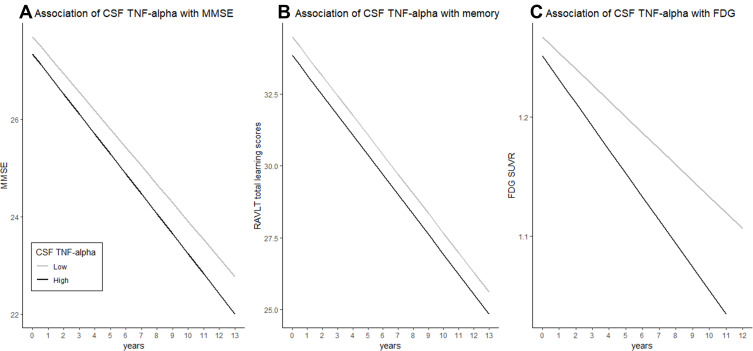
Patients and methods: At baseline, there were a total of 214 non-demented older people from Alzheimer's Disease Neuroimaging Initiative (ADNI) study. We examined the cross-sectional and longitudinal associations of CSF TNF-α with global cognition (as assessed by mini-mental state examination), verbal memory (as assessed by Rey Auditory Verbal Learning Test-total learning score), and cerebral glucose metabolism (as measured by FDF-PET). Linear mixed-effects models were used to examine the longitudinal association of CSF TNF- α with change in each outcome over time with adjustment of age, educational level, gender, and APOE4 status.
Results: In the cross-sectional study, CSF TNF-α was negatively associated with MMSE scores, but not verbal memory or FDG-PET. In the longitudinal study, higher CSF TNF- α at baseline was associated with a faster decline in cerebral glucose metabolism, but not MMSE scores or RAVLT total learning scores.
Conclusion: Higher CSF TNF-α levels were associated with a steeper decline in cerebral glucose metabolism among non-demented older people.
Keywords: Alzheimer’s disease; FDG-PET; TNF-α; cerebral glucose metabolism; mild cognitive impairment.
© 2021 Fu et al.
Conflict of interest statement
The authors declare that they have no conflicts of interest.
Figures

References
Grants and funding
LinkOut - more resources
Full Text Sources
