Value of total lesion glycolysis and cell-of-origin subtypes for prognostic stratification of diffuse large B-cell lymphoma patients
- PMID: 34079720
- PMCID: PMC8107342
- DOI: 10.21037/qims-20-1166
Value of total lesion glycolysis and cell-of-origin subtypes for prognostic stratification of diffuse large B-cell lymphoma patients
Abstract
Background: This study aimed to explore the added prognostic value of baseline metabolic volumetric parameters and cell of origin subtypes to the National Comprehensive Cancer Network International Prognostic Index (NCCN-IPI) in nodal diffuse large B-cell lymphoma (DLBCL) patients.
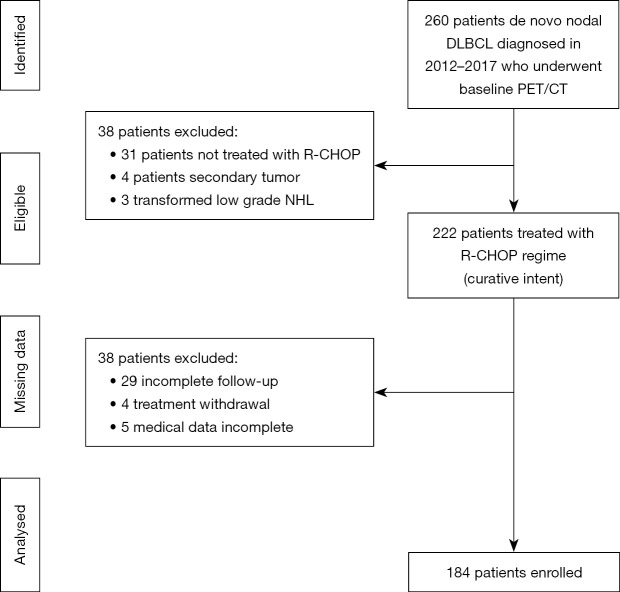
Methods: A total of 184 consecutive de novo nodal DLBCL patients who underwent baseline positron emission tomography/computed tomography (PET/CT) were included in this study. Kaplan-Meier estimates were generated to evaluate the clinical, biological, and PET/CT parameters' prognostic value. The Cox proportional hazards model was performed to examine the potential independent predictors for progression-free survival (PFS) and overall survival (OS).
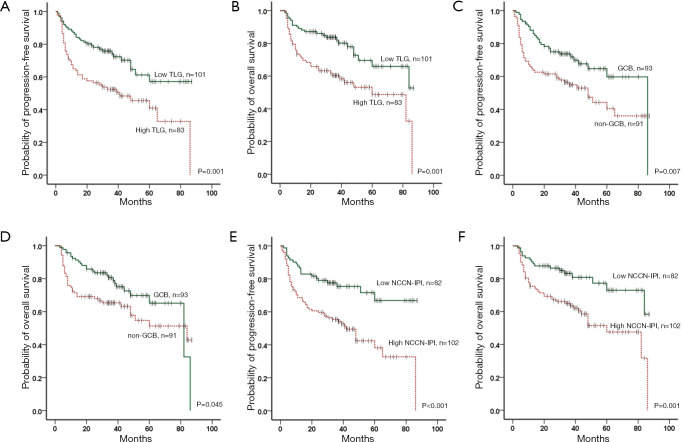
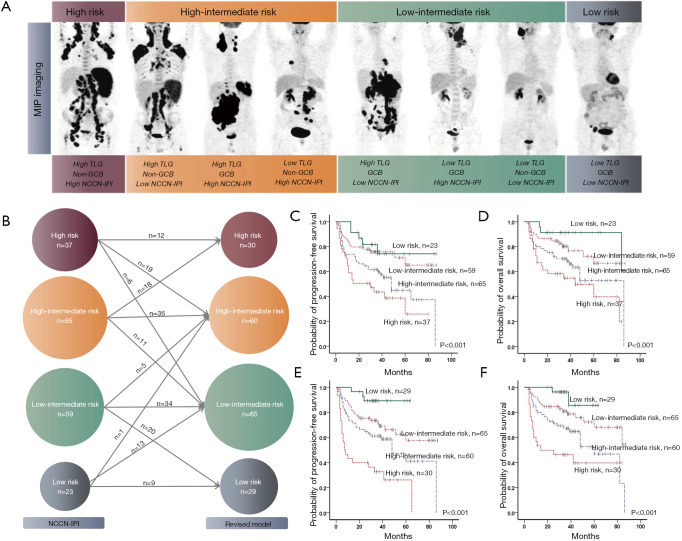
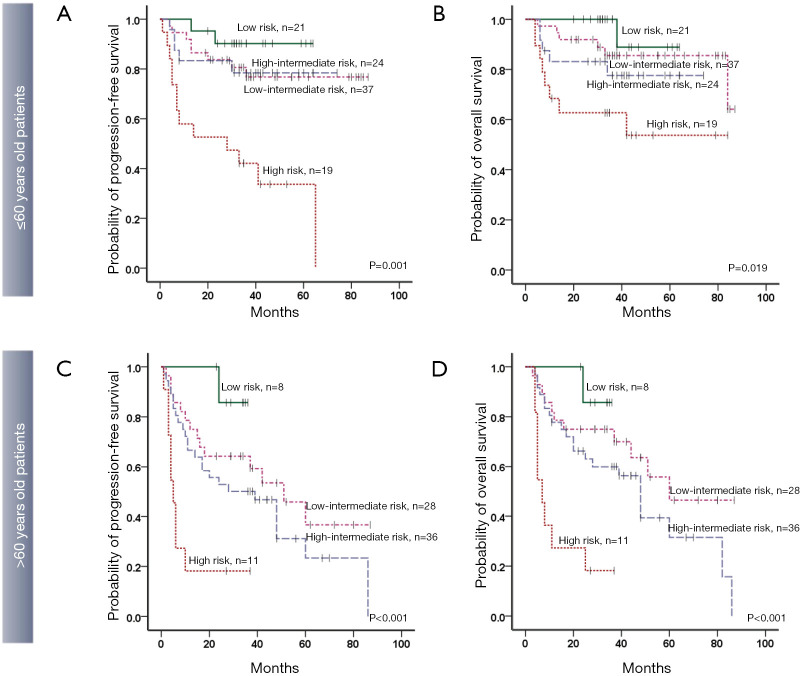
Results: With a median follow-up of 35 months, the 3-year PFS and OS were 65.2% and 73.0%, respectively. In univariate analysis, total lesion glycolysis (TLG), cell-of-origin subtypes, and NCCN-IPI were both PFS and OS predictors. High TLG (≥1,852), non-germinal center B (non-GCB), as well as high NCCN-IPI (≥4), were shown to be independently significantly associated with inferior PFS and OS after multivariate analysis. Based on the number of risk factors (high TLG, non-GCB, and high NCCN-IPI), a revised risk model was designed, and the participants were divided into four risk groups with very different outcomes, in which the PFS rates were 89.7%, 66.2%, 51.7%, and 26.7% (χ2=30.179, P<0.001), and OS rates were 93.1%, 73.8%, 56.7%, and 43.3%, respectively (χ2=23.649, P<0.001), respectively. Compared with the NCCN-IPI alone, the revised risk model showed a stronger ability to reveal further discrimination among subgroups, especially for participants with very unfavorable survival outcomes (PFS: χ2=9.963, P=0.002; OS: χ2=4.166, P=0.041, respectively).
Conclusions: The TLG, cell-of-origin subtypes, and NCCN-IPI are independent prognostic survival factors in DLBCL patients. Moreover, the revised risk model composed of the number of risk factors (high TLG, non-GCB, and high NCCN-IPI) can stratify patients better than the NCCN-IPI, especially for patients at high risk, which suggests its potential integration into decision making for personalized medicine.
Keywords: National Comprehensive Cancer Network International Prognostic Index (NCCN-IPI); Total lesion glycolysis (TLG); cell-of-origin; diffuse large B-cell lymphoma (DLBCL); prognosis.
2021 Quantitative Imaging in Medicine and Surgery. All rights reserved.
Conflict of interest statement
Conflicts of Interest: All authors have completed the ICMJE uniform disclosure (available at http://dx.doi.org/10.21037/qims-20-1166). The authors have no conflicts of interest to declare.
Figures
References
-
- Coiffier B, Lepage E, Briere J, Herbrecht R, Tilly H, Bouabdallah R, Morel P, Van Den Neste E, Salles G, Gaulard P, Reyes F, Lederlin P, Gisselbrecht C. CHOP chemotherapy plus rituximab compared with CHOP alone in elderly patients with diffuse large-B-cell lymphoma. N Engl J Med 2002;346:235-42. 10.1056/NEJMoa011795 - DOI - PubMed
-
- Sehn LH, Berry B, Chhanabhai M, Fitzgerald C, Gill K, Hoskins P, Klasa R, Savage KJ, Shenkier T, Sutherland J, Gascoyne RD, Connors JM. The revised International Prognostic Index (R-IPI) is a better predictor of outcome than the standard IPI for patients with diffuse large B-cell lymphoma treated with R-CHOP. Blood 2007;109:1857-61. 10.1182/blood-2006-08-038257 - DOI - PubMed
LinkOut - more resources
Full Text Sources