


Measuring Problematic Internet Use, Internet Gaming Disorder, and Social Media Addiction in Young Adults: Cross-sectional Survey Study
- PMID: 34081596
- PMCID: PMC8832277
- DOI: 10.2196/27719
Measuring Problematic Internet Use, Internet Gaming Disorder, and Social Media Addiction in Young Adults: Cross-sectional Survey Study
Abstract
Background: Digital technology use is nearly ubiquitous among young adults; this use provides both benefits and risks. The risks of technology use include maladaptive technology use or technology addiction. Several conceptualizations of these addictions have emerged, each with its own assessment tools. These conditions include problematic internet use (PIU), internet gaming disorder (IGD), and social media addiction (SMA). These conditions have been associated with health outcomes such as problematic alcohol use, sleep disorders, and mental illness. These maladaptive technology conditions have been most commonly studied in isolation from each other.
Objective: The aim of this study is to examine PIU, IGD, and SMA together to better inform future research approaches and provider screening practices for young adults.
Methods: This cross-sectional survey study was conducted using Qualtrics panel-based recruitment and survey hosting. We recruited US young adults aged 18-25 years. The survey assessed PIU, IGD, and SMA. Survey measures also included assessments of problematic alcohol use, sleep, depression, and anxiety. We evaluated the frequency of and overlap in positive screening scores among PIU, IGD, and SMA and modeled each condition using multivariate logistic regression. Finally, we calculated sensitivity and specificity, as well as the positive predictive value and negative predictive value of the screening tools using the most prevalent maladaptive technology type.
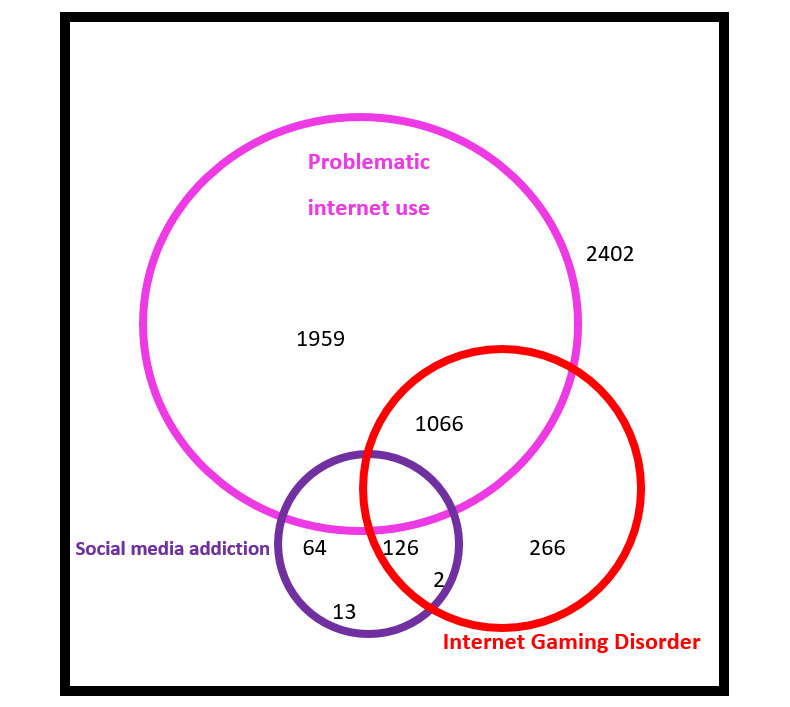
Results: Our 6000 participants had an average age of 21.7 (SD 2.5) years. Of these 6000 participants, 3062 (51.03%) were female, 3431 (57.18%) were Caucasian, 1686 (28.1%) were in a 4-year college program, and 2319 (38.65%) worked full time. The mean PIU score was 3.5 (SD 3.1), and 53.58% (3215/6000) of participants met the criteria for PIU. The mean IGD score was 2.7 (SD 2.6), and 24.33% (1460/6000) of participants met the criteria for IGD. The mean SMA score was 7.5 (SD 5.7), and 3.42% (205/6000) met the criteria for SMA. Across all 3 maladaptive technology use diagnoses, there were varied associations with demographic variables and similar overlap with health outcomes. The sensitivity of PIU screening to detect IGD was 82% and to detect SMA was 93%, whereas the specificity and positive predictive value were much lower (37%-54% specificity; 6%-37% positive predictive value).
Conclusions: This cross-sectional survey screened a large national sample of adolescents and young adults for PIU, IGD, and SMA to determine prevalence and overlap, demographic associations with each, and associations between these technology-related conditions and health outcomes. There was overlap across PIU, IGD, and SMA in some associated demographic variables and health outcomes. However, the patterns in the associated variables demonstrated unique qualities of each of these conditions.
Keywords: addiction; cross-sectional; internet; mobile phone; screening; social media; surveillance; survey; technology; video games; young adults.
©Megan Moreno, Karyn Riddle, Marina C Jenkins, Ajay Paul Singh, Qianqian Zhao, Jens Eickhoff. Originally published in JMIR Public Health and Surveillance (https://publichealth.jmir.org), 27.01.2022.
Conflict of interest statement
Conflicts of Interest: None declared.
Figures
References
-
- Teens, social media and technology 2018. Pew Research Center. 2018. [2021-11-15]. https://www.pewresearch.org/internet/2018/05/31/teens-social-media-techn...
-
- Ellison N, Steinfield BC, Lampe C. The benefits of Facebook “Friends:” social capital and college students’ use of online social network sites. J Comp Mediate Commun. 2007 Jul 1;12(4):1143–68. doi: 10.1111/j.1083-6101.2007.00367.x. - DOI
-
- Younes F, Halawi G, Jabbour H, El Osta N, Karam L, Hajj A, Rabbaa Khabbaz L. Internet addiction and relationships with insomnia, anxiety, depression, stress and self-esteem in university students: a cross-sectional designed study. PLoS One. 2016 Sep 12;11(9):e0161126. doi: 10.1371/journal.pone.0161126. https://dx.plos.org/10.1371/journal.pone.0161126 PONE-D-16-13071 - DOI - DOI - PMC - PubMed
-
- Shensa A, Escobar-Viera CG, Sidani JE, Bowman ND, Marshal MP, Primack BA. Problematic social media use and depressive symptoms among U.S. young adults: a nationally-representative study. Soc Sci Med. 2017 Jun;182:150–7. doi: 10.1016/j.socscimed.2017.03.061. http://europepmc.org/abstract/MED/28446367 S0277-9536(17)30223-X - DOI - PMC - PubMed
MeSH terms
Grants and funding
LinkOut - more resources
Full Text Sources
Miscellaneous
