


Personalized Telerehabilitation for a Head-mounted Low Vision Aid: A Randomized Feasibility Study
- PMID: 34081649
- PMCID: PMC8216601
- DOI: 10.1097/OPX.0000000000001704
Personalized Telerehabilitation for a Head-mounted Low Vision Aid: A Randomized Feasibility Study
Abstract
Significance: A recent trend in low vision rehabilitation has been the use of portable head-mounted displays to enhance residual vision. Our study confirms the feasibility of telerehabilitation and informs the development of evidence-based recommendations to improve telerehabilitation interventions to reduce device abandonment.
Purpose: To develop evidence-based recommendations for telerehabilitation, we conducted a feasibility study in preparation for a future randomized trial on the use of head-mounted displays.
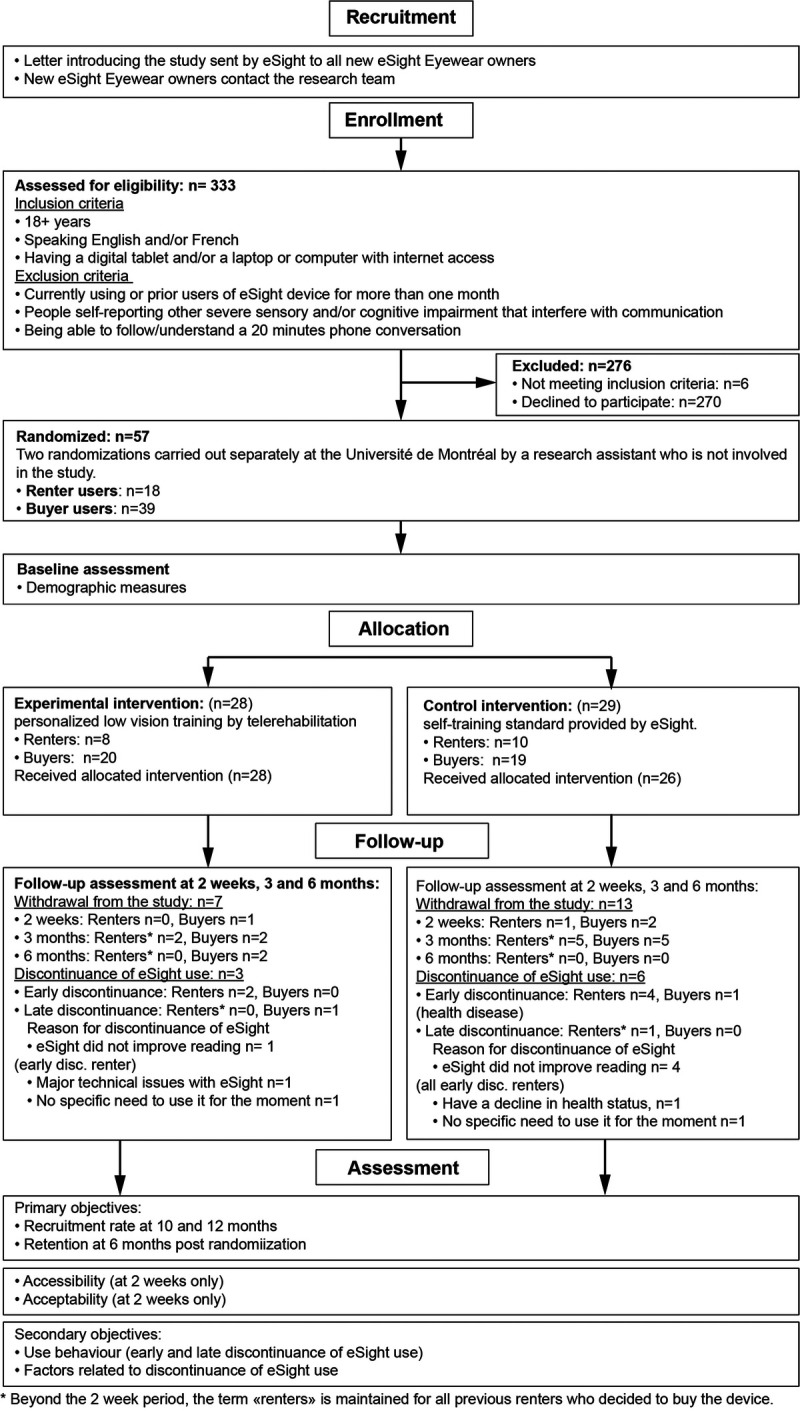
Methods: We recruited novice eSight Eyewear users, randomized 1:1: the experimental group received telerehabilitation by a low vision therapist using video conferencing; the control group completed at home self-training provided by the device manufacturer. The primary feasibility outcomes were whether the recruitment goal of 60 participants (30/group) was attainable within 1 year and how participants judged the accessibility and acceptability of the telerehabilitation. An exploratory outcome was the impact of telerehabilitation on eSight Eyewear use behavior.
Results: Among 333 eSight users, 57 participants were enrolled, of which 35% withdrew from the study, whereas the remainder completed the 6-month follow-up. The withdrawal rate was higher in the control group but did not differ significantly from the experimental group. High accessibility (93% of participants accessed the platform) and global acceptability (100% overall satisfaction) were reported among those who completed the telerehabilitation protocol. The therapist had no difficulty judging the participants' reading performances qualitatively while participants used their device to read their eSkills and VisExc guides. Most participants improved their daily activities, based on qualitative reports of the attained goals. Seventy-nine percent of individuals declined to participate, whereas 16% of participants decided not to use eSight Eyewear anymore.
Conclusions: The data demonstrated the feasibility of a randomized controlled telerehabilitation study for people with low vision using a head-mounted display. Positive feedback from the participants and the therapist suggests the potential value of this modality for low vision services.
Copyright © 2021 The Author(s). Published by Wolters Kluwer Health, Inc. on behalf of the American Academy of Optometry.
Conflict of interest statement
Conflict of Interest Disclosure: None of the authors have reported a financial conflict of interest. The sponsor facilitated subject recruitment; however, the sponsor was not involved in study design, analyses, and interpretation. The authors were responsible for the preparation of this article and the decision to submit this article for publication. Each of the authors had access to the study data and takes full responsibility for his/her presentation in this article.
Figures
References
-
- Corn A, Lusk KE. Perspectives on low vision. In: Corn A, Koenig A, eds. Foundations of Low Vision: Clinical and Functional Perspectives. 2nd ed. New York: AFB Press; 2010:3–25.
-
- Binns AM Bunce C Dickinson C, et al. How Effective Is Low Vision Service Provision? A Systematic Review. Surv Ophthalmol 2012;57:34–65. - PubMed
-
- Trauzettel-Klosinski S. Rehabilitation for Visual Disorders. J Neuroophthalmol 2010;30:73–84. - PubMed
Publication types
MeSH terms
LinkOut - more resources
Full Text Sources
