What You Need to Know Before Performing Endoscopic Ultrasound-guided Hepaticogastrostomy
- PMID: 34082486
- PMCID: PMC8182256
- DOI: 10.5946/ce.2021.103
What You Need to Know Before Performing Endoscopic Ultrasound-guided Hepaticogastrostomy
Abstract
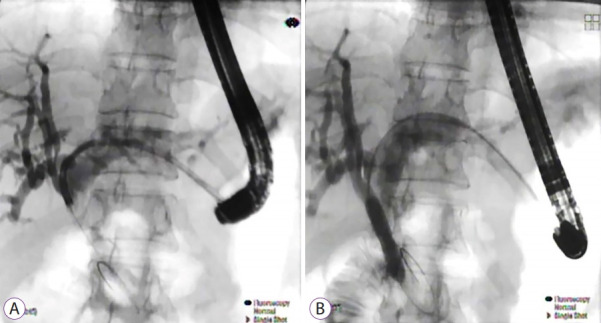
Endoscopic retrograde cholangiopancreatography (ERCP) is the primary treatment modality for bile duct obstruction. When ERCP is unsuccessful, percutaneous transhepatic biliary drainage can be an alternative method. Endoscopic ultrasound-guided biliary drainage (EUS-BD) has emerged as a treatment option for biliary obstruction, especially after ERCP failure. EUS-BD offers transluminal intrahepatic and extrahepatic drainage through a transgastric and transduodenal approach. EUS-guided hepaticogastrostomy (EUS-HGS) is an excellent choice for patients with hilar strictures or those with a surgically altered anatomy. The optimal steps in EUS-HGS are case selection, bile duct visualization, puncture-site selection, wire insertion and manipulation, tract dilation, and stent placement. Caution should be taken at each step to prevent complications. Dedicated devices for EUS-HGS have been developed to improve the technical success rate and reduce complications. This technical review focuses on the essential practical points at each step of EUS-HGS.
Keywords: Bile duct obstruction; Biliary fistula; Drainage; Endoscopic ultrasonography.
Conflict of interest statement
Figures
References
-
- Teoh AYB, Dhir V, Kida M, et al. Consensus guidelines on the optimal management in interventional EUS procedures: results from the Asian EUS group RAND/UCLA expert panel. Gut. 2018;67:1209–1228. - PubMed
-
- Nakai Y, Isayama H, Yamamoto N, et al. Indications for endoscopic ultrasonography (EUS)-guided biliary intervention: does EUS always come after failed endoscopic retrograde cholangiopancreatography? Dig Endosc. 2017;29:218–225. - PubMed
LinkOut - more resources
Full Text Sources