. 2021 Jun 3;11(1):11812.
doi: 10.1038/s41598-021-90962-5.

Giant Mesozoic coelacanths (Osteichthyes, Actinistia) reveal high body size disparity decoupled from taxic diversity

Affiliations

Giant Mesozoic coelacanths (Osteichthyes, Actinistia) reveal high body size disparity decoupled from taxic diversity

Lionel Cavin et al. Sci Rep. .

Abstract

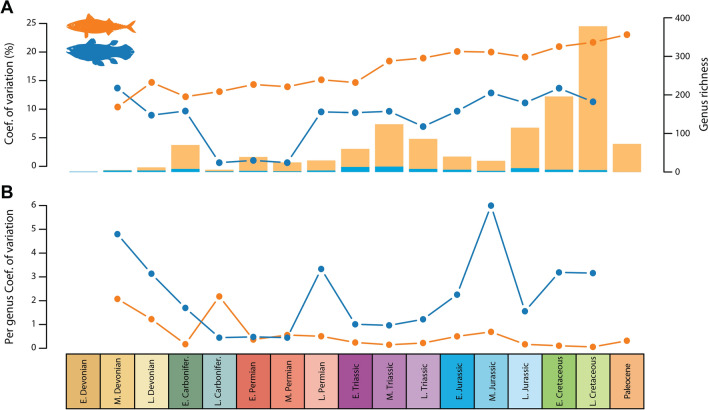
The positive correlation between speciation rates and morphological evolution expressed by body size is a macroevolutionary trait of vertebrates. Although taxic diversification and morphological evolution are slow in coelacanths, their fossil record indicates that large and small species coexisted, which calls into question the link between morphological and body size disparities. Here, we describe and reassess fossils of giant coelacanths. Two genera reached up to 5 m long, placing them among the ten largest bony fish that ever lived. The disparity in body size adjusted to taxic diversity is much greater in coelacanths than in ray-finned fishes. Previous studies have shown that rates of speciation and rates of morphological evolution are overall low in this group, and our results indicate that these parameters are decoupled from the disparity in body size in coelacanths. Genomic and physiological characteristics of the extant Latimeria may reflect how the extinct relatives grew to such a large size. These characteristics highlight new evolutionary traits specific to these "living fossils".


Conflict of interest statement

The authors declare no competing interests.

Figures
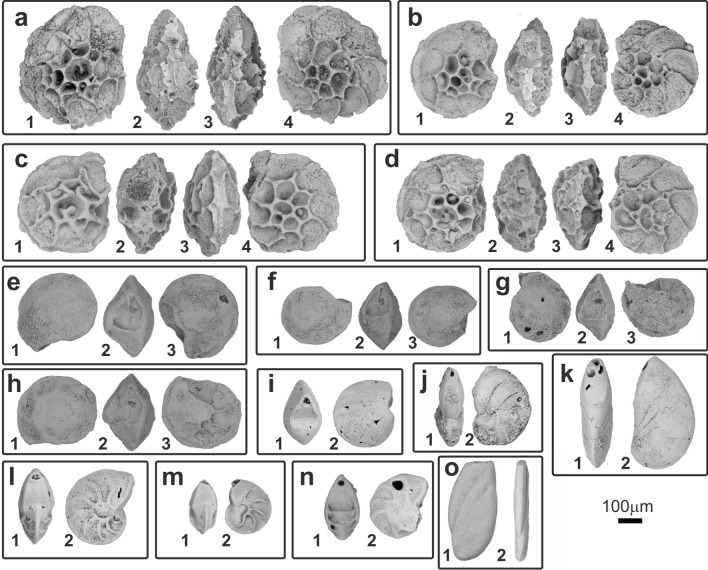
Figure 1
Figure 1
Foraminifera found in the matrix containing the fragment of the coelacanth skull (MHNG GEPI V5778). (ad) Epistomina ex. gr. mosquensis Uhlig 1883, umbilical, apertural, carinal and spiral views; (eh) Epistomina ex. gr. uhligi Mjatliuk 1953, spiral, apertural and umbilical views; (ik) Lenticulina muensteri (Roemer 1839), apertural and lateral views; (lm) Lenticulina quenstedti (Gümbel 1862), apertural and lateral views; (n) Lenticulina subalata (Reuss 1854), apertural and lateral views; (o) Planularia beierana (Gümbel 1862), lateral and apertural views.
Figure 2
Figure 2
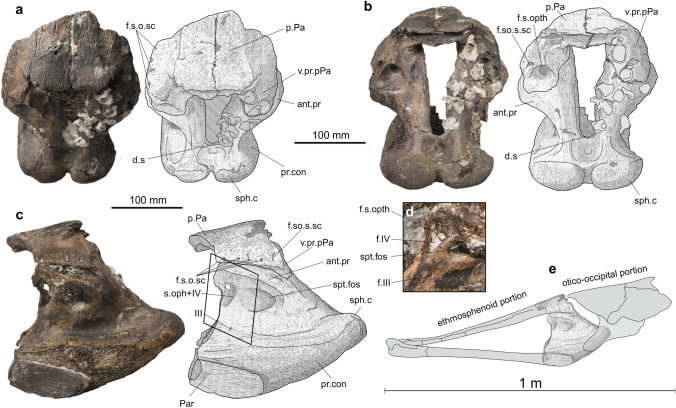
MHNG GEPI V5778. Trachymetopon sp. Basisphenoid with fragments of the posterior parietals and parasphenoid. Dorsal (a), dorsoposterior (b) and left lateral views (c). d, detail of exits of the nerve in anterolaterodorsal view (corresponding approximately to the frame in c); e, position of the fossil in a schematic reconstruction of the braincase of a mawsoniid coelacanth (modified from Maisey, 1986). Abbreviations: d.s, dorsum sellae; f.s.o.sc, foramen for the supraorbital sensory canal; f.s.opth, foramen for the superficial ophthalmic nerve; s.oph + IV, opening for the superficial ophthalmic nerve and the trochlear nerve; III, foramen for the oculomotor nerve; f.IV, foramen for the trochlear nerve (IV); ant. pr, antotic process; Par, parasphenoid; pr.con, processus conectens; p.Pa, posterior parietal; sph.c, sphenoid condyle; spt.fos, suprapterygoid fossa; v.pr.pPa, ventral process of the parietal posterior.
Figure 3
Figure 3
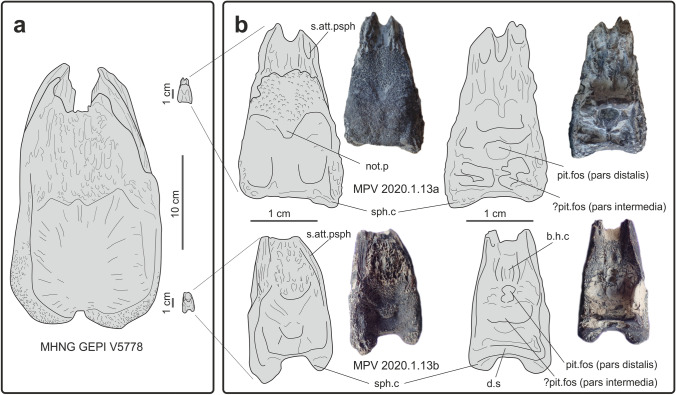
Basisphenoids of embryos or newborns of Trachymetopon sp. from Callovian beds from the Vaches Noires. (a) Comparison of the giant specimen (MHNG GEPI V5778) with basisphenoids of potential pups (MPV 2020.1.13); (b) details of the basisphenoids of the potential pups (MPV 2020.1.13a and MPV 2020.1.13b) in ventral (left) and dorsal (right) views. Abbreviations: b.h.c, buccohypophysal canal; d.s, dorsum sellae; not.p, notochordal pit; pit.fos, pituitary fossa; s.att.psph, surface of attachment for the parasphenoid; sph.c, sphenoid condyle.
Figure 4
Figure 4
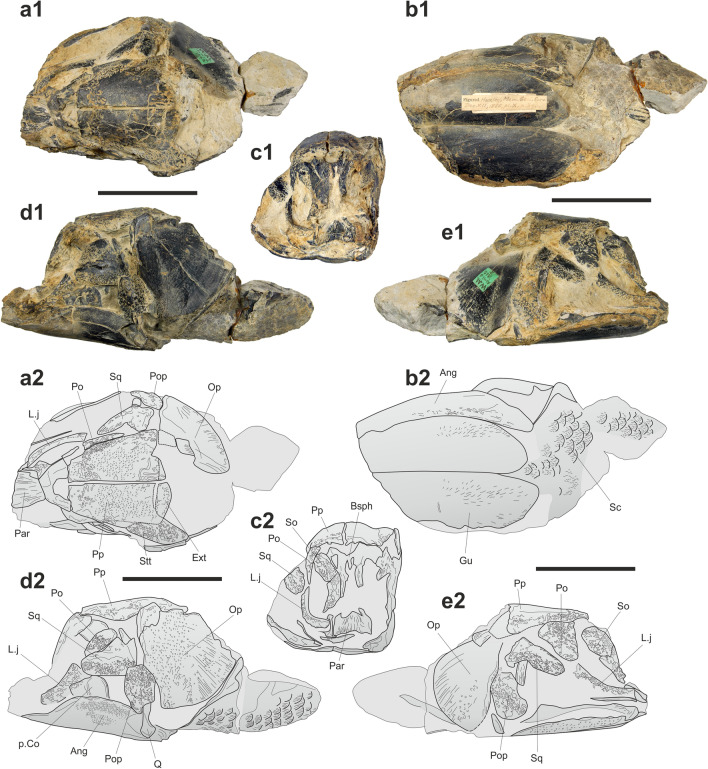
Trachymetopon (“Macropoma”) substriolatum (holotype, SMC J27415) from the Kimmeridgian of Cottenham, Cambridgeshire. Photograph (1) and semi-interpretative drawings (2) in dorsal (a), ventral (b), anterior (c), left lateral (d) and right lateral (e) views. Scale bars = 50 mm. Abbreviations: Ang, angular; Bsph, basisphenoid; Ext, extrascapular; Gu, gular; L.j, lachrymojugal; Op, opercle; Par, parasphenoid; p.Co, principal coronoid; Pop, preopercle; Pp, postparietal; Po, postorbital; Q, quadrate; Sc, scale; So, supraorbital; Sq, squamosal; Stt, supratemporal.
Figure 5
Figure 5
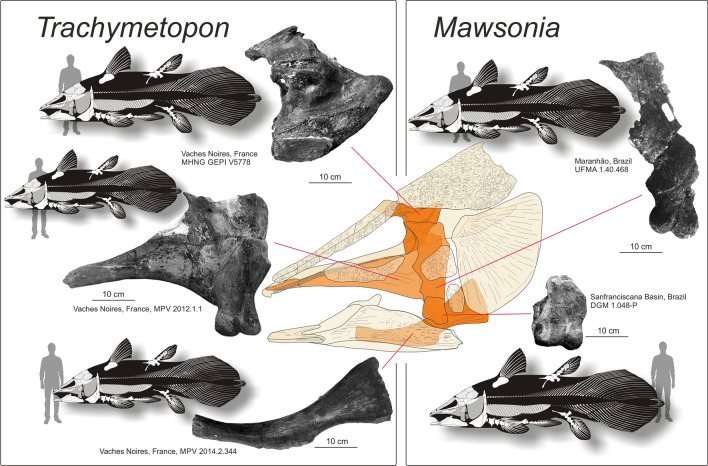
Fragmentary elements from the giant specimens of the Jurassic Trachymetopon and the Cretaceous Mawsonia. Human silhouettes corresponds to 1.8 m.
Figure 6
Figure 6
(A) range-through genus richness (histograms) and disparity expressed by the coefficient of variation (dots and lines); (B) per genus coefficient of variation, which is the coefficient of variation standardized by taxic diversity. Orange, Actinopterygii; blue, Actinistia.

References

    1. Bokma F, et al. Testing for Depéret's rule (body size increase) in mammals using combined extinct and extant data. Syst. Biol. 2016;65:98–108. doi: 10.1093/sysbio/syv075. - DOI - PMC - PubMed
    1. Heim NA, Knope ML, Schaal EK, Wang SC, Payne JL. Cope’s rule in the evolution of marine animals. Science. 2015;347:867–870. doi: 10.1126/science.1260065. - DOI - PubMed
    1. Rabosky DL, et al. Rates of speciation and morphological evolution are correlated across the largest vertebrate radiation. Nat. commun. 2013 doi: 10.1038/ncomms2958. - DOI - PubMed
    1. Cooney CR, Thomas GH. Heterogeneous relationships between rates of speciation and body size evolution across vertebrate clades. Nat. Ecol. Evol. 2020;5:101–110. doi: 10.1038/s41559-020-01321-y. - DOI - PubMed
    1. Lloyd GT. Journeys through discrete-character morphospace: Synthesizing phylogeny, tempo, and disparity. Palaeontology. 2018;61:637–645. doi: 10.1111/pala.12380. - DOI

Publication types