. 2021 Jun 3;11(1):11779.
doi: 10.1038/s41598-021-91394-x.

A conserved rhizobial peptidase that interacts with host-derived symbiotic peptides

Affiliations

A conserved rhizobial peptidase that interacts with host-derived symbiotic peptides

Alex B Benedict et al. Sci Rep. .

Abstract

In the Medicago truncatula-Sinorhizobium meliloti symbiosis, chemical signaling initiates rhizobial infection of root nodule tissue, where a large portion of the bacteria are endocytosed into root nodule cells to function in nitrogen-fixing organelles. These intracellular bacteria are subjected to an arsenal of plant-derived nodule-specific cysteine-rich (NCR) peptides, which induce the physiological changes that accompany nitrogen fixation. NCR peptides drive these intracellular bacteria toward terminal differentiation. The bacterial peptidase HrrP was previously shown to degrade host-derived NCR peptides and give the bacterial symbionts greater fitness at the expense of host fitness. The hrrP gene is found in roughly 10% of Sinorhizobium isolates, as it is carried on an accessory plasmid. The objective of the present study is to identify peptidase genes in the core genome of S. meliloti that modulate symbiotic outcome in a manner similar to the accessory hrrP gene. In an overexpression screen of annotated peptidase genes, we identified one such symbiosis-associated peptidase (sap) gene, sapA (SMc00451). When overexpressed, sapA leads to a significant decrease in plant fitness. Its promoter is active in root nodules, with only weak expression evident under free-living conditions. The SapA enzyme can degrade a broad range of NCR peptides in vitro.


Conflict of interest statement

The authors declare no competing interests.

Figures
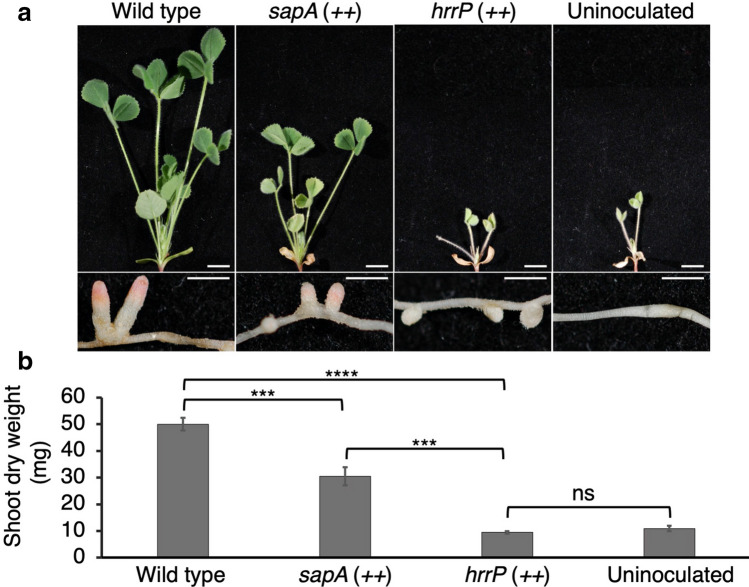
Figure 1
Figure 1
Effects of over-expressing peptidases on plant fitness. (a) Representative plants and nodules from each condition were harvested 28 dpi. Scale bars in shoot and nodule pictures are 1 cm and 0.25 cm, respectively. (b) Shoot dry mass was determined using the average masses of 12 plants of each condition harvested 28 dpi. For statistical analysis, a one-way ANOVA with a post-hoc Dunnett’s T3 test was performed. Significance levels are indicated (ns = not significant, ***P < 0.001, ****P < 0.0001). Standard error of the mean is represented in each bar.
Figure 2
Figure 2
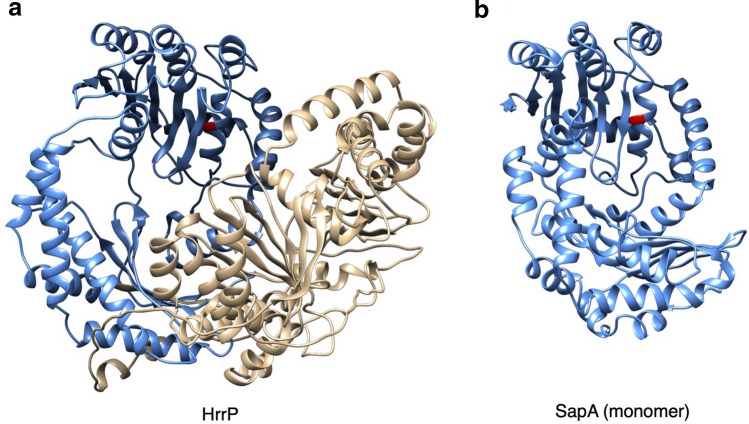
Predicted structures of HrrP and SapA. (a) Structures of HrrP and SapA were modelled with I-Tasser and rendered by Chimera (closest PDB structural analogs for each protein were ID codes 6OFS and 1HR6 respectively). The two roughly symmetrical domains in HrrP are colored in blue and gold. (b) Though SapA is predicted to function as a homodimer it is depicted above in its monomeric form, colored blue. The active sites in both HrrP and SapA (E62 and E50, respectively), are shown in red.
Figure 3
Figure 3
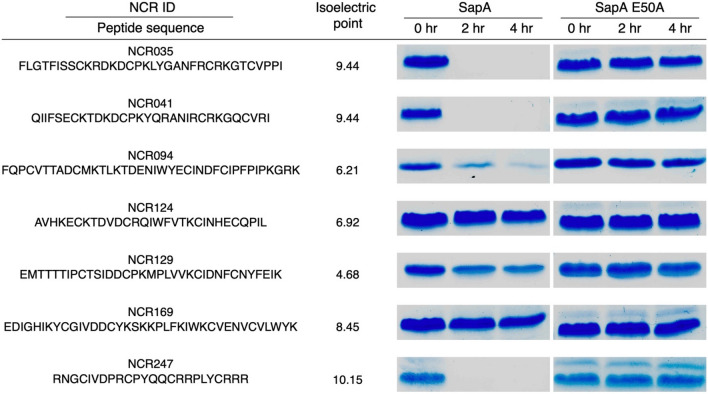
Degradation of NCR peptides by SapA in vitro. SapA and a catalytically inactive version (SapA E50A) were each incubated with several different NCR peptides individually and analyzed via tricine gel at 0, 2, and 4 h. Images of representative experiments are shown above though each peptide was tested for degradation in at least three separate experiments with equivalent results. Full-length gels are presented in Supplementary Fig. S3.
Figure 4
Figure 4
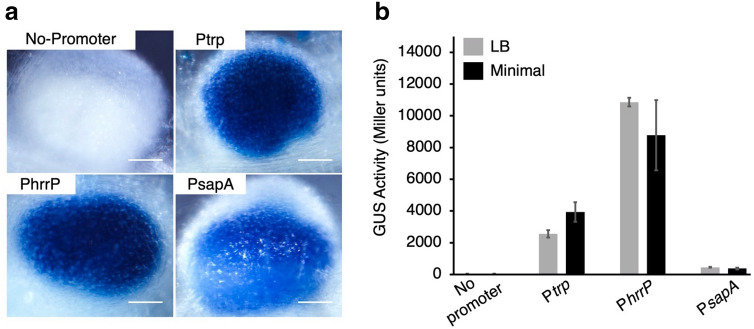
Expression pattern of sapA in vivo and in vitro. Promoter-gus fusion strains were made to determine if the promoter for sapA is active in nodules (a) or in free-living cells (b). In (a), nodules were harvested 7 dpi and stained for GUS activity. Scale bars are 100 μm. In (b), Miller assays were performed on three biological replicates of each condition. Error bars correspond to 95% confidence intervals.

References

    1. Peters N, Frost J, Long S. A plant flavone, luteolin, induces expression of rhizobium meliloti nodulation genes. Science. 1986;233:977–980. doi: 10.1126/science.3738520. - DOI - PubMed
    1. Subramanian S, Stacey G, Yu O. Distinct, crucial roles of flavonoids during legume nodulation. Trends Plant Sci. 2007;12:282–285. doi: 10.1016/j.tplants.2007.06.006. - DOI - PubMed
    1. Hartwig UA, Phillips DA. Release and modification of nod-gene-inducing flavonoids from alfalfa seeds. Plant Physiol. 1991;95:804–807. doi: 10.1104/pp.95.3.804. - DOI - PMC - PubMed
    1. Roche P, et al. The common nodabc genes of rhizobium meliloti are host-range determinants. Proc. Natl. Acad. Sci. USA. 1996;93:15305–15310. doi: 10.1073/pnas.93.26.15305. - DOI - PMC - PubMed
    1. Wais RJ, Keating DH, Long SR. Structure-function analysis of nod factor-induced root hair calcium spiking in rhizobium-legume symbiosis. Plant Physiol. 2002;129:211. doi: 10.1104/pp.010690. - DOI - PMC - PubMed

Publication types

MeSH terms