


Limitations and perceived delays for diagnosis and staging of lung cancer in Portugal: A nationwide survey analysis
- PMID: 34086757
- PMCID: PMC8177459
- DOI: 10.1371/journal.pone.0252529
Limitations and perceived delays for diagnosis and staging of lung cancer in Portugal: A nationwide survey analysis
Abstract
Background: We aimed to identify the perception of physicians on the limitations and delays for diagnosing, staging and treatment of lung cancer in Portugal.
Methods: Portuguese physicians were invited to participate an electronic survey (Feb-Apr-2020). Descriptive statistical analyses were performed, with categorical variables reported as absolute and relative frequencies, and continuous variables with non-normal distribution as median and interquartile range (IQR). The association between categorical variables was assessed through Pearson's chi-square test. Mann-Whitney test was used to compare categorical and continuous variables (Stata v.15.0).
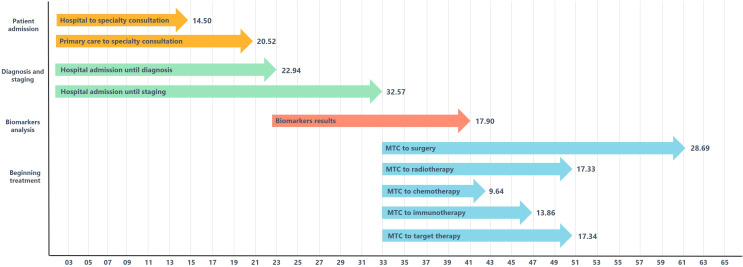
Results: Sixty-one physicians participated in the study (45 pulmonologists, 16 oncologists), with n = 26 exclusively assisting lung cancer patients. Most experts work in public hospitals (90.16%) in Lisbon (36.07%). During the last semester of 2019, responders performed a median of 85 (IQR 55-140) diagnoses of lung cancer. Factors preventing faster referral to the specialty included poor articulation between services (60.0%) and patients low economic/cultural level (44.26%). Obtaining National Drugs Authority authorization was one of the main reasons (75.41%) for delaying the begin of treatment. The cumulative lag-time from patients' admission until treatment ranged from 42-61 days. Experts believe that the time to diagnosis could be optimized in around 11.05 days [IQR 9.61-12.50]. Most physicians (88.52%) started treatment before biomarkers results motivated by performance status deterioration (65.57%) or high tumor burden (52.46%). Clinicians exclusively assisting lung cancer cases reported fewer delays for obtaining authorization for biomarkers analysis (p = 0.023). Higher waiting times for surgery (p = 0.001), radiotherapy (p = 0.004), immunotherapy (p = 0.003) were reported by professionals from public hospitals.
Conclusions: Physicians believe that is possible to reduce delays in all stages of lung cancer diagnosis with further efforts from multidisciplinary teams and hospital administration.
Conflict of interest statement
I have read the journal’s policy and the authors of this manuscript have the following competing interests: Sara Figueiredo works at the Oncology-Medical Department, AstraZeneca Portugal. She had no role on the study design, data collection or analysis. The other authors have declared that no competing interests exist. The study’s medical writing was supported by AstraZeneca Portugal. AstraZeneca Portugal had no role on the study design, data collection or analysis. This does not alter our adherence to PLOS ONE policies on sharing data and materials.
Figures
References
-
- Santucci C, Carioli G, Bertuccio P, Malvezzi M, Pastorino U, Boffetta P, et al. Progress in cancer mortality, incidence, and survival: a global overview. Eur J Cancer Prev. 2020. - PubMed
-
- The Global Cancer Observatory. Portugal—Globocan 2018 2019 [cited 2021 01 Feb 2021]. Available from: https://gco.iarc.fr/today/data/factsheets/populations/620-portugal-fact-....
Publication types
MeSH terms
LinkOut - more resources
Full Text Sources
Medical
Miscellaneous
