


Twelve years of European cancer drug approval-a systematic investigation of the 'magnitude of clinical benefit'
- PMID: 34087744
- PMCID: PMC8182388
- DOI: 10.1016/j.esmoop.2021.100166
Twelve years of European cancer drug approval-a systematic investigation of the 'magnitude of clinical benefit'
Abstract
Background: The magnitude of clinical benefit of solid cancer drugs can be standardly assessed via the Magnitude of Clinical Benefit Scale (MCBS) developed by the European Society for Medical Oncology (ESMO). We applied two ESMO-MCBS versions to the last 12 years of European cancer drug approval and compared two predefined marketing authorisation timeframes to identify potential score changes over time.
Material and methods: Originator solid cancer drugs and indication extensions that were approved between 1 January 2009 and 31 October 2020 by the European Medicines Agency (EMA) were included in our analyses. To evaluate the clinical benefit of these cancer indications, the original ESMO-MCBS (v 1.1) and a locally adapted ESMO-MCBS version were applied to the study sample. Thus, two ESMO-MCBS versions were compared, and an additional analysis was conducted to identify potential score differences between two approval timeframes 2009-2014 versus 2015-2020.
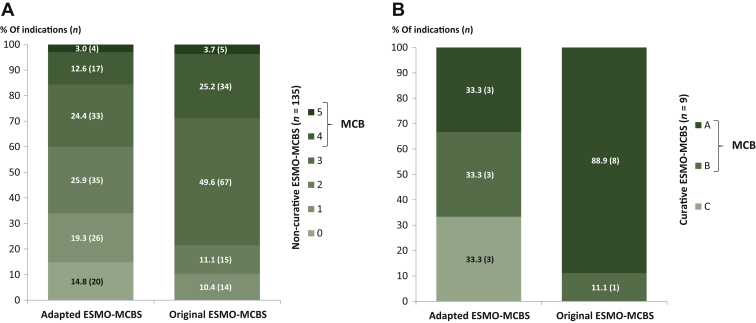
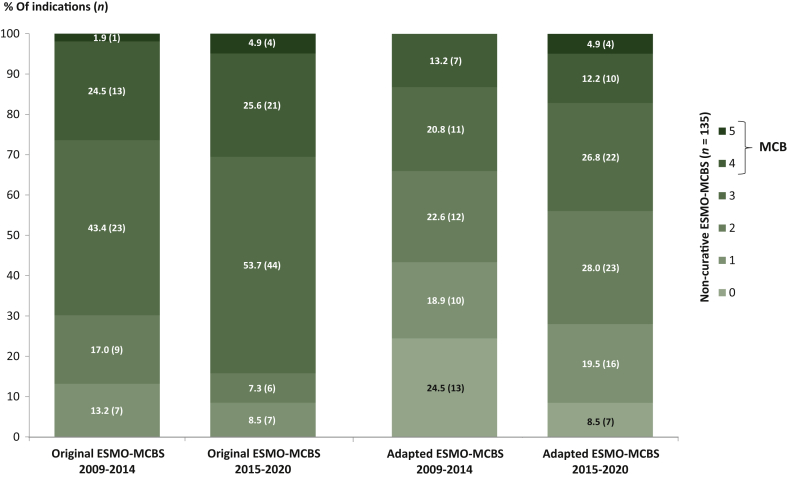
Results: A total of 144 cancer indications intended as curative (n = 9) or non-curative (n = 135) treatment options were eligible for an ESMO-MCBS assessment. Solely a minority of the assessed cancer indications met the meaningful clinical benefit (MCB) criteria independent of the applied version of the scale and treatment intention (original: n = 48/144, 33.3% versus adapted: n = 27/144, 18.8%). Comparing the two EMA approval timeframes, a growing number of approved cancer indications could be observed: 2009-2014: n = 9/year versus 2015-2020: n = 14/year. In addition, almost no difference in the proportion of cancer indications that have met the MCB criteria was detectable when comparing the predefined authorisation timeframes (MCB increase original: +4.1% and adapted: +3.9%).
Conclusion: Applying both versions of the ESMO-MCBS can help to identify potentially beneficial cancer indications, but also those with rather uncertain or low clinical benefit and thus, support the fair allocation of limited health care resources.
Keywords: ESMO-MCBS; cancer drug approval; clinical benefit; evidenced-based decision making; health technology assessment.
Copyright © 2021 The Author(s). Published by Elsevier Ltd.. All rights reserved.
Conflict of interest statement
Disclosure The authors have declared no conflicts of interest.
Figures
Comment in
-
Letter comments on: "Twelve years of European cancer drug approval-a systematic investigation of the 'magnitude of clinical benefit'".ESMO Open. 2022 Jun;7(3):100487. doi: 10.1016/j.esmoop.2022.100487. Epub 2022 May 4. ESMO Open. 2022. PMID: 35525185 Free PMC article. No abstract available.
References
-
- Banzi R., Gerardi C., Bertele V., Garattini S. Approvals of drugs with uncertain benefit-risk profiles in Europe. Eur J Intern Med. 2015;26:572–584. - PubMed
-
- Salas-Vega S., Iliopoulos O., Mossialos E. Assessment of overall survival, quality of life, and safety benefits associated with new cancer medicines. JAMA Oncol. 2017;3:382–390. - PubMed
-
- Cherny N.I., Dafni U., Bogaerts J. ESMO-magnitude of clinical benefit scale version 1.1. Ann Oncol. 2017;28:2340–2366. - PubMed
-
- Cherny N.I., Sullivan R., Dafni U. A standardised, generic, validated approach to stratify the magnitude of clinical benefit that can be anticipated from anti-cancer therapies: the European Society for Medical Oncology Magnitude of Clinical Benefit Scale (ESMO-MCBS) Ann Oncol. 2015;26:1547–1573. - PubMed
-
- Schnipper L.E., Davidson N.E., Wollins D.S. Updating the American Society of Clinical Oncology value framework: revisions and reflections in response to comments received. J Clin Oncol. 2016;34:2925–2934. - PubMed
MeSH terms
Substances
LinkOut - more resources
Full Text Sources
Medical
Research Materials
Miscellaneous
