


Cost-effectiveness of bariatric surgery and non-surgical weight management programmes for adults with severe obesity: a decision analysis model
- PMID: 34088970
- PMCID: PMC8455321
- DOI: 10.1038/s41366-021-00849-8
Cost-effectiveness of bariatric surgery and non-surgical weight management programmes for adults with severe obesity: a decision analysis model
Erratum in
-
Correction: Cost-effectiveness of bariatric surgery and non-surgical weight management programmes for adults with severe obesity: a decision analysis model.Int J Obes (Lond). 2021 Dec;45(12):2689. doi: 10.1038/s41366-021-00931-1. Int J Obes (Lond). 2021. PMID: 34446846 Free PMC article. No abstract available.
Abstract
Objectives: To determine the most cost-effective weight management programmes (WMPs) for adults, in England with severe obesity (BMI ≥ 35 kg/m2), who are more at risk of obesity related diseases.
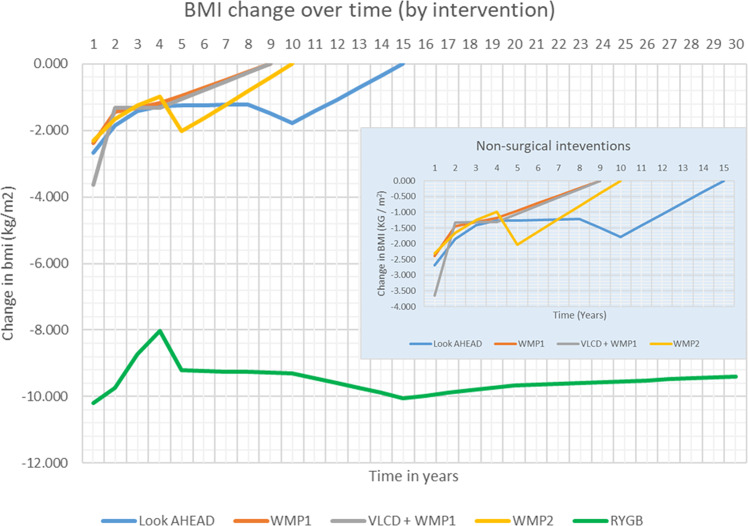
Methods: An economic evaluation of five different WMPs: 1) low intensity (WMP1); 2) very low calorie diets (VLCD) added to WMP1; 3) moderate intensity (WMP2); 4) high intensity (Look AHEAD); and 5) Roux-en-Y gastric bypass (RYGB) surgery, all compared to a baseline scenario representing no WMP. We also compare a VLCD added to WMP1 vs. WMP1 alone. A microsimulation decision analysis model was used to extrapolate the impact of changes in BMI, obtained from a systematic review and meta-analysis of randomised controlled trials (RCTs) of WMPs and bariatric surgery, on long-term risks of obesity related disease, costs, quality adjusted life years (QALYs) and incremental cost-effectiveness ratios (ICERs) measured as incremental cost per QALY gained over a 30-year time horizon from a UK National Health Service (NHS) perspective. Sensitivity analyses explored the impact of long-term weight regain assumptions on results.
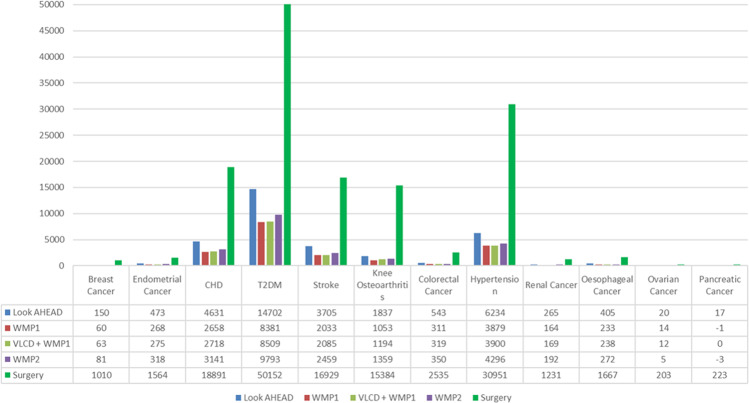
Results: RYGB was the most costly intervention but also generated the lowest incidence of obesity related disease and hence the highest QALY gains. Base case ICERs for WMP1, a VLCD added to WMP1, WMP2, Look AHEAD, and RYGB compared to no WMP were £557, £6628, £1540, £23,725 and £10,126 per QALY gained respectively. Adding a VLCD to WMP1 generated an ICER of over £121,000 per QALY compared to WMP1 alone. Sensitivity analysis found that all ICERs were sensitive to the modelled base case, five year post intervention cessation, weight regain assumption.
Conclusions: RYGB surgery was the most effective and cost-effective use of scarce NHS funding resources. However, where fixed healthcare budgets or patient preferences exclude surgery as an option, a standard 12 week behavioural WMP (WMP1) was the next most cost-effective intervention.
© 2021. The Author(s).
Conflict of interest statement
PA was an investigator on an investigator-initiated trial funded by Cambridge Weight Plan, and has done half a day’s consultancy for Weight Watchers. These activities led to payments to the University of Oxford for his time but no payments to him personally. All others: none declared.
Figures
References
-
- Health and Social Care Information Centre. Health Survey for England 2018: Overweight and obesity in adults and children. Health and Social Care Information Centre (NHS digital), 2018.HSCIC, London.
-
- Department of Health. Healthy Lives, Healthy People: A call to action on obesity in England. London: DOH; 2011.
Publication types
MeSH terms
Grants and funding
LinkOut - more resources
Full Text Sources
Medical
Research Materials
