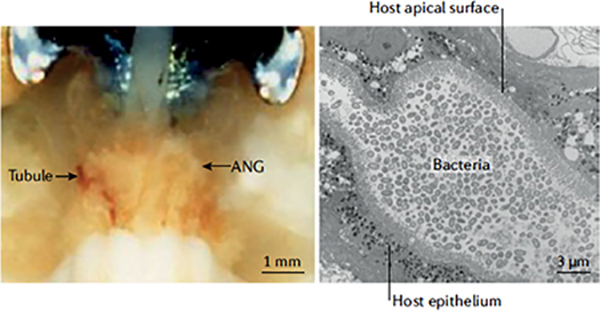
Review
. 2021 Oct;19(10):666-679.
doi: 10.1038/s41579-021-00567-y. Epub 2021 Jun 4.

A lasting symbiosis: how the Hawaiian bobtail squid finds and keeps its bioluminescent bacterial partner

Affiliations
Review

A lasting symbiosis: how the Hawaiian bobtail squid finds and keeps its bioluminescent bacterial partner

Spencer V Nyholm et al. Nat Rev Microbiol. 2021 Oct.

Erratum in

Abstract

For more than 30 years, the association between the Hawaiian bobtail squid, Euprymna scolopes, and the bioluminescent bacterium Vibrio fischeri has been studied as a model system for understanding the colonization of animal epithelia by symbiotic bacteria. The squid-vibrio light-organ system provides the exquisite resolution only possible with the study of a binary partnership. The impact of this relationship on the partners' biology has been broadly characterized, including their ecology and evolutionary biology as well as the underlying molecular mechanisms of symbiotic dynamics. Much has been learned about the factors that foster initial light-organ colonization, and more recently about the maturation and long-term maintenance of the association. This Review synthesizes the results of recent research on the light-organ association and also describes the development of new horizons for E. scolopes as a model organism that promises to inform biology and biomedicine about the basic nature of host-microorganism interactions.


Conflict of interest statement

Competing interests

The authors declare no competing interests.

Figures
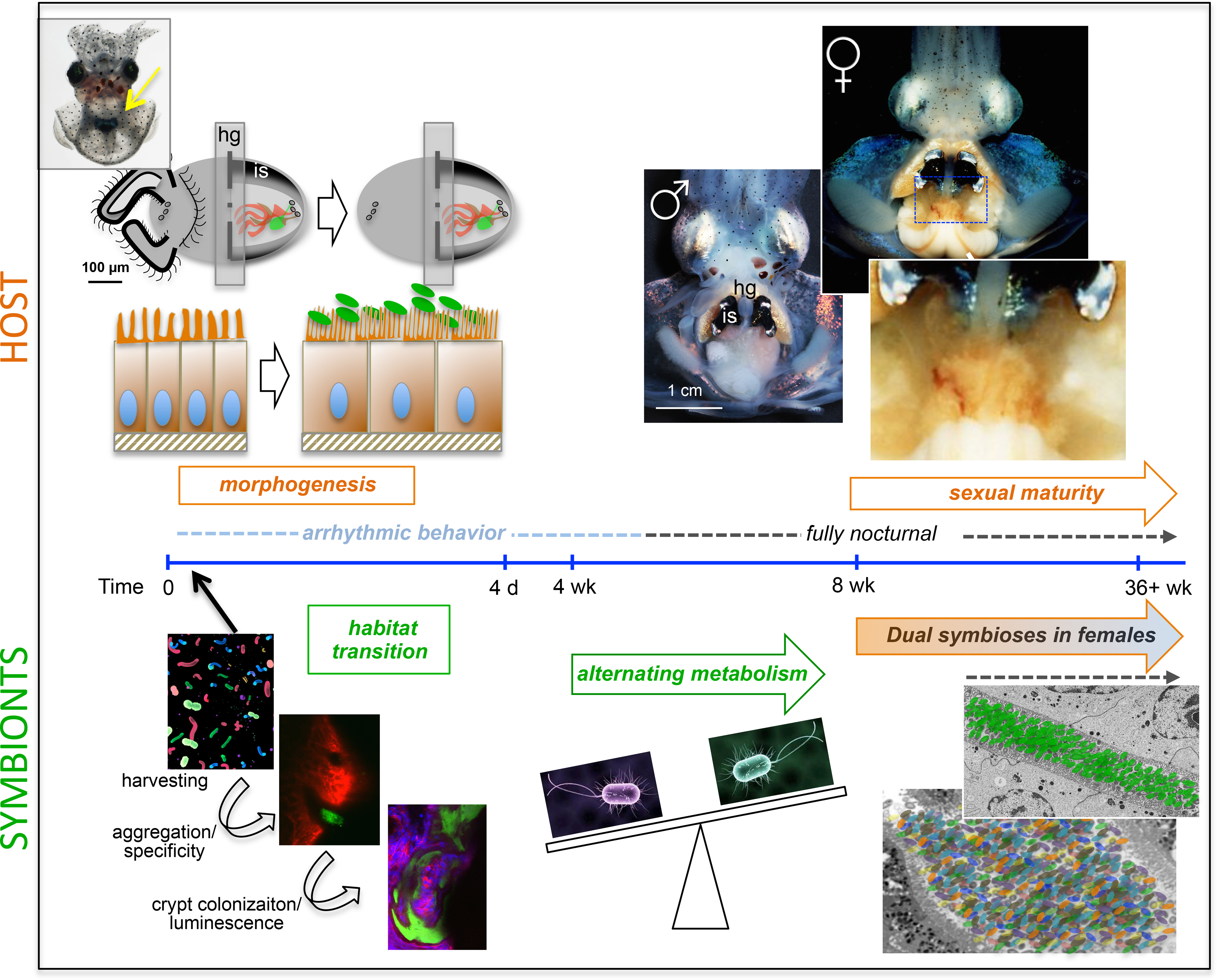
Figure 1:
Figure 1:. The Hawaiian bobtail squid as a model host for studying symbiosis.
The light organ symbiosis in Euprymna scolopes involves a series of developmental events that ensure successful colonization by Vibrio fischeri and the long-term maintenance of the association. At hatching, juvenile squid (upper left) have a nascent light organ with a superficial ciliated epithelium containing “appendages” that help recruit environmental V. fischeri. Three pores on either side of the light organ lead to epithelium-lined crypts of distinct sizes (crypt 1, peach; crypt 2, brown; crypt, 3 green). Colonization occurs within hours after hatching as V. fischeri undergoes habitat transition from a free-living bacterium found in the bacterioplankton to aggregating in host mucus, the first site of specificity (lower left). Aggregation is followed by migration through the pores and colonization of the crypts where bioluminescence is induced (lower panel left; an inoculum larger than normal was used to visualize the aggregating cells in relation to the host tissues). Colonization leads to light organ morphogenesis over the first 4 days of the association. Cellular changes include epithelial swelling and an increase in microvillar density (upper panel left) such that the crypt spaces of fully colonized hosts contain a dense population of V. fisheri in direct contact with host epithelial cells (lower right). Over a period of approximately four weeks, the light organ symbiosis matures and host behavior changes from being arrhythmic to becoming fully nocturnal. A diel rhythm of alternating symbiont metabolism is also established during which the symbiont switches between glycerol phosphate respiration and chitin fermentation in the day and night respectively (lower right). This alternating metabolism helps facilitate luminescence (i.e., the light organ become acidic at night which increases the availability of oxygen used in light production). Sexual dimorphism is evident after E. scolopes reaches maturity at approximately 8 weeks after hatching. Female squid have a second symbiotic organ, the accessory nidamental gland (ANG) that houses a simple bacterial consortium (upper right; see Box 3). Image credits: juvenile squid, adapted from REF, male squid; photo credit, William Omerod; copyright M. McFal-Ngai, female squid: adapted from REF; Transmission electron micrograph courtesy of Mary Montgomery.
Figure 2:
Figure 2:. Update to the winnowing model of colonization
Initial colonization of the light organ involves a number of biochemical and biomechanical mechanisms to establish the partnership between the Hawaiian bobtail squid, Euprymna scolopes, and the bioluminescent bacterium, Vibrio fischeri. The habitat transition of V. fischeri from the bacterioplankton to light organ symbiont involves several features that help facilitate colonization. The nascent light organ is made up of ciliated fields (inset; 1/2 of a light organ as shown by a scanning electron micrograph) that are composed of metachronally and randomly beating cilia that create microcurrents (arrows) that help to focus bacteria-sized particles above three pores on either side of the light organ in a shelter zone. The host increases expression of endochitinase and secretes mucus that contains a number of biochemical factors including chitobiose, a symbiont chemoattractant and a suite of host immunity factors that may serve to inhibit other bacteria. This unique microenvironment selects for V. fischeri while preventing colonization by non-symbiotic bacteria. V. fischeri cells that enter the light organ must traverse a unique biogeography that includes ciliated ducts, an antechamber and a bottleneck. A single V. fischeri cell (or on occasion several cells) migrate into each of the three crypts where they become nonmotile and divide and grow until a cell density is reached that enables the induction of quorum sensing and light production (approximately 9–12 h). Colonization also initiates cellular changes in the host, including the induction of haemocyte migration into the host ciliated fields along with apoptosis and regression of the ciliated field four days after colonization. lipopolysaccharide binding protein, LBP; bacteriocidal permeability-increasing protein, BPI; nitric oxide synthase, NOS; nitric oxide; NO, peptidoglycan recognition protein 2, PGRP2. Image credit: REF
Figure 3:
Figure 3:. The diel rhythm of the host–symbiont association highlights major differences between juvenile and adult stages.
A. Within the first four weeks after hatching, the host transitions to a fully nocturnal active period with a functional symbiosis that allows for the camouflage behavior (counterillumination) and a diurnal quiescent period where the host buries in the sand. Symbiont density is also regulated on a diel cycle where 95% of the symbionts are expelled each morning at dawn followed by a period of regrowth so that the host has a full complement of V. fischeri to engage in counterillumination via bioluminescence at night. b. Host and symbiont gene expression are regulated as part of these critical diel and circadian rhythms that drive the cell biology and biochemistry of the light to facilitate the production of light when the host is active at night. The symbiont diel population and corresponding luminescence rhythms are established early in the association as are some critical host pathways including changes in microvillar density, and genes that help regulate circadian rhythms and immunity. By four weeks major cellular and physiological shifts occur in the light organ over the day/night cycle as indicated by changes in genes/proteins involved with osmolarity, oxidative stress, actin rearrangement, circadian rhythms, and haemocyte trafficking. This haemocyte migration into the crypts at night helps deliver chitin to the symbionts; a process involved with the symbiont undergoing a major metabolic shift, using the anaerobic respiration of glycerol phosphate during the day and fermentation of host-derived chitin at night that helps facilitate effective luminescence by acidifying the crypts and releasing oxygen from bound haemocyanin.
None

Comment in

  • Beating in on a stable partnership.
    Giez C, Bosch TCG. Giez C, et al. Nat Rev Microbiol. 2021 Oct;19(10):619-620. doi: 10.1038/s41579-021-00575-y. Nat Rev Microbiol. 2021. PMID: 34089009 No abstract available.

References

    1. de Bary A De la symbiose. Rev Int Sci 3, 301–309 (1879).
    1. Casadevall A & Pirofski LA Ditch the term pathogen. Nature 516, 165–166 (2014). - PubMed
    1. McFall-Ngai M et al. Animals in a bacterial world, a new imperative for the life sciences. Proc. Natl. Acad. Sci. U. S. A. 110, 3229–36 (2013). - PMC - PubMed
    1. Ruby EG Symbiotic conversations are revealed under genetic interrogation. Nature Reviews Microbiology 6, 752–762 (2008). - PMC - PubMed
    1. Douglas AE Simple animal models for microbiome research. Nat. Rev. Microbiol. 12, 764–775 (2019). - PubMed

Publication types