


Advances in mouse genetics for the study of human disease
- PMID: 34089057
- PMCID: PMC8490014
- DOI: 10.1093/hmg/ddab153
Advances in mouse genetics for the study of human disease
Abstract
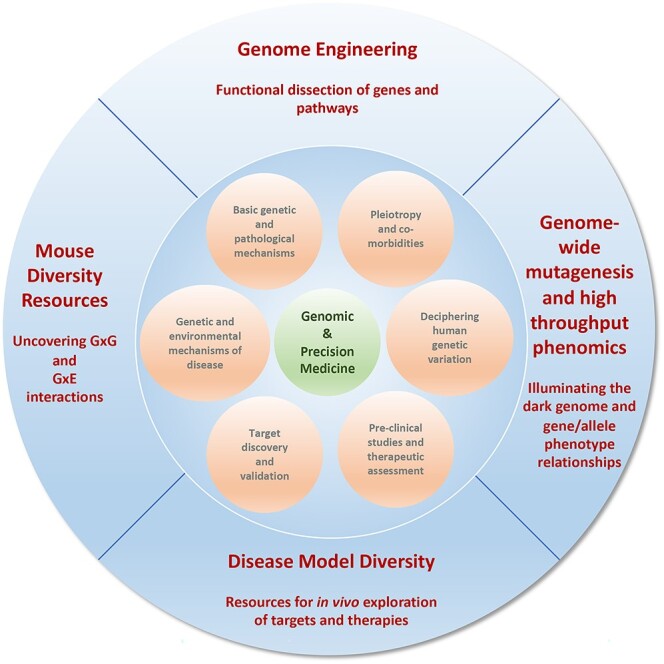
The mouse is the pre-eminent model organism for studies of mammalian gene function and has provided an extraordinarily rich range of insights into basic genetic mechanisms and biological systems. Over several decades, the characterization of mouse mutants has illuminated the relationship between gene and phenotype, providing transformational insights into the genetic bases of disease. However, if we are to deliver the promise of genomic and precision medicine, we must develop a comprehensive catalogue of mammalian gene function that uncovers the dark genome and elucidates pleiotropy. Advances in large-scale mouse mutagenesis programmes allied to high-throughput mouse phenomics are now addressing this challenge and systematically revealing novel gene function and multi-morbidities. Alongside the development of these pan-genomic mutational resources, mouse genetics is employing a range of diversity resources to delineate gene-gene and gene-environment interactions and to explore genetic context. Critically, mouse genetics is a powerful tool for assessing the functional impact of human genetic variation and determining the causal relationship between variant and disease. Together these approaches provide unique opportunities to dissect in vivo mechanisms and systems to understand pathophysiology and disease. Moreover, the provision and utility of mouse models of disease has flourished and engages cumulatively at numerous points across the translational spectrum from basic mechanistic studies to pre-clinical studies, target discovery and therapeutic development.
© The Author(s) 2021. Published by Oxford University Press.
Figures
References
-
- Zhang, Y., Proenca, R., Maffei, M., Barone, M., Leopold, L. and Friedman, J.M. (1994) Positional cloning of the mouse obese gene and its human homologue. Nature, 372, 425–432. - PubMed
-
- Gibson, F., Walsh, J., Mburu, P., Varela, A., Brown, K.A., Antonio, M., Beisel, K.W., Steel, K.P. and Brown, S.D.M. (1995) A type VII myosin encoded by the mouse deafness gene shaker-1. Nature, 374, 62–64. - PubMed
-
- Avraham, K.B., Hasson, T., Steel, K.P., Kingsley, D.M., Russell, L.B., Mooseker, M.S., Copeland, N.G. and Jenkins, N.A. (1995) The mouse Snell’s Waltzer deafness gene encodes an unconventional myosin required for structural integrity of inner ear hair cells. Nat. Genet., 11, 369–375. - PubMed
-
- Sicinski, P., Geng, Y., Ryder-Cook, A.S., Barnard, E.A., Darlison, M.G. and Barnard, P.J. (1989) The molecular basis of muscular dystrophy in the mdx mouse: a point mutation. Science, 244, 1578–1580. - PubMed
-
- Acevedo-Arozena, A., Wells, S., Potter, P., Kelly, M., Cox, R.D. and Brown, S.D.M. (2008) ENU mutagenesis, a way forward to understand gene function. Annu. Rev. Genomics Hum. Genet., 9, 49–69. - PubMed
