. 2022 May;32(4):683-692.
doi: 10.1007/s00590-021-03022-z. Epub 2021 Jun 5.

Locked fracture dislocations of the proximal humerus: postoperative results and a proposed modification of the classification

Affiliations

Locked fracture dislocations of the proximal humerus: postoperative results and a proposed modification of the classification

Jonas Schmalzl et al. Eur J Orthop Surg Traumatol. 2022 May.

Abstract

Background: Locked dislocations of the glenohumeral joint are disabling and often painful conditions and the treatment is challenging. This study evaluates the functional outcome and the different prosthetic treatment options for chronic locked dislocations of the glenohumeral joint and a subclassification is proposed.

Methods: In this single-center retrospective case series, all patients with a chronic locked dislocation treated surgically during a four-year period were analyzed. Constant score (CS), Quick Disabilities of Shoulder and Hand Score (DASH), patient satisfaction (subjective shoulder value (SSV)), revision rate and glenoid notching were analyzed.

Results: 26 patients presented a chronic locked dislocation of the glenohumeral joint. 16 patients (62%) with a mean age of 75 [61-83] years were available for follow-up at 24 ± 18 months. CS improved significantly from 10 ± 6 points to 58 ± 21 points (p < 0.0001). At the final follow-up, the mean DASH was 27 ± 23 and the mean SSV was 58 ± 23 points. The complication rate was 19% and the revision rate was 6%; implant survival was 94%. Scapular notching occurred in 2 (13%) cases (all grade 1).

Conclusion: With good preoperative planning and by using the adequate surgical technique, good clinical short-term results with a low revision rate can be achieved. The authors suggest extending the Boileau classification for fracture sequelae type 2 and recommend using a modified classification to facilitate the choice of treatment as the suggested classification system includes locked posterior and anterior dislocations with and without glenoid bone loss.

Level of evidence: IV.

Keywords: Bone defect; Fracture sequelae shoulder; Glenoid bone grafting; Locked shoulder dislocation; Pectoralis major transfer; Shoulder arthroplasty.


Conflict of interest statement

All authors declare that they have no conflict of interest.

Figures

Fig. 1
Fig. 1
Subclassification of proximal humeral fracture sequelae type 2 according to Boileau (a). Type 2a lesions (b) are defined as locked posterior dislocations and can be treated with hemiarthroplasty or total shoulder arthroplasty. Type 2b lesions (c) represent locked chronic anterior dislocations and should be treated with reverse shoulder arthroplasty. Type 2c lesions (d) are defined as locked chronic anterior dislocations with glenoid bone loss and a treatment option is autologous bone grafting of the glenoid, implantation of a reverse prosthesis and pectoralis major tendon transfer for soft tissue balancing
Fig. 2
Fig. 2
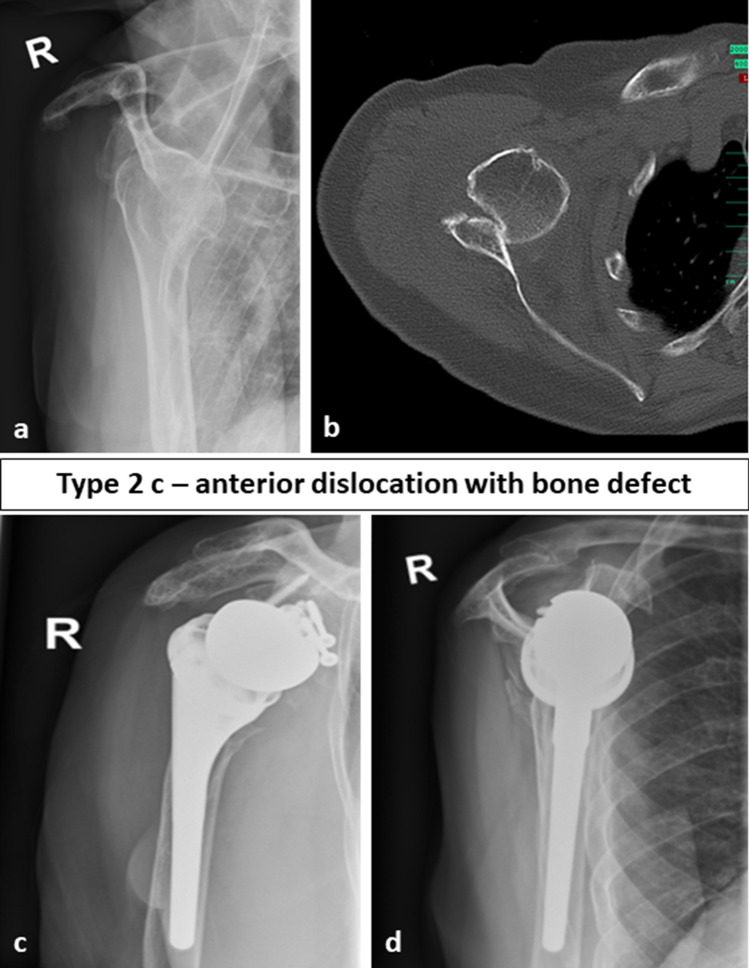
Preoperative (a, b), postoperative (c), follow-up images (d) and intraoperative images (eg) of a 79-year-old female patient with a FS type 2c, i.e., a locked anterior dislocation with concomitant anterior glenoid bone loss of around 80% (b) treated with primary reverse shoulder arthroplasty with glenoid bone grafting with the resected humeral head (e, f) and pectoralis major tendon transfer for better soft tissue balancing (g). At final follow-up after 19 months, the Constant score was 75 points
Fig. 3
Fig. 3
Preoperative (a, b) and follow-up images (c, d) of a 76-year-old female patient with a FS type 2a, i.e., a posterior dislocation treated with primary anatomic hemiarthroplasty. At final follow-up after 12 months, the Constant score was 70 points
Fig. 4
Fig. 4
Preoperative (a, b) and follow-up images (c, d) of a 76-year-old female patient with a FS type 2b, i.e., an anterior dislocation treated with primary reverse shoulder arthroplasty. At final follow-up after 65 months, the Constant score was 71 points
Fig. 5
Fig. 5
Preoperative (a, b) and follow-up images (c, d) of a 81-year-old female patient with a FS type 2c, i.e., an anterior dislocation treated with autologous glenoid bone grafting, primary reverse shoulder arthroplasty and pectoralis major transfer. At final follow-up after 32 months, the Constant score was 69 points

References

    1. Matsoukis J, Tabib W, Guiffault P, et al. Primary unconstrained shoulder arthroplasty in patients with a fixed anterior glenohumeral dislocation. J Bone Jt Surg Ser A. 2006;88:547–552. doi: 10.2106/JBJS.E.00368. - DOI - PubMed
    1. Raiss P, Aldinger PR, Kasten P, et al. Humeral head resurfacing for fixed anterior glenohumeral dislocation. Int Orthop. 2009;33:451–456. doi: 10.1007/s00264-007-0487-6. - DOI - PMC - PubMed
    1. Boileau P, Trojani C, Walch G, et al. Shoulder arthroplasty for the treatment of the sequelae of fractures of the proximal humerus. J Shoulder Elb Surg. 2001;10:299–308. doi: 10.1067/mse.2001.115985. - DOI - PubMed
    1. Boileau P, Trojani C, Chuinard C, Lehuec JC, Walch G (2006) Proximal humerus fracture sequelae: impact of a new radiographic classification on arthroplasty. Clin Orthop Relat Res 442:121–130. 10.1097/01.blo.0000195679.87258.6e - PubMed
    1. Weber BG, Simpson LA, Hardegger F. Rotational humeral osteotomy for recurrent anterior dislocation of the shoulder associated with a large Hill-Sachs lesion. J Bone Joint Surg Am. 1984;66:1443–1450. doi: 10.2106/00004623-198466090-00019. - DOI - PubMed