


Klebsiella spp. cause severe and fatal disease in Mozambican children: antimicrobial resistance profile and molecular characterization
- PMID: 34090384
- PMCID: PMC8178901
- DOI: 10.1186/s12879-021-06245-x
Klebsiella spp. cause severe and fatal disease in Mozambican children: antimicrobial resistance profile and molecular characterization
Abstract
Background: Klebsiella spp. are important pathogens associated with bacteremia among admitted children and is among the leading cause of death in children < 5 years in postmortem studies, supporting a larger role than previously considered in childhood mortality. Herein, we compared the antimicrobial susceptibility, mechanisms of resistance, and the virulence profile of Klebsiella spp. from admitted and postmortem children.
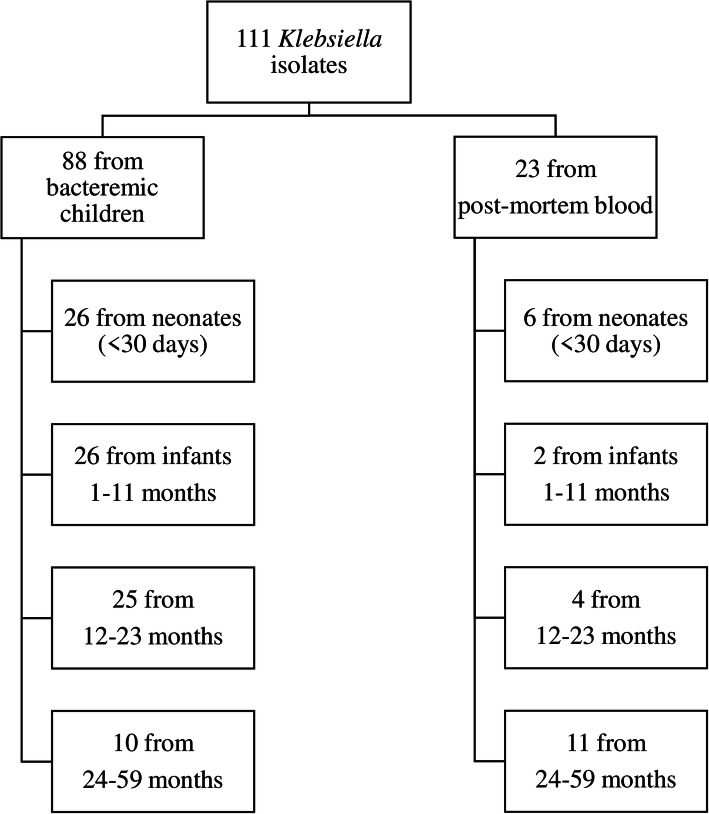
Methods: Antimicrobial susceptibility and virulence factors of Klebsiella spp. recovered from blood samples collected upon admission to the hospital (n = 88) and postmortem blood (n = 23) from children < 5 years were assessed by disk diffusion and multiplex PCR.
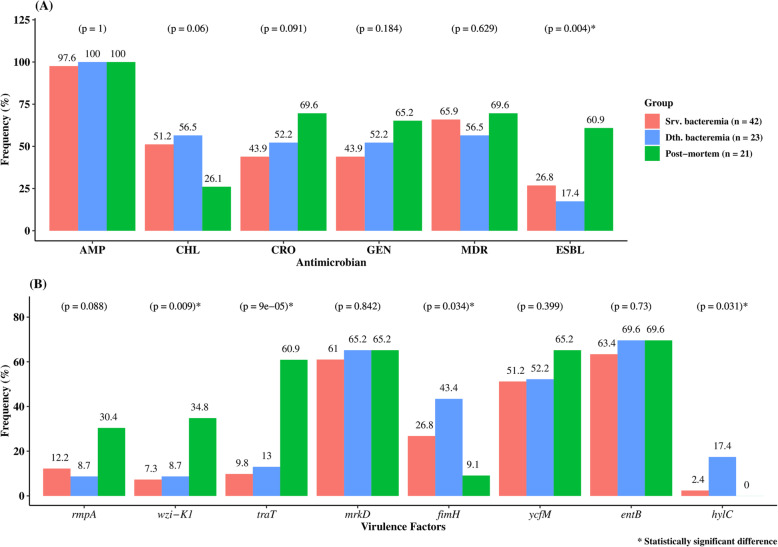
Results: Klebsiella isolates from postmortem blood were likely to be ceftriaxone resistant (69.6%, 16/23 vs. 48.9%, 43/88, p = 0.045) or extended-spectrum β-lactamase (ESBL) producers (60.9%, 14/23 vs. 25%, 22/88, p = 0.001) compared to those from admitted children. blaCTX-M-15 was the most frequent ESBL gene: 65.3%, 9/14 in postmortem isolates and 22.7% (5/22) from admitted children. We found higher frequency of genes associated with hypermucoviscosity phenotype and invasin in postmortem isolates than those from admitted children: rmpA (30.4%; 7/23 vs. 9.1%, 8/88, p = 0.011), wzi-K1 (34.7%; 8/23 vs. 8%; 7/88, p = 0.002) and traT (60.8%; 14/23 vs. 10.2%; 9/88, p < 0.0001), respectively. Additionally, serine protease auto-transporters of Enterobacteriaceae were detected from 1.8% (pic) to 12.6% (pet) among all isolates. Klebsiella case fatality rate was 30.7% (23/75).
Conclusion: Multidrug resistant Klebsiella spp. harboring genes associated with hypermucoviscosity phenotype has emerged in Mozambique causing invasive fatal disease in children; highlighting the urgent need for prompt diagnosis, appropriate treatment and effective preventive measures for infection control.
Keywords: Bacteremia; CTX-M-15; ESBL genes; Hypermucoviscosity; Hypervirulence; Mozambique; SPATEs.
Conflict of interest statement
The authors declare that they have no competing interests.
Figures
References
-
- Sigaúque B, Roca A, Mandomando I, Morais L, Quintó L, Sacarlal J, Macete E, Nhamposa T, Machevo S, Aide P, Bassat Q, Bardají A, Nhalungo D, Soriano-Gabarró M, Flannery B, Menendez C, Levine MM, Alonso PL. Community-acquired bacteremia among children admitted to a rural hospital in Mozambique. Pediatr Infect Dis J. 2009;28(2):108–113. doi: 10.1097/INF.0b013e318187a87d. - DOI - PubMed
-
- Kim D, Park BY, Choi MH, Yoon EJ, Lee H, Lee KJ, Park YS, Shin JH, Uh Y, Shin KS, Shin JH, Kim YA, Jeong SH. Antimicrobial resistance and virulence factors of Klebsiella pneumoniae affecting 30 day mortality in patients with bloodstream infection. J Antimicrob Chemother. 2019;74:190–199. doi: 10.1093/jac/dky397. - DOI - PubMed
MeSH terms
Substances
LinkOut - more resources
Full Text Sources
Medical
Miscellaneous
