


Reproductive-Age Women's Experience of Accessing Treatment for Opioid Use Disorder: "We Don't Do That Here"
- PMID: 34090780
- PMCID: PMC9111968
- DOI: 10.1016/j.whi.2021.03.010
Reproductive-Age Women's Experience of Accessing Treatment for Opioid Use Disorder: "We Don't Do That Here"
Abstract
Purpose: For reproductive-age women, medications for opioid use disorder (OUD) decrease risk of overdose death and improve outcomes but are underutilized. Our objective was to provide a qualitative description of reproductive-age women's experiences of seeking an appointment for medications for OUD.
Methods: Trained female callers placed telephone calls to a representative sample of publicly listed opioid treatment clinics and buprenorphine providers in Florida, Kentucky, Massachusetts, Michigan, Missouri, North Carolina, Tennessee, Virginia, Washington, and West Virginia to obtain appointments to receive medication for OUD. Callers were randomly assigned to be pregnant or non-pregnant and have private or Medicaid-based insurance to assess differences in the experiences of access by these characteristics. The callers placed 28,651 uniquely randomized calls, 10,117 to buprenorphine-waivered prescribers and 754 to opioid treatment programs. Open-ended, qualitative data were obtained from the callers about the access experiences and were analyzed using a qualitative, iterative inductive-deductive approach. From all 28,651 total calls, there were 17,970 unique free-text comments to the question "Please give an objective play-by-play of the description of what happened in this conversation."
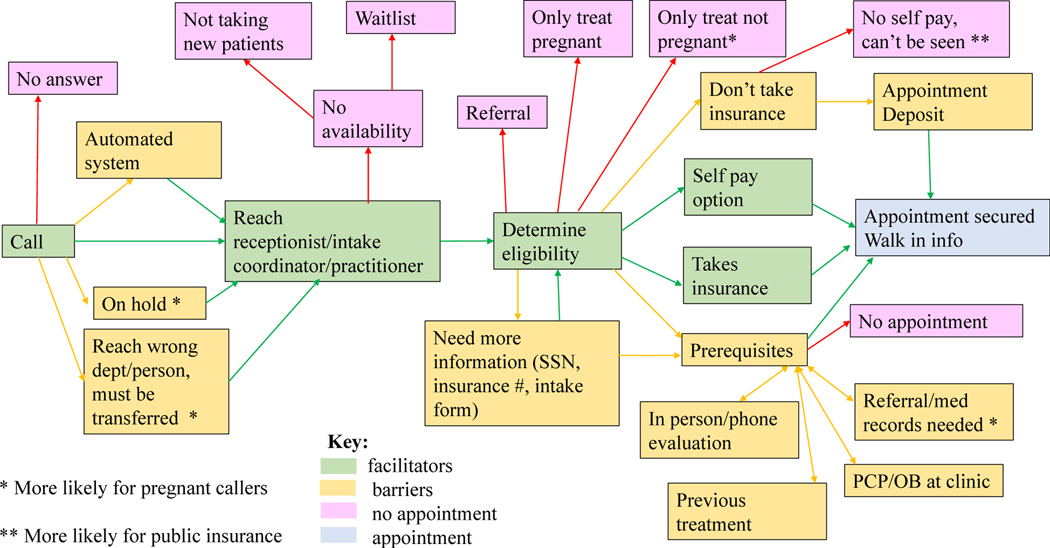
Findings: Analysis demonstrated a common path to obtaining an appointment. Callers frequently experienced long hold times, multiple transfers, and difficult interactions. Clinic receptionists were often mentioned as facilitating or obstructing access. Pregnant callers and those with Medicaid noted more barriers. Obtaining an appointment was commonly difficult even for these persistent, trained callers.
Conclusions: Interventions are needed to improve the experiences of reproductive-age women as they enter care for OUD, especially for pregnant women and those with Medicaid coverage.
Copyright © 2021 Jacobs Institute of Women's Health. Published by Elsevier Inc. All rights reserved.
Conflict of interest statement
Declarations of Competing Interest: The authors have no conflicts of interest to disclose.
Figures
References
-
- American College of Obstetricians and Gynecologists Committee on Obstetric Practice. (2017). Committee Opinion No. 711: Opioid use and opioid use disorder in pregnancy. Obstetrics & Gynecology, 130(2), e81–e94. - PubMed
-
- Atkins DN, & Durrance CP (2020). State policies that treat prenatal substance use as child abuse or neglect fail to achieve their intended goals: Study examines the effect of state policies that treat prenatal substance use as child abuse or neglect on the incidence of neonatal abstinence syndrome and other factors. Health Affairs, 39(5), 756–763. - PubMed
-
- Azungah T. (2018). Qualitative research: deductive and inductive approaches to data analysis. Qualitative Research Journal.
-
- Bisgaier J, & Rhodes KV (2011). Auditing access to specialty care for children with public insurance. New England Journal of Medicine, 364(24), 2324–2333. - PubMed
Publication types
MeSH terms
Substances
Grants and funding
LinkOut - more resources
Full Text Sources
Medical
