Review
. 2021 Mar 26;23(9):3191-3206.
doi: 10.1039/d1gc00561h.

Applied biocatalysis beyond just buffers - from aqueous to unconventional media. Options and guidelines

Affiliations
Review

Applied biocatalysis beyond just buffers - from aqueous to unconventional media. Options and guidelines

Morten M C H van Schie et al. Green Chem. .

Abstract

In nature, enzymes conventionally operate under aqueous conditions. Because of this, aqueous buffers are often the choice for reaction media when enzymes are applied in chemical synthesis. However, to meet the demands of an industrial application, due to the poor water solubility of many industrially relevant compounds, an aqueous reaction system will often not be able to provide sufficient substrate loadings. A switch to a non-aqueous solvent system can provide a solution, which is already common for lipases, but more challenging for biocatalysts from other enzyme classes. The choices in solvent types and systems, however, can be overwhelming. Furthermore, some engineering of the protein structure of biocatalyst formulation is required. In this review, a guide for those working with biocatalysts, who look for a way to increase their reaction productivity, is presented. Examples reported clearly show that bulk water is not necessarily required for biocatalytic reactions and that clever solvent systems design can support increased product concentrations thereby decreasing waste formation. Additionally, under these conditions, enzymes can also be combined in cascades with other, water-sensitive, chemical catalysts. Finally, we show that the application of non-aqueous solvents in biocatalysis can actually lead to more sustainable processes. At the hand of flowcharts, following simple questions, one can quickly find what solvent systems are viable.


Conflict of interest statement

There are no conflicts to declare.

Figures
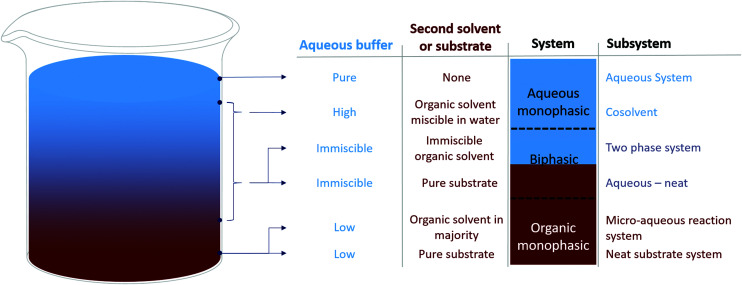
Fig. 1
Fig. 1. Scheme of different solvent systems sorted by relative water content.
Fig. 2
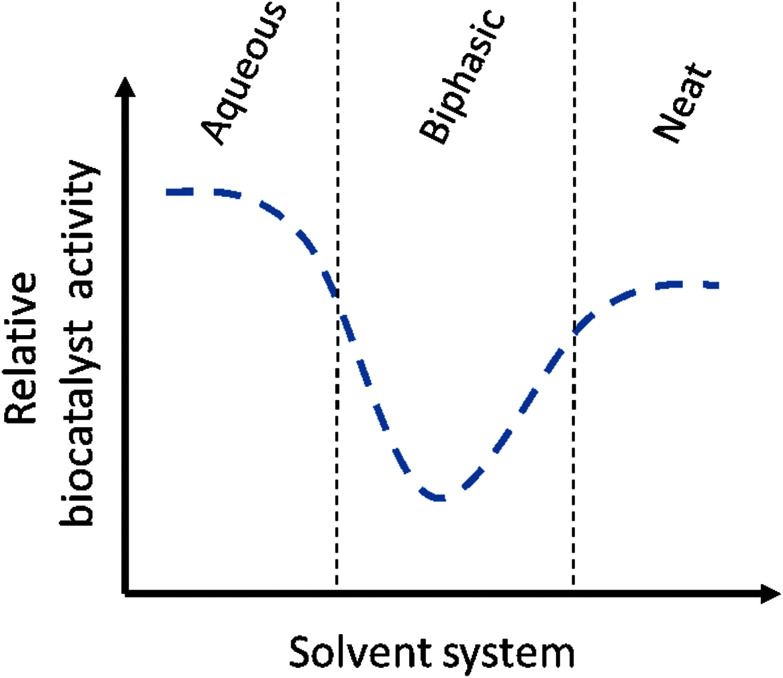
Fig. 2. Graphical representation of the activity of the transaminase on acetophenone and isopropylamine in different solvent systems from the example by Enzymaster. While the biocatalyst showed good activity in an aqueous buffer with cosolvent, only low conversions were observed when the pure substrate was added as a second phase. When the biocatalysts was introduced in a neat system however, an enhanced activity was determined again.
Fig. 3
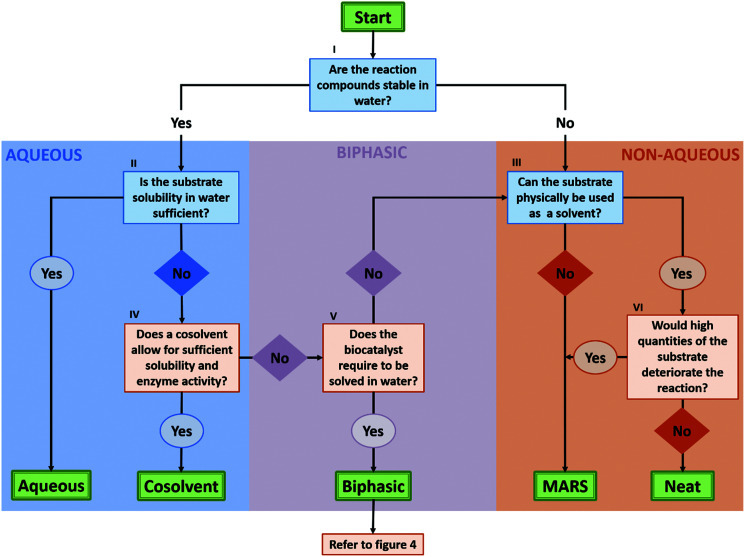
Fig. 3. Decision flow chart on which solvent system is suitable for a biocatalytic reaction. I: Some compounds, like lactones and esters, can hydrolyse in presence of water and require to be synthesized under non-aqueous conditions. II: This depends on what product concentrations are required to make the system economically viable and whether a fed-batch approach is a suitable reaction mode. III: This requires the substrate to be a liquid under reaction conditions with an appropriate viscosity. IV: In other words, will the addition of the required amount of cosolvents enable sufficient solubility of the substrate, while not hampering the enzyme performance and/or downstream processing significantly? As the amount and choice in cosolvent can significantly influence enzyme behaviour, it is advised to test different conditions in solvent type and concentration. V: Most free enzymes require to be solved in water to remain sufficiently active. If this is not the case, excluding water as the solvent might improve the system in respect to productivity and convenience in DSP. If the enzyme in question is not stable or active in an alternative solvent, a change in formulation can still enable the application of non-aqueous solvent systems. VI: Here, one should take into account the influences of the substrate on the biocatalyst, the reaction and DSP. For the biocatalyst, neat conditions can hamper the reaction if the compounds can act as strong inhibitors, or if the integrity of the protein or the whole cell catalyst is deteriorated. For the reaction, as for any other system, the actual (in this case high) concentration of compounds should not induce any side reactions. Finally, from a DSP point of view, the reaction components should conveniently be separable at the end of the reaction. This, as under neat conditions, the substrate concentration cannot be conveniently adjusted by substrate loading. In the likely case that full conversion is not reached, one ends up with a mixture of substrates and products.
Fig. 4
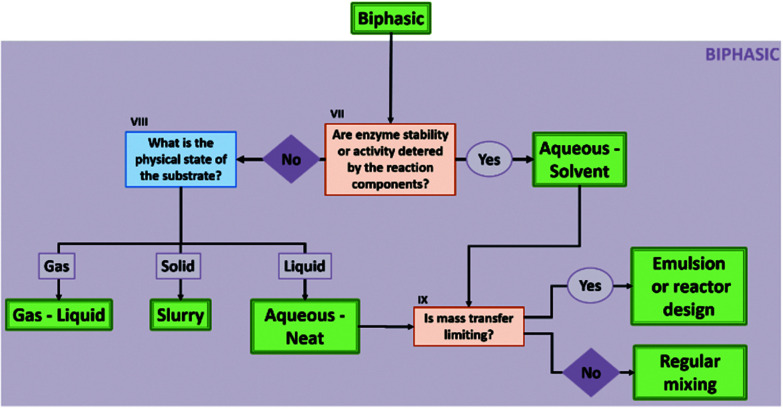
Fig. 4. Decision flow chart on which biphasic solvent system is suitable for a biocatalytic reaction. VII: This can happen if the substrate or product concentrations will accumulate in the aqueous phase to a point they will act as an inhibitor or will negatively influence the protein structure. If this is the case, a second phase is required to act as reservoir for the compounds and to decrease aqueous concentrations of the compounds. VIII: Also in the case of aqueous-neat reaction conditions, some cosolvents can be added to increase the substrate concentration in the aqueous phase, if beneficial for the reaction. IX: If the required biocatalytic rates are significantly higher than the mass transfer rates, the reaction is not working optimally and effort should be put in increasing these transfer rates. A convenient way to test if transfer rates are limiting, is to increase the biocatalyst concentration and check if the reaction rate is increasing accordingly.
Fig. 5
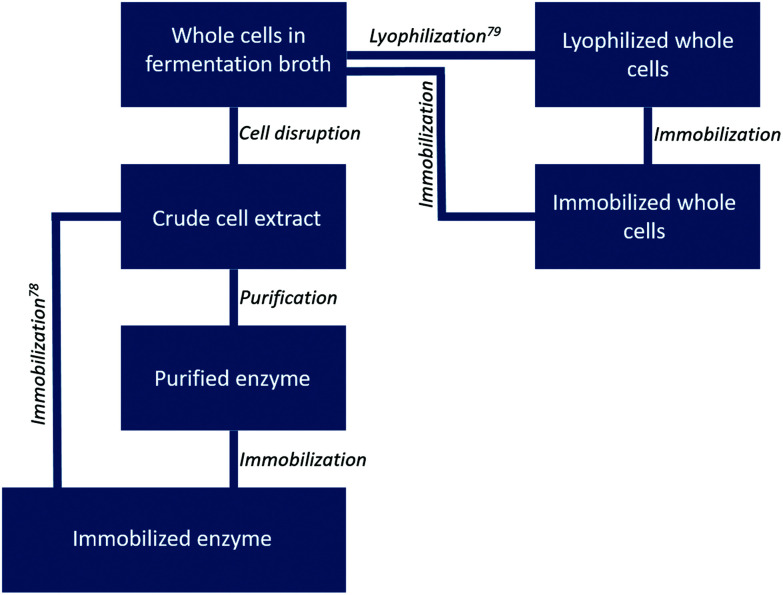
Fig. 5. Possible enzyme formulations and how they can be prepared from cultivated cells. Whole cells can be used directly as the catalyst, or be lyophilized or immobilized. Otherwise, cells can be disrupted to obtain cell free extract, which can be purified or (directly) immobilized.
None
Morten M. C. H. van Schie
None
Jan-Dirk Spöring
None
Marco Bocola
None
Pablo Domínguez de María
None
Dörte Rother

References

    1. Domínguez de María P. de Gonzalo G. Alcántara A. R. Catalysts. 2019;9:802. doi: 10.3390/catal9100802. - DOI
    1. Wu S. Snajdrova R. Moore J. C. Baldenius K. Bornscheuer U. Angew. Chem. 2020;60:88–119. doi: 10.1002/anie.202006648. - DOI - PMC - PubMed
    1. de Gonzalo G. and Domínguez de María P., Biocatalysis: An industrial perspective, Royal Society of Chemistry, 2017
    1. Bornscheuer U. T. Philos. Trans. R. Soc., A. 2018;376:20170063. doi: 10.1098/rsta.2017.0063. - DOI - PubMed
    1. Bornscheuer U. T. Huisman G. W. Kazlauskas R. J. Lutz S. Moore J. C. Robins K. Nature. 2012;485:185–194. doi: 10.1038/nature11117. - DOI - PubMed

LinkOut - more resources