


Navigating Hereditary Hearing Loss: Pathology of the Inner Ear
- PMID: 34093131
- PMCID: PMC8172992
- DOI: 10.3389/fncel.2021.660812
Navigating Hereditary Hearing Loss: Pathology of the Inner Ear
Abstract
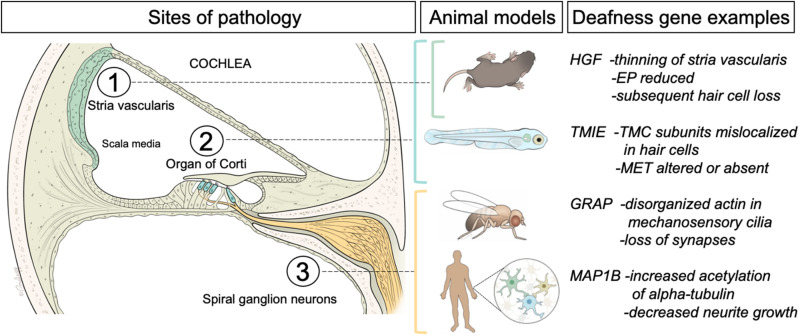
Inherited forms of deafness account for a sizable portion of hearing loss among children and adult populations. Many patients with sensorineural deficits have pathological manifestations in the peripheral auditory system, the inner ear. Within the hearing organ, the cochlea, most of the genetic forms of hearing loss involve defects in sensory detection and to some extent, signaling to the brain via the auditory cranial nerve. This review focuses on peripheral forms of hereditary hearing loss and how these impairments can be studied in diverse animal models or patient-derived cells with the ultimate goal of using the knowledge gained to understand the underlying biology and treat hearing loss.
Keywords: afferent neurons; cochlea; endolymph; hair cells; organ of corti; stria vascularis.
Copyright © 2021 Nicolson.
Conflict of interest statement
The author declares that the research was conducted in the absence of any commercial or financial relationships that could be construed as a potential conflict of interest.
Figures
References
-
- Chang Q., Wang J., Li Q., Kim Y., Zhou B., Wang Y., et al. (2015). Virally mediated Kcnq1 gene replacement therapy in the immature scala media restores hearing in a mouse model of human Jervell and Lange-Nielsen deafness syndrome. EMBO Mol. Med. 7 1077–1086. 10.15252/emmm.201404929 - DOI - PMC - PubMed
Publication types
Grants and funding
LinkOut - more resources
Full Text Sources
