


Cortical Contributions to Higher-Order Conditioning: A Review of Retrosplenial Cortex Function
- PMID: 34093148
- PMCID: PMC8170078
- DOI: 10.3389/fnbeh.2021.682426
Cortical Contributions to Higher-Order Conditioning: A Review of Retrosplenial Cortex Function
Abstract
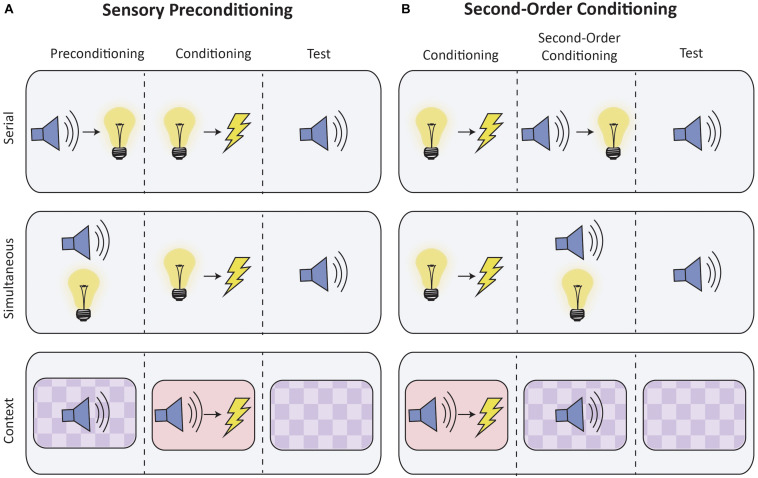
In higher-order conditioning paradigms, such as sensory preconditioning or second-order conditioning, discrete (e.g., phasic) or contextual (e.g., static) stimuli can gain the ability to elicit learned responses despite never being directly paired with reinforcement. The purpose of this mini-review is to examine the neuroanatomical basis of high-order conditioning, by selectively reviewing research that has examined the role of the retrosplenial cortex (RSC) in sensory preconditioning and second-order conditioning. For both forms of higher-order conditioning, we first discuss the types of associations that may occur and then review findings from RSC lesion/inactivation experiments. These experiments demonstrate a role for the RSC in sensory preconditioning, suggesting that this cortical region might contribute to higher-order conditioning via the encoding of neutral stimulus-stimulus associations. In addition, we address knowledge gaps, avenues for future research, and consider the contribution of the RSC to higher-order conditioning in relation to related brain structures.
Keywords: associative learning; higher-order conditioning; retrosplenial cortex; second-order conditioning; sensory preconditioning.
Copyright © 2021 Fournier, Cheng, Robinson and Todd.
Conflict of interest statement
The authors declare that this review was conducted in the absence of any commercial or financial relationships that could be construed as a potential conflict of interest.
Figures
References
-
- Brogden W. J. (1939). Sensory preconditioning. J. Exp. Psychol. 25 323–332.
-
- Buckner R. L., Snyder A. Z., Shannon B. J., LaRossa G., Sachs R., Fotenos A. F., et al. (2005). Molecular, structural, and functional characterization of Alzheimer’s disease: evidence for a relationship between default activity, amyloid, and memory. J. Neurosci. 25 7709–7717. 10.1523/jneurosci.2177-05.2005 - DOI - PMC - PubMed
Publication types
Grants and funding
LinkOut - more resources
Full Text Sources
