


COVID-19 mRNA Vaccines Are Generally Safe in the Short Term: A Vaccine Vigilance Real-World Study Says
- PMID: 34093567
- PMCID: PMC8177815
- DOI: 10.3389/fimmu.2021.669010
COVID-19 mRNA Vaccines Are Generally Safe in the Short Term: A Vaccine Vigilance Real-World Study Says
Abstract
Background: The prophylactic vaccination of COVID-19 mRNA vaccines is the first large-scale application of this kind in the human world. Over 1.8 million doses of the COVID-19 vaccine had been administered in the US until December 2020, and around 0.2% submitted AE reports to the Vaccine Adverse Event Reporting System (VAERS). This study aimed to evaluate the AEs following immunization (AEFIs) and analyze the potential associations based on the information from the VAERS database.
Methods: We searched the VAERS database recorded AEFIs after COVID-19 vaccines in December 2020. After data mapping, we summarized demographic and clinical features of reported cases. Fisher exact test was used to comparing the clinical characteristics among AE groups with an anaphylactic response, concerning neurological disorders and death.
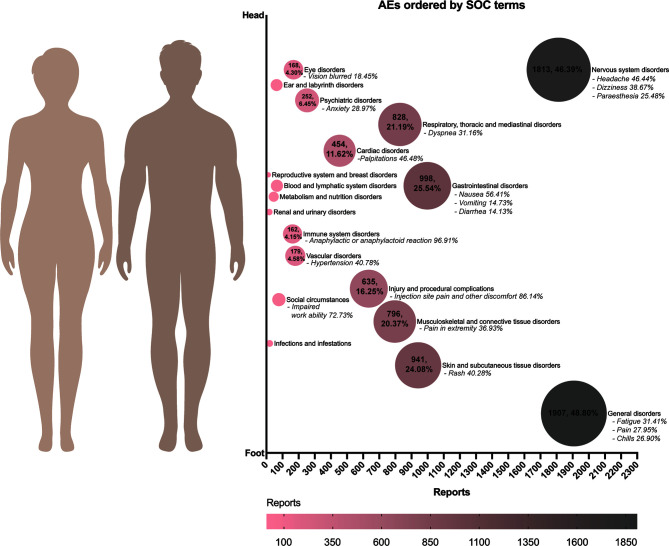
Results: VAERS reported 3,908 AEFIs of COVID-19 vaccines in December 2020. Most (79.68%) were reported after the first dose of the vaccine. Among the reported cases, we found that general disorders (48.80%), nervous system disorders (46.39%), and gastrointestinal disorders (25.54%) were the most common AEFIs. The allergy history was more frequent in vaccine recipients with anaphylactic reactions than those without (64.91% vs. 49.62%, OR = 1.88, P <0.017). History of anxiety or depression was more common in subjects reporting severe neurological AEFIs than those reporting other AEFIs (18.37% vs. 7.85%, OR = 2.64, P <0.017). Cases reporting death were significantly older (79.36 ± 10.41-year-old vs. 42.64 ± 12.55-year-old, P <0.01, 95% CI 29.30-44.15) and more likely experienced hypertension (50.00% vs. 11.42%, OR = 7.76, P <0.01) and neurological disorders (50.00% vs. 5.36%, OR = 17.65, P <0.01) than other vaccine recipients. The outpatient and emergency room visit rates were 11.92 and 22.42% for AEFIs, and 2.53% of cases needed hospitalization.
Conclusion: AEFIs of COVID-19 mRNA vaccines were generally non-severe local or systemic reactions. A prior allergy history is the risk factor for anaphylaxis, while a history of anxiety may link with severe neurological AEs. Such vaccine recipients need further evaluation and monitor.
Keywords: COVID-19; adverse event; mRNA; safety issue; vaccine.
Copyright © 2021 Chen, Li, Sun, Zhou, Yin, Zhao and Li.
Conflict of interest statement
The authors declare that the research was conducted in the absence of any commercial or financial relationships that could be construed as a potential conflict of interest.
Figures
References
-
- Centers for Disease Control and Prevention . COVID Data Tracker (2021). Available at: https://covid.cdc.gov/covid-data-tracker/#datatracker-home.
-
- World Health Organization . DRAFT Landscape of COVID-19 Candidate Vaccines (2021). Available at: https://www.who.int/publications/m/item/draft-landscape-of-covid-19-cand....
Publication types
MeSH terms
Substances
LinkOut - more resources
Full Text Sources
Medical
