. 2020 Aug 6;11(47):12737-12745.
doi: 10.1039/d0sc03348k.

Extraordinary electrochemical stability and extended polaron delocalization of ladder-type polyaniline-analogous polymers

Affiliations

Extraordinary electrochemical stability and extended polaron delocalization of ladder-type polyaniline-analogous polymers

Xiaozhou Ji et al. Chem Sci. .

Abstract

Electrochemical stability and delocalization of states critically impact the functions and practical applications of electronically active polymers. Incorporation of a ladder-type constitution into these polymers represents a promising strategy to enhance the aforementioned properties from a fundamental structural perspective. A series of ladder-type polyaniline-analogous polymers are designed as models to test this hypothesis and are synthesized through a facile and scalable route. Chemical and electrochemical interconversions between the fully oxidized pernigraniline state and the fully reduced leucoemeraldine state are both achieved in a highly reversible and robust manner. The protonated pernigraniline form of the ladder polymer exhibits unprecedented electrochemical stability under highly acidic and oxidative conditions, enabling the access of a near-infrared light-absorbing material with extended polaron delocalization in the solid-state. An electrochromic device composed of this ladder polymer shows distinct switching between UV- and near-infrared-absorbing states with a remarkable cyclability, meanwhile tolerating a wide operating window of 4 volts. Taken together, these results demonstrate the principle of employing a ladder-type backbone constitution to impart superior electrochemical properties into electronically active polymers.


Conflict of interest statement

There are no conflicts to declare.

Figures
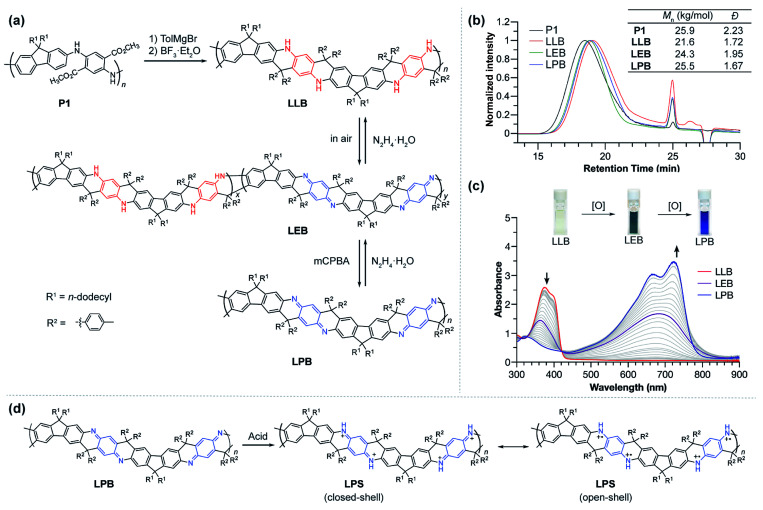
Fig. 1
Fig. 1. (a) Synthesis of LPANI from polymer precursor P1, and the redox interconversion of its LLB, LEB, and LPB forms. (b) Size exclusion chromatogram, calculated Mn, and polydispersity (Đ) values. (c) UV-vis spectra of the oxidation process from LLB to LEB to LPB in THF; (inset) photographic images of LLB, LEB and LPB solutions. (d) Protonation of LPB with MSA and structural formulae of the closed-shell and open-shell resonance forms of the protonated LPS form.
Fig. 2
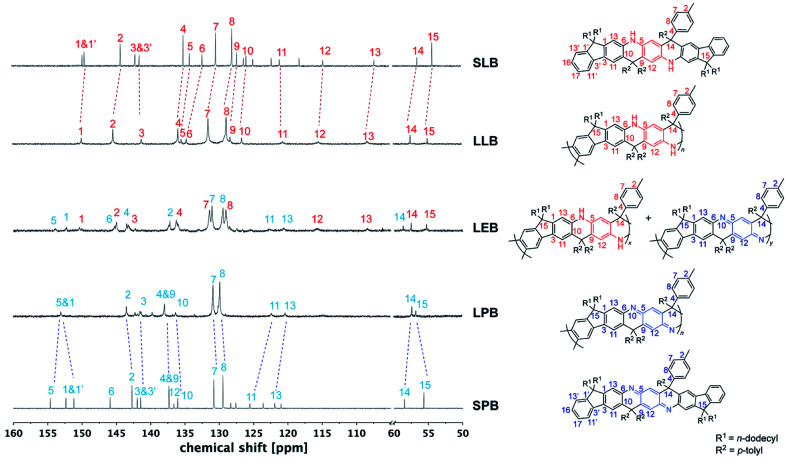
Fig. 2. 13C NMR spectra of small molecule model SLB and SPB, and varied oxidation states of LPANI (d8-THF at 298 K).
Fig. 3
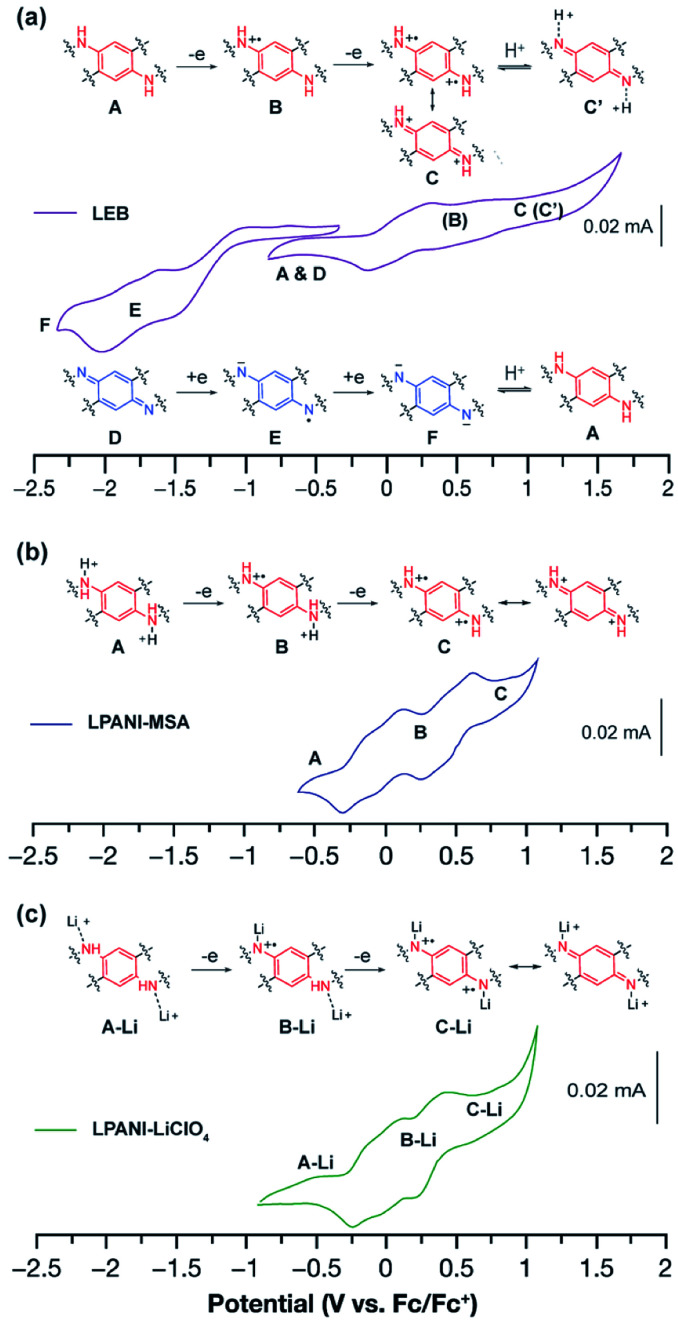
Fig. 3. Cyclic voltammograms of (a) the LEB film in acetonitrile with 0.1 mol L−1 TBAPF6. (b) LPANI solution in THF with 0.15 mol L−1 MSA. (c) LPANI solution in THF with 1.2 mol L−1 LiClO4. In all cases, a Pt wire was used as the counter electrode and Ag/AgCl was used as the reference electrode.
Fig. 4
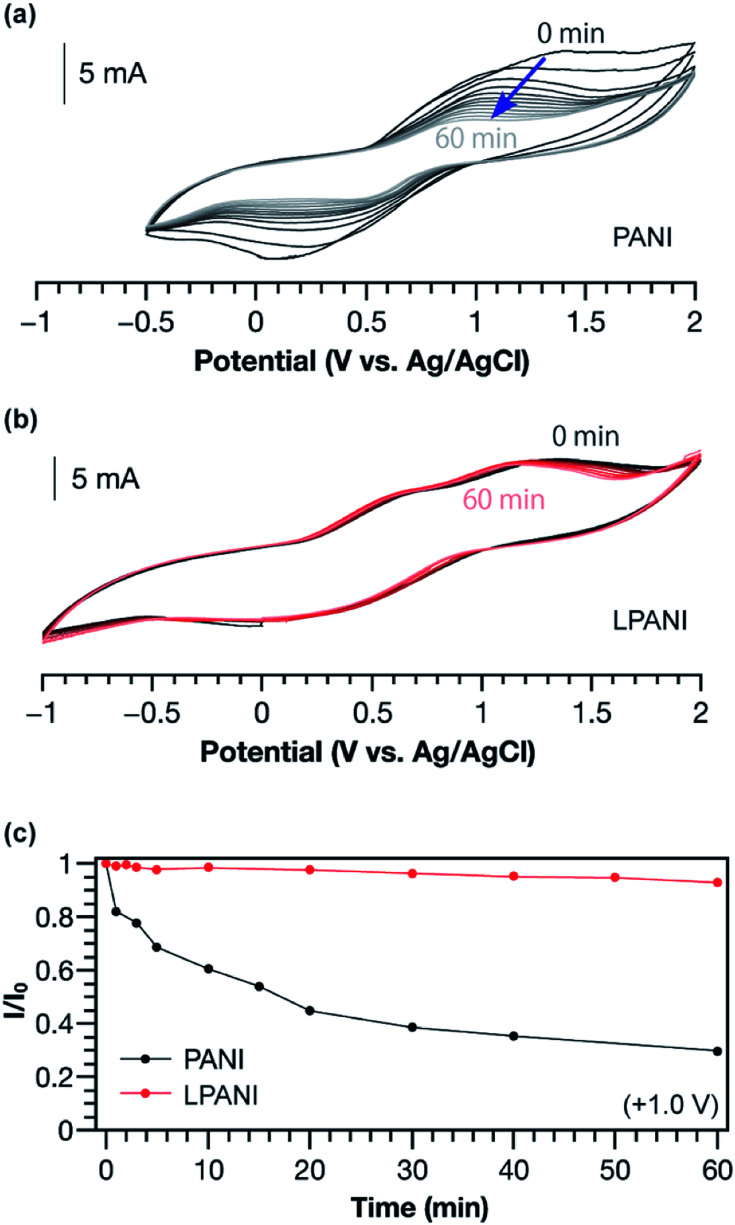
Fig. 4. Cyclic voltammograms of (a) conventional PANI and (b) LPANI after applying +1.0 V potential for a variable amount of time (0–60 min). (c) Plot of the current intensities in (a) and (b) vs. the time of holding at +1.0 V. The experiment was performed on working electrodes (conventional PANI or LPANI solid deposited on carbon fabric cloth) in acetonitrile with 0.5 mol L−1 sulfuric acid. A Pt wire was used as the counter electrode and Ag/AgCl was used as the reference electrode.
Fig. 5
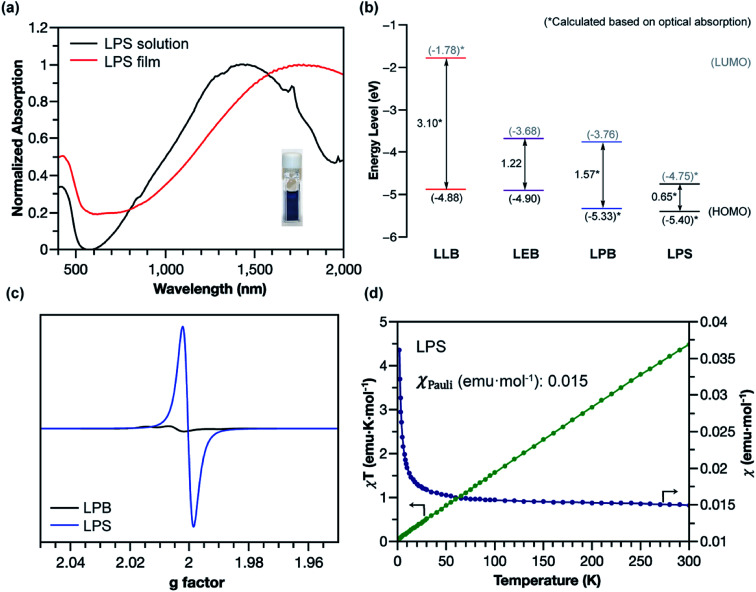
Fig. 5. (a) Visible-NIR absorption spectra of LPS in solution and in thin film. (b) HOMO/LUMO energy level diagrams of LLB, LEB, LPB, and LPS. (c) EPR spectra of LPB and the LPS solid. (d) Temperature-varied magnetic susceptibility of the LPS solid.
Fig. 6
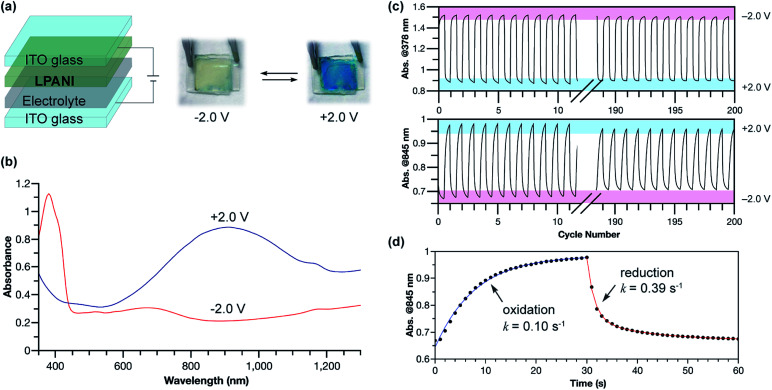
Fig. 6. (a) Architecture and photographic images of the electrochromic device at −2.0 V and +2.0 V, respectively. (b) Absorption spectra of the electrochromic device when applying −2.0 V or +2.0 V for 60 s. (c) Absorbance at 378 nm and 845 nm with voltage swept between −2.0 V and +2.0 V for 200 cycles. (d) Time-dependent absorbance changes at 845 nm; dots: experimental data spots; lines: pseudo-first-order fitting.

References

    1. Lee J. Kalin A. J. Yuan T. Al-Hashimi M. Fang L. Chem. Sci. 2017;8:2503–2521. doi: 10.1039/C7SC00154A. - DOI - PMC - PubMed
    1. Zhu C. Kalin A. J. Fang L. Acc. Chem. Res. 2019;52:1089–1100. doi: 10.1021/acs.accounts.9b00022. - DOI - PubMed
    1. Cai Z. Awais M. A. Zhang N. Yu L. Chem. 2018;4:2538–2570.
    1. Cai Z. Lo W.-Y. Zheng T. Li L. Zhang N. Hu Y. Yu L. J. Am. Chem. Soc. 2016;138:10630–10635. doi: 10.1021/jacs.6b05983. - DOI - PubMed
    1. Silverstein T. P. J. Chem. Educ. 2012;89:1159–1167. doi: 10.1021/ed1007712. - DOI