Review
. 2021 May 18:30:e00633.
doi: 10.1016/j.btre.2021.e00633. eCollection 2021 Jun.

Chemical diversity of dietary phytochemicals and their mode of chemoprevention

Affiliations
Review

Chemical diversity of dietary phytochemicals and their mode of chemoprevention

Srimanta Patra et al. Biotechnol Rep (Amst). .

Abstract

Despite the advancement in prognosis, diagnosis and treatment, cancer has emerged as the second leading cause of disease-associated death across the globe. With the remarkable application of synthetic drugs in cancer therapy and the onset of therapy-associated adverse effects, dietary phytochemicals have been materialized as potent anti-cancer drugs owing to their antioxidant, apoptosis and autophagy modulating activities. With dynamic regulation of apoptosis and autophagy in association with cell cycle regulation, inhibition in cellular proliferation, invasion and migration, dietary phytochemicals have emerged as potent anti-cancer pharmacophores. Dietary phytochemicals or their synthetic analogous as individual drug candidates or in combination with FDA approved chemotherapeutic drugs have exhibited potent anti-cancer efficacy. With the advancement in cancer therapeutics, dietary phytochemicals hold high prevalence for their use as precision and personalized medicine to replace conventional chemotherapeutic drugs. Hence, keeping these perspectives in mind, this review focuses on the diversity of dietary phytochemicals and their molecular mechanism of action in several cancer subtypes and tumor entities. Understanding the possible molecular key players involved, the use of dietary phytochemicals will thrive a new horizon in cancer therapy.

Keywords: Apoptosis; Autophagy; Cancer; Chemoprevention; Dietary phytochemical.


Conflict of interest statement

The authors have no conflicts of interest to disclose.

Figures
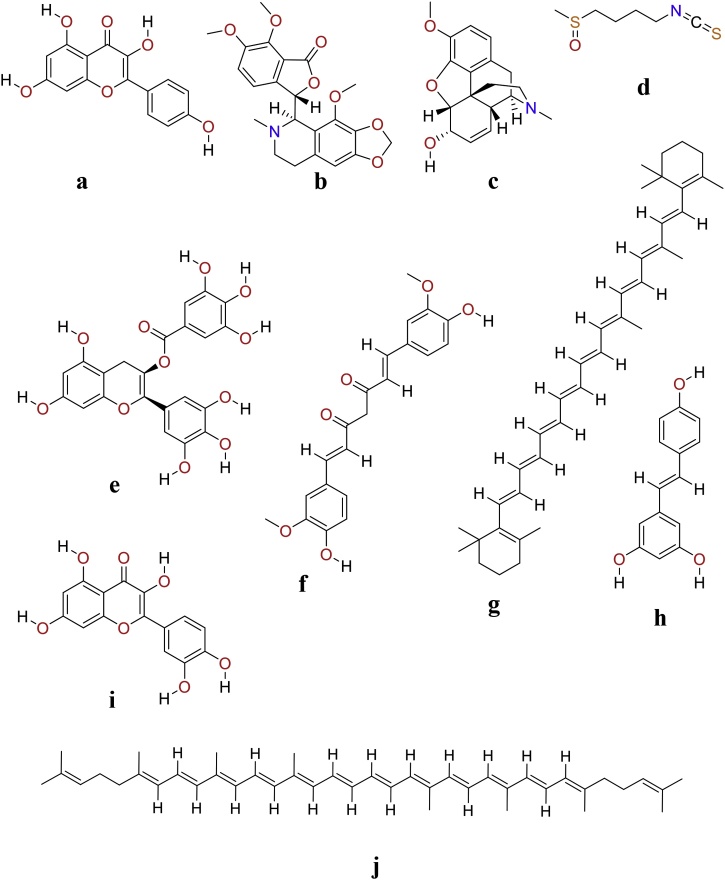
Fig. 1
Fig. 1
Chemical structure of chemo-preventive dietary phytochemicals. Kaempferol (a), Noscapine (b), Codeine (c), Sulforaphane (d), EGCG (e), Curcumin (f), β-carotene (g), Resveratrol (h), Quercetin (i) and Lycopene (j).
Fig. 2
Fig. 2
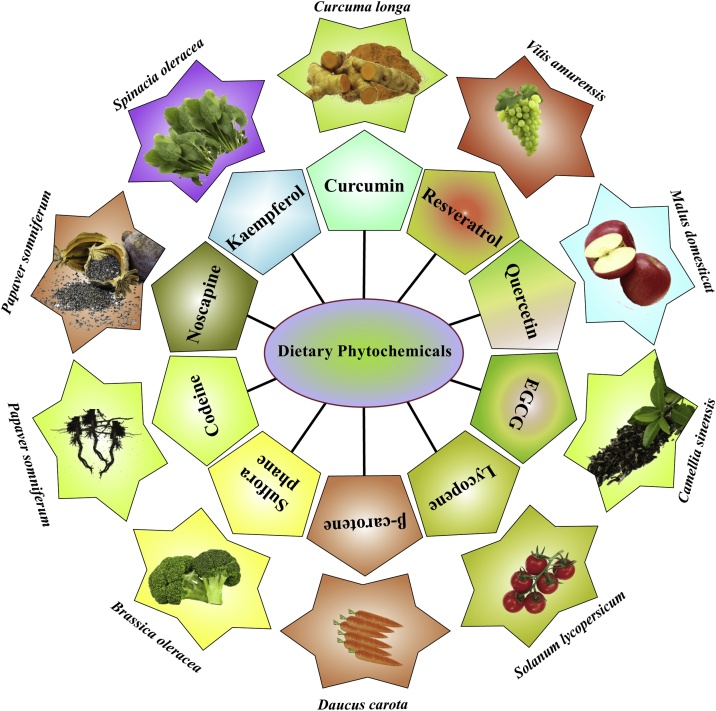
Dietary sources of chemo-preventive dietary phytochemicals. Dietary polyphenols, carotenoids, terpenoids, glucosinolates, organosulphides and nitrogen containing compounds exhibit potent chemo-preventive activity against several cancers. Dietary polyphenols such as curcumin, resveratrol, quercetin, kaempferol, EGCG and carotenoids like β-carotene and lycopene exhibit potent chemo-prevention. In addition to this, glucosinolates and organosulphides such as sulforaphane also demonstrate potent anti-cancer efficacy. Nitrogen containing compounds like codeine and noscapine also display potent anti-cancer efficacy in several cancer cells.
Fig. 3
Fig. 3
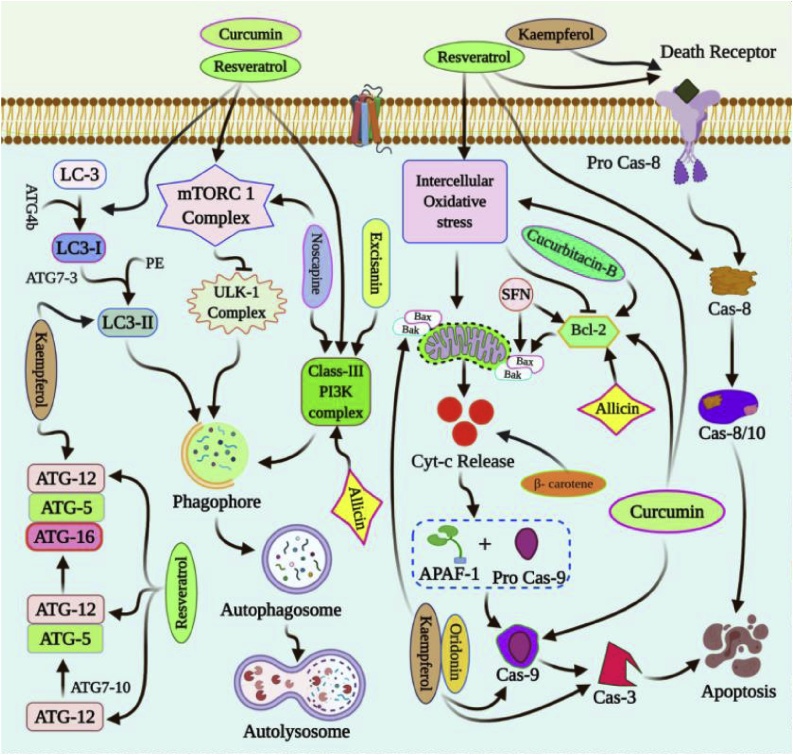
Molecular mechanisms of chemoprevention by dietary phytochemicals. Polyphenols like curcumin, resveratrol and noscapine regulate autophagic cell death via inhibition of mTORC1 signalling. Similarly, curcumin, resveratrol, noscapine, allicin, and excisanin activate the PI3K signalling for elongation of extending phagophore. Kaempferol, curcumin and resveratrol enhance the LC3 lipidation in the extending autophagosomes. Resveratrol enhances the expression of ATG-5 and ATG-12. Similarly, kaempferol and resveratrol also regulate the ATG-16 formation from ATG-5 and ATG-12. Curcumin, resveratrol and kaempferol enhance the Bax/Bcl-2 expression to regulate apoptosis. In addition to this, kaempferol, oridonin and curcumin upregulate the caspase cascades responsible for the onset of apoptosis. Oridonin regulates the expression of caspase 3 and caspase 9 while cucurbitacin B and allicin regulate the Bcl-2 expression for induction of apoptotic cell death. Sulforaphane also alters the apoptotic signal through upregulation of Bax and downregulation of Bcl-2. β-carotene enhances the release of cytochrome C to mediate mitochondrial apoptosis. Resveratrol enhances the expression of caspase 8 during the onset of extrinsic apoptosis while kaempferol elicits the death receptors that are responsible for extrinsic apoptosis.

References

    1. Bray F., Ferlay J., Soerjomataram I., Siegel R.L., Torre L.A., Jemal A. Global cancer statistics 2018: GLOBOCAN estimates of incidence and mortality worldwide for 36 cancers in 185 countries. CA Cancer J. Clin. 2018;68:394–424. - PubMed
    1. Jemal A., Bray F., Center M.M., Ferlay J., Ward E., Forman D. Global cancer statistics. CA Cancer J. Clin. 2011;61:69–90. - PubMed
    1. Nounou M.I., ElAmrawy F., Ahmed N., Abdelraouf K., Goda S., Syed-Sha-Qhattal H. Breast cancer: conventional diagnosis and treatment modalities and recent patents and technologies. Breast Cancer Basic Clin. Res. 2015;9 BCBCR. - PMC - PubMed
    1. Tatum J.L. Hypoxia: importance in tumor biology, noninvasive measurement by imaging, and value of its measurement in the management of cancer therapy. Int. J. Radiat. Biol. 2006;82:699–757. - PubMed
    1. Law B.Y.K., Mok S.W.F., Wu A.G., Lam C.W.K., Yu M.X.Y., Wong V.K.W. New potential pharmacological functions of Chinese herbal medicines via regulation of autophagy. Molecules. 2016;21:359. - PMC - PubMed

LinkOut - more resources