Dyslipidemia Fact Sheets in Korea 2020: an Analysis of Nationwide Population-based Data
- PMID: 34095012
- PMCID: PMC8159761
- DOI: 10.12997/jla.2021.10.2.202
Dyslipidemia Fact Sheets in Korea 2020: an Analysis of Nationwide Population-based Data
Abstract
Objective: The Korean Society of Lipid and Atherosclerosis (KSoLA) has published the Dyslipidemia Fact Sheets in Korea 2020 to provide an overview of magnitude and management status of dyslipidemia and their recent trends therein.
Methods: The Fact Sheets were based on the analyses of Korean adults aged 20 years or older of the 2007-2018 Korea National Health and Nutrition Examination Survey (KNHANES) and the 2002-2018 National Health Insurance Big Data (NHI-BD).
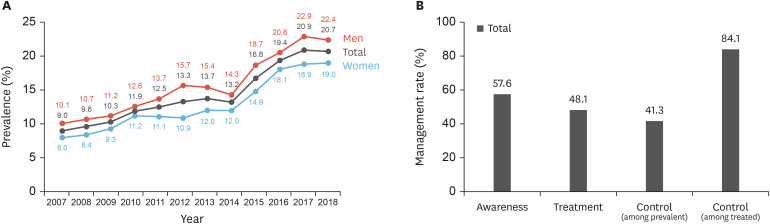
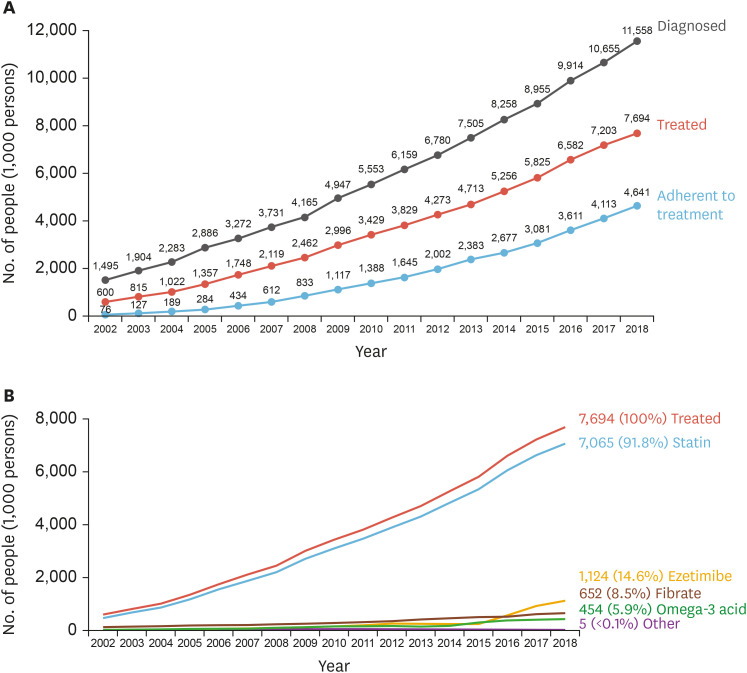
Results: Between 2007 and 2018, the crude prevalence of hypercholesterolemia increased from 9.0% to 20.7%. During the same period, its management rate also improved yet remained unsatisfactory. In 2018, the prevalence of dyslipidemia was 45.6% in men and 31.3% in women, which increased with older age and presence of metabolic abnormalities. Indeed, the number of people diagnosed with dyslipidemia has increased nearly 8-fold from 1.5 million in 2002 to 11.6 million in 2018; alongside, the number of people receiving pharmacological treatment for dyslipidemia has also risen. Of the 7.7 million people treated for dyslipidemia in 2018, statin accounted for the majority (91.8%) of lipid-lowering drug prescriptions, followed by ezetimibe (14.6%), fibrate (8.5%), and omega-3 acid (5.9%). The most frequently used combination therapy was statin plus ezetimibe, accounting for 72% of dual therapy prescriptions.
Conclusion: Dyslipidemia continues to impose a substantial disease burden in Korea. Both healthcare practitioners and patients need to actively adopt guideline-recommended lifestyle modification and pharmacological treatment for comprehensive, timely, and sustained management.
Keywords: Dyslipidemias; Hypercholesterolemia; Korea; Lipids.
Copyright © 2021 The Korean Society of Lipid and Atherosclerosis.
Conflict of interest statement
Conflict of Interest: The authors have no conflict of interest to declare.
Figures

References
-
- GBD 2017 Risk Factor Collaborators. Global, regional, and national comparative risk assessment of 84 behavioural, environmental and occupational, and metabolic risks or clusters of risks for 195 countries and territories, 1990-2017: a systematic analysis for the Global Burden of Disease Study 2017. Lancet. 2018;392:1923–1994. - PMC - PubMed
-
- Roth GA, Nguyen G, Forouzanfar MH, Mokdad AH, Naghavi M, Murray CJ. Estimates of global and regional premature cardiovascular mortality in 2025. Circulation. 2015;132:1270–1282. - PubMed
-
- Arnett DK, Blumenthal RS, Albert MA, Buroker AB, Goldberger ZD, Hahn EJ, et al. 2019 ACC/AHA guideline on the primary prevention of cardiovascular disease: executive summary: a report of the American College of Cardiology/American Heart Association Task Force on Clinical Practice Guidelines. Circulation. 2019;140:e563–e595. - PMC - PubMed
LinkOut - more resources
Full Text Sources