


Human Chr18 transcriptome dataset combined from the Illumina HiSeq, ONT MinION, and qPCR data
- PMID: 34095379
- PMCID: PMC8166769
- DOI: 10.1016/j.dib.2021.107130
Human Chr18 transcriptome dataset combined from the Illumina HiSeq, ONT MinION, and qPCR data
Abstract
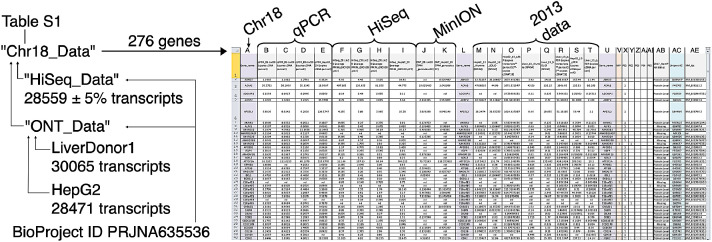
The chromosome-centric dataset was created by applying several technologies of transcriptome profiling. The described dataset is available at NCBI repository (BioProject ID PRJNA635536). The dataset referred to the same type of tissue, cell lines, transcriptome sequencing technologies, and was accomplished in a period of 8 years (the first data were obtained in 2013 while the last ones - in 2020). The high-throughput sequencing technologies were employed along with the quantitative PCR (qPCR) approach, for data generation using the gene expression level assessment. qPCR was performed for a limited group of genes, encoded on human chromosome 18, for the Russian part of the Chromosome-Centric Human Proteome Project. The data of high-throughput sequencing are provided as Excel spreadsheets, where the data on FPKM and TMP values were evaluated for the whole transcriptome with both Illumina HiSeq and Oxford Nanopore Technologies MinION sequencing.
Keywords: HepG2; Human proteome project; Illumina HiSeq; Liver tissue; Oxford nanopore Technologies; Transcriptome.
© 2021 The Author(s). Published by Elsevier Inc.
Conflict of interest statement
The authors declare that they have no known competing financial interests or personal relationships which have or could be perceived to have influenced the work reported in this article.
Figures
References
-
- Zgoda V.G., Kopylov A.T., Tikhonova O.V., Moisa A.A., Pyndyk N.V., Farafonova T.E., Novikova S.E., Lisitsa A.V., Ponomarenko E.A., Poverennaya E.V., Radko S.P., Khmeleva S.A., Kurbatov L.K., Filimonov A.D., Bogolyubova N.A., Ilgisonis E.V., Chernobrovkin A.L., Ivanov A.S., Medvedev A.E., Mezentsev Y.V., Moshkovskii S.A., Naryzhny S.N., Ilina E.N., Kostrjukova E.S., Alexeev D.G., Tyakht A.V., Govorun V.M., Archakov A.I. Chromosome 18 transcriptome profiling and targeted proteome mapping in depleted plasma, liver tissue and HepG2 cells. J. Proteome Res. 2013;12:123–134. doi: 10.1021/pr300821n. - DOI - PubMed
-
- Ponomarenko E.A., Kopylov A.T., Lisitsa A.V., Radko S.P., Kiseleva Y.Y., Kurbatov L.K., Ptitsyn K.G., Tikhonova O.V., Moisa A.A., Novikova S.E., Poverennaya E.V., Ilgisonis E.V., Filimonov A.D., Bogolubova N.A., Averchuk V.V., Karalkin P.A., Vakhrushev I.V., Yarygin K.N., Moshkovskii S.A., Zgoda V.G., Sokolov A.S., Mazur A.M., Prokhortchouck E.B., Skryabin K.G., Ilina E.N., Kostrjukova E.S., Alexeev D.G., Tyakht A.V., Gorbachev A.Y., Govorun V.M., Archakov A.I. Chromosome 18 transcriptoproteome of liver tissue and HepG2 Cells and targeted proteome mapping in depleted plasma: update 2013. J. Proteome Res. 2014;13:183–190. doi: 10.1021/pr400883x. - DOI - PubMed
-
- Riedel G., Rüdrich U., Fekete-Drimusz N., Manns M.P., Vondran F.W.R., Bock M. An extended ΔCT-method facilitating normalisation with multiple reference genes suited for quantitative RT-PCR analyses of human hepatocyte-like cells. PLoS ONE. 2014;9:e93031. doi: 10.1371/journal.pone.0093031. - DOI - PMC - PubMed
LinkOut - more resources
Full Text Sources
