


Activity Levels in Survivors of the Intensive Care Unit
- PMID: 34097055
- PMCID: PMC8418209
- DOI: 10.1093/ptj/pzab135
Activity Levels in Survivors of the Intensive Care Unit
Abstract
Objective: Limited data exist on the quantification of activity levels and functional status in critically ill patients as they transition from the intensive care unit (ICU) to the wards and, subsequently, back into the community. The physical activity of critically ill patients from their ICU stay until 7 days after hospital discharge was characterized, as well as correlate physical activity levels with an objective measure of physical function.
Methods: This prospective observational study of previously independent adults aged 55 or older, undergoing mechanical ventilation for up to 7 days, recruited participants at the time of spontaneous breathing trials or less than 24 hours after extubation. Participants received an accelerometer at enrollment to wear until 1 week after discharge.
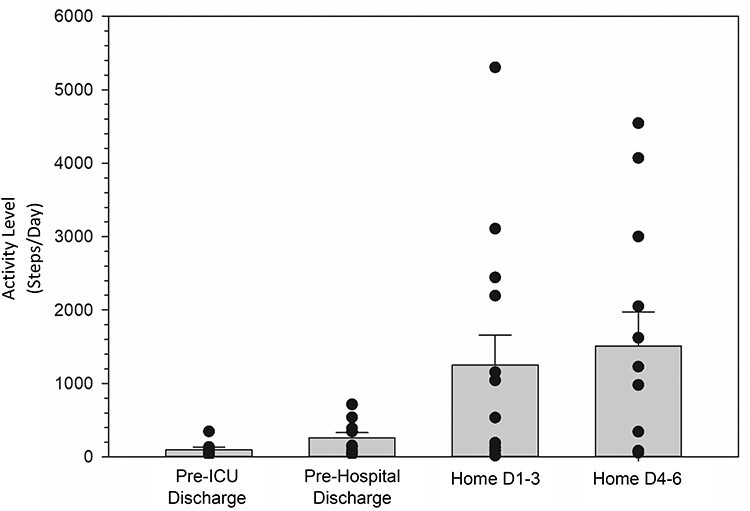
Results: Twenty-two participants received accelerometers; 15 were suitable for analysis. Participants had a mean (SD) age of 68 (9.6) years; 47% were female. Mean step counts were 95 (95% CI = 15-173) in the 3 days before ICU discharge, 257 (95% CI = 114-400) before hospital discharge, 1223 (95% CI = 376-2070) in the first 3 days at home, and 1278 (95% CI = 349-2207) between day 4 and 6 post-hospital discharge. Physical activity was significantly higher post- compared with pre-hospital discharge. Short Physical Performance Battery scores were poor at ICU and hospital discharge; however, they correlated moderately with physical activity levels immediately upon return home.
Conclusions: Physical activity remained low as survivors of critical illness transitioned from ICU to hospital wards, but significantly increased upon return to the community. Despite poor Short Physical Performance Battery scores at both ICU and hospital discharge, participants were significantly more active immediately after discharge than in their last 3 days of hospitalization. This may represent rapid functional improvement or, conversely, constrained physical activity in hospital.
Impact: This study highlights the need for further evaluation of physical activity constraints in hospital and ways to augment physical activity and function upon discharge.
Lay summary: Physical activity (step counts) increased modestly as survivors of critical illness transitioned from ICU to hospital wards, but significantly increased upon return to the community. This study highlights the need for further evaluation of physical activity constraints in the hospital setting and ways to augment physical activity and function postdischarge.
Trial registration: ClinicalTrials.gov NCT02293616.
Keywords: Critical Illness; Early Mobility; ICU Outcomes; Intensive Care Unit; Mechanical Ventilation; Skeletal Muscle.
© The Author(s) 2021. Published by Oxford University Press on behalf of the American Physical Therapy Association. All rights reserved. For permissions, please email: journals.permissions@oup.com.
Figures
References
-
- Baldwin C, van Kessel G, Phillips A, Johnston K. Accelerometry shows inpatients with acute medical or surgical conditions spend little time upright and are highly sedentary: systematic review. Phys Ther. 2017;97:1044–1065. - PubMed
-
- Berney SC, Rose JW, Bernhardt J, Denehy L. Prospective observation of physical activity in critically ill patients who were intubated for more than 48 hours. J Crit Care. 2015;30:658–663. - PubMed
-
- Allen C, Glasziou P, Del Mar C. Bed rest: a potentially harmful treatment needing more careful evaluation. Lancet. 1999;354:1229–1233. - PubMed
Publication types
MeSH terms
Associated data
Grants and funding
LinkOut - more resources
Full Text Sources
Medical
