


The Cortisol and ACTH Response to Dex/CRH Testing in Women With and Without Perimenopausal Depression
- PMID: 34097071
- PMCID: PMC8475231
- DOI: 10.1210/clinem/dgab407
The Cortisol and ACTH Response to Dex/CRH Testing in Women With and Without Perimenopausal Depression
Erratum in
-
Corrigendum to: The Cortisol and ACTH Response to Dex/CRH Testing in Women With and Without Perimenopausal Depression.J Clin Endocrinol Metab. 2022 May 17;107(6):e2657. doi: 10.1210/clinem/dgac061. J Clin Endocrinol Metab. 2022. PMID: 35171269 Free PMC article. No abstract available.
Abstract
Context: Abnormalities in the hypothalamic-pituitary-adrenal (HPA) axis are frequent accompaniments of depression, and studies have documented the role of stress and stressful life events in the ontogeny of perimenopausal depressions (PMD). Because HPA axis function in women is further modulated both by aging and ovarian steroids, it is possible that a dysregulated HPA axis contributes to the increased risk of PMD.
Objective: We examined HPA axis function in perimenopausal women with and without depression using the combined dexamethasone-corticotropin-releasing hormone (Dex/CRH) test.
Methods: Dex/CRH tests were performed on 20 women with PMD and 20 women who were also perimenopausal but without current or past depression (control women). Main outcome measures were plasma levels of cortisol and adrenocorticotropin (ACTH) and 24-hour urinary free cortisol (UFC). Five women took chronic stable medications, otherwise all women were medically healthy, and both groups were comparable with respect to reproductive stage and age. Standardized symptom rating scales were administered to each woman prior to Dex/CRH testing.
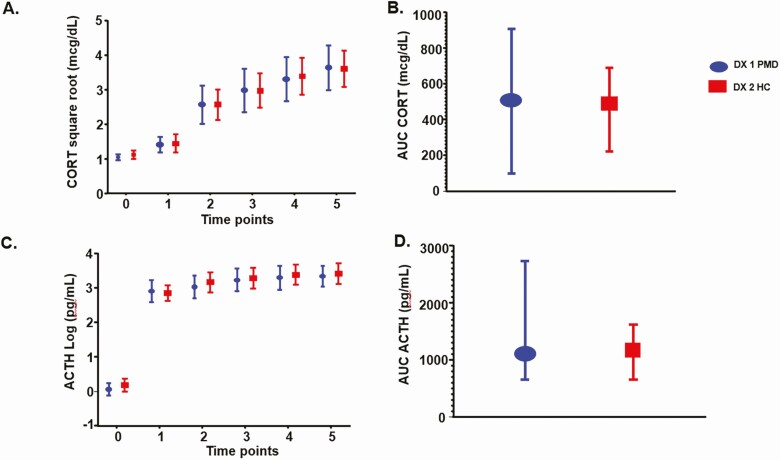
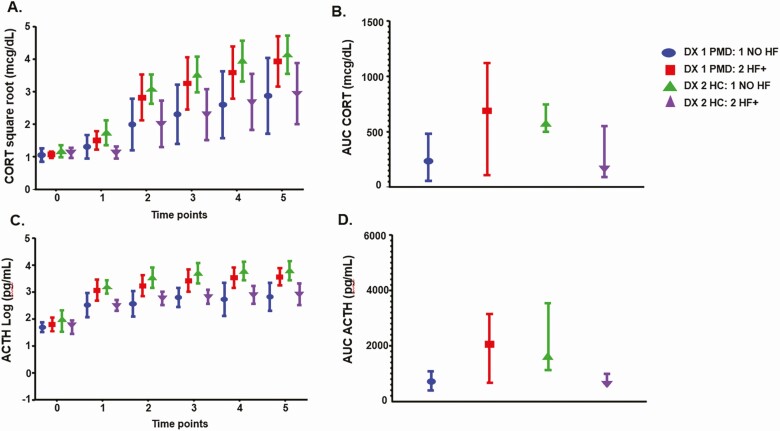
Results: No group differences were present in either baseline or stimulated ACTH and cortisol secretion. Baseline plasma measures of estradiol, progesterone, and 24-hour UFC levels similarly did not differ in PMD and control women.
Conclusion: Despite reports of increased stress responsiveness in PMD, we observed no abnormalities of HPA axis activity associated with PMD compared with women without depression. These findings suggest that PMD is not uniformly associated with HPA dysregulation and could reflect underlying pathophysiologic processes that are distinct from women with nonreproductive-related depressions.
Trial registration: ClinicalTrials.gov NCT00001231.
Keywords: ACTH; Dex/CRH test; cortisol; depression; perimenopause.
Published by Oxford University Press on behalf of the Endocrine Society 2021.
Figures
References
-
- Freeman EW, Sammel MD, Liu L, Gracia CR, Nelson DB, Hollander L. Hormones and menopausal status as predictors of depression in women in transition to menopause. Arch Gen Psychiatry. 2004;61(1):62-70. - PubMed
-
- Cohen LS, Soares CN, Vitonis AF, Otto MW, Harlow BL. Risk for new onset of depression during the menopausal transition: the Harvard Study of Moods and Cycles. Arch Gen Psychiatry. 2006;63(4):385-390. - PubMed
-
- Freeman EW, Sammel MD, Lin H, Nelson DB. Associations of hormones and menopausal status with depressed mood in women with no history of depression. Arch Gen Psychiatry. 2006;63(4):375-382. - PubMed
Publication types
MeSH terms
Substances
Associated data
Grants and funding
LinkOut - more resources
Full Text Sources
Medical
Miscellaneous
