


3D Biomechanics of Rugby Tackle Techniques to Inform Future Rugby Research Practice: a Systematic Review
- PMID: 34097146
- PMCID: PMC8184906
- DOI: 10.1186/s40798-021-00322-w
3D Biomechanics of Rugby Tackle Techniques to Inform Future Rugby Research Practice: a Systematic Review
Abstract
Background: The tackle is the most common in-play event in rugby union and rugby league (the rugby codes). It is also associated with the greatest propensity for injury and thus accounts for the most injuries in the sport. It is therefore of critical importance to accurately quantify how tackle technique alters injury risk using gold-standard methodology of three-dimensional motion (3D) capture.
Objective: To examine the 3D motion capture methodology of rugby-style tackle techniques to provide recommendations to inform practice for future rugby code research and advance the knowledge of this field.
Study design: Systematic review.
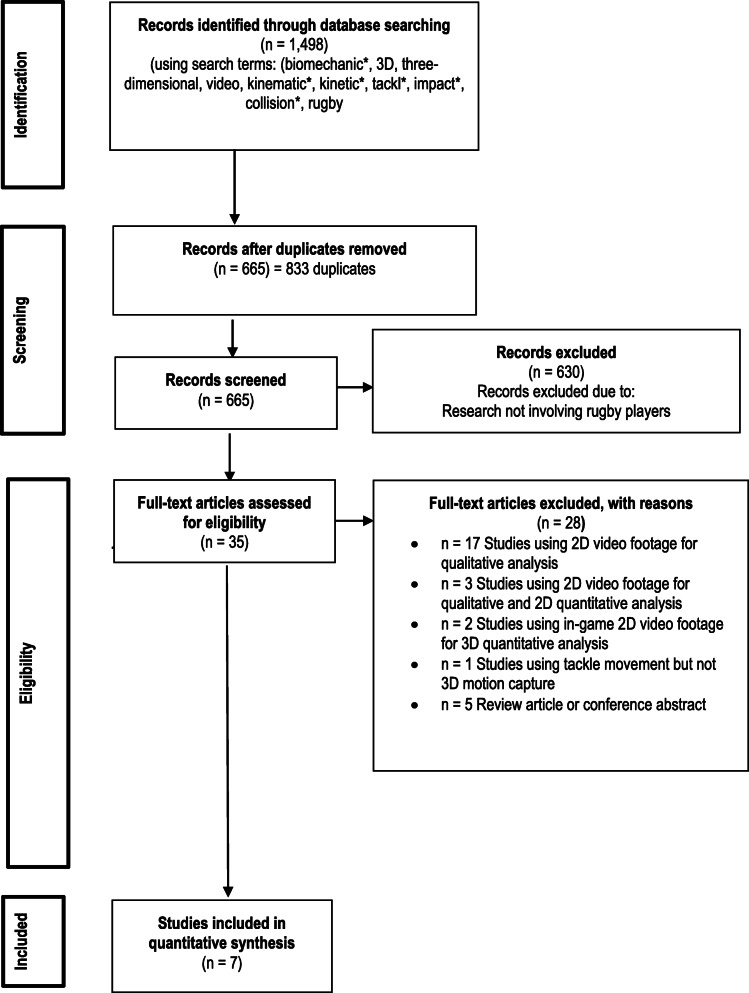
Methods: Articles published in English language, up to May 2020, were retrieved via nine online databases. All cross-sectional, correlational, observational, and cohort study designs using 3D motion capture of tackle techniques in rugby code players met inclusion criteria for this review. A qualitative synthesis using thematic analysis was pre-specified to identify five key themes.
Results: Seven articles met eligibility criteria. Participant demographic information (theme one) involved a total of 92 rugby union players, ranging in skill level and playing experience. Experimental task design information (theme two) included one-on-one, front-on (n=5) or side-on (n=1) contact between a tackler and a ball carrier, or a tackler impacting a tackle bag or bump pad (n=3). 3D data collection (theme three) reported differing sampling frequencies and marker sets. 3D data reduction and analysis (theme four) procedures could be mostly replicated, but the definitions of temporal events, joint modelling and filtering varied between studies. Findings of the studies (theme five) showed that the one-on-one tackle technique can be altered (n=5) when tackle height, leg drive and/or tackle speed is modified. A study reported tackle coaching intervention.
Conclusions: This is the first review to evaluate 3D motion capture of rugby-style tackle technique research. A research framework was identified: (i) participant demographic information, (ii) experimental task design information, (iii) 3D motion capture data specifications, and (iv) 3D data reduction and analysis. Adherence of future 3D tackling research to these framework principles will provide critical scientific evidence to better inform injury reduction and performance practices in the rugby codes.
Trial registration: The review was registered with PROSPERO (registration number CRD42018092312 ).
Keywords: 3D motion capture; Rugby league; Rugby union; Systematic review; Tackle technique.
Conflict of interest statement
The authors, Suzi Edwards, Gordon Fuller, Matthew Buchanan, Roger Lee, Timana Tahu, Ross Tucker, and Andrew Gardner, declare that they have no competing interest. Andrew Gardner, Ph.D. serves as a scientific advisor for hitIQ, Ltd. He has a clinical practice in neuropsychology involving individuals who have sustained sport-related concussion (including current and former athletes). He has been a contracted concussion consultant to Rugby Australia (2016–2020). He has received travel funding or been reimbursed by professional sporting bodies, and commercial organisations for discussing or presenting sport-related concussion research at meetings, scientific conferences, workshops and symposiums. He has received research funding from the National Rugby League (NRL) for the Retired Professional Rugby League Players Brain Health Research Program. Previous grant funding includes the NSW Sporting Injuries Committee, the Brain Foundation (Australia), an Australian-American Fulbright Commission Postdoctoral Award, a Hunter New England Local Health District, Research, Innovation and Partnerships Health Research & Translation Centre and Clinical Research Fellowship Scheme, and the Hunter Medical Research Institute (HMRI), supported by Jennie Thomas, and the HMRI, supported by Anne Greaves. Ross Tucker is a research consultant to World Rugby (Pty) Ltd, the governing body for Rugby Union globally. Timana Tahu is an employee of the National Rugby League as a transitional officer working with Indigenous students.
Figures
References
-
- Rugby W. Global rugby participation. 2017.
-
- League NR . Stats Players: NRL Telstra Premiership 2020 Tackles. 2020.
Publication types
LinkOut - more resources
Full Text Sources
Miscellaneous
