


How are OCD Patients and Family Members Dealing with the Waxing and Waning Pattern of the COVID-19 Pandemic? Results of a Longitudinal Observational Study
- PMID: 34097247
- PMCID: PMC8182341
- DOI: 10.1007/s11126-021-09932-9
How are OCD Patients and Family Members Dealing with the Waxing and Waning Pattern of the COVID-19 Pandemic? Results of a Longitudinal Observational Study
Abstract
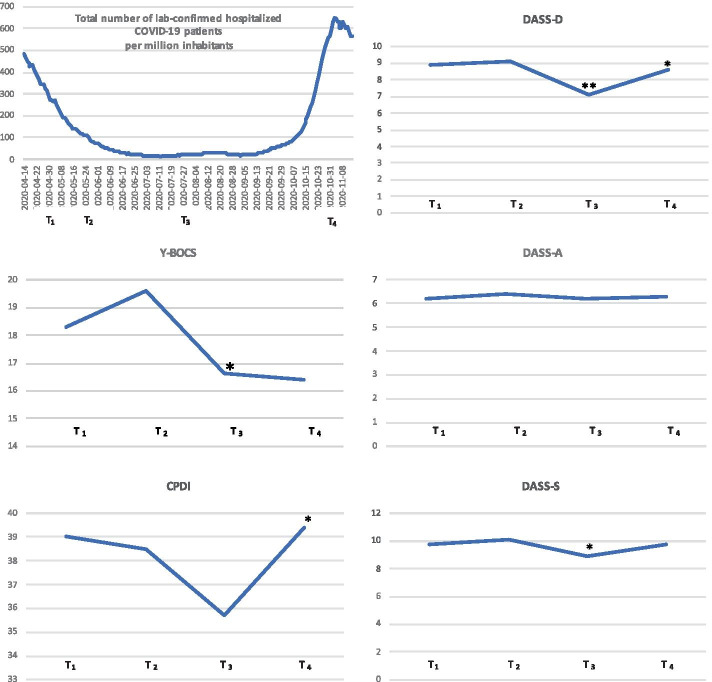
The current study aimed to investigate the impact of the COVID-19 pandemic on the mental health of people with OCD and the degree of family accommodation (FA) by live-in family members across phases of the lockdown measures imposed by the Belgian government. Forty-nine OCD patients and 26 live-in family members participated in the study. We assessed OCD symptom severity and FA of the live-in family members, as well as depressive symptoms, anxiety and stress levels and COVID-19 related psychological distress of patients and family members at four different timepoints: one month after the start of the lockdown (T1), during the gradual relaxation (T2), between the two waves (T3) and during the second wave (T4). Results showed that although COVID-19 related stress increased and decreased in accordance with the waxing and waning pattern of the pandemic, OCD symptoms showed an initial slight increase followed by a decrease at T3 and again at T4. Changes in family members' accommodation of symptoms followed the same course as the OCD symptoms. Furthermore, OCD symptoms correlated with depressive symptoms, anxiety and stress levels and COVID-19 related distress at all timepoints. It is important to involve family members in the treatment of OCD even during a pandemic. Clinicians should also pay attention to symptoms of depression, anxiety and stress during OCD treatment. Further research is necessary to entangle the causal relationship between OCD symptoms, FA and symptoms of depression, anxiety and stress.
Keywords: COVID-19; Family accommodation; OCD; Obsessive-compulsive disorder; Pandemic.
© 2021. The Author(s), under exclusive licence to Springer Science+Business Media, LLC, part of Springer Nature.
Conflict of interest statement
EDJ reports non-financial support from Pfizer and non-financial support from PharmaMar, all outside the submitted work and institutional (not personal). All other authors declare that they have no conflicts of interest.
Figures
References
-
- Pan KY, Kok AAL, Eikelenboom M, Horsfall M, Jörg F, Luteijn RA, Penninx BWJH. The mental health impact of the COVID-19 pandemic on people with and without depressive, anxiety, or obsessive-compulsive disorders: a longitudinal study of three Dutch case-control cohorts. The Lancet Psychiatry. 2021 doi: 10.1016/S2215-0366(20)30491-0. - DOI - PMC - PubMed
-
- Khosravani V, Aardema F, Ardestani SMS, Sharifi Bastan F. The impact of the coronavirus pandemic on specific symptom dimensions and severity in OCD: A comparison before and during COVID-19 in the context of stress responses. Journal of Obsessive-Compulsive and Related Disorders. 2021 doi: 10.1016/j.jocrd.2021.100626. - DOI - PMC - PubMed
-
- Khosravani V, Asmundson GJG, Taylor S, Sharifi Bastan F, Samimi Ardestani SM. The Persian COVID stress scales (Persian-CSS) and COVID-19-related stress reactions in patients with obsessive-compulsive and anxiety disorders. Journal of Obsessive-Compulsive and Related Disorders. 2021 doi: 10.1016/j.jocrd.2020.100615. - DOI - PMC - PubMed
-
- Fineberg NA, Van Ameringen M, Drummond L, Hollander E, Stein DJ, Geller D, Dell’Osso B. How to manage obsessive-compulsive disorder (OCD) under COVID-19: A clinician’s guide from the International College of Obsessive Compulsive Spectrum Disorders (ICOCS) and the Obsessive-Compulsive and Related Disorders Research Network (OCRN) of the Europ. Comprehensive Psychiatry. 2020 doi: 10.1016/j.comppsych.2020.152174. - DOI - PMC - PubMed
Publication types
MeSH terms
LinkOut - more resources
Full Text Sources
Medical
