


The Psychological Well-Being of Medical Versus Dental GME Residents During the COVID 19 Pandemic: A Cross-Sectional Study
- PMID: 34097864
- PMCID: PMC8062423
- DOI: 10.1016/j.joms.2021.04.016
The Psychological Well-Being of Medical Versus Dental GME Residents During the COVID 19 Pandemic: A Cross-Sectional Study
Abstract
Purpose: Trainees are facing isolation and burnout, due to the fear of contracting and transmitting novel coronavirus-19 (COVID-19). There has been a reduction in clinical activities of residents. The purpose of this paper is to measure and compare the psychological well-being of dental versus medical residents during the COVID-19 outbreak.
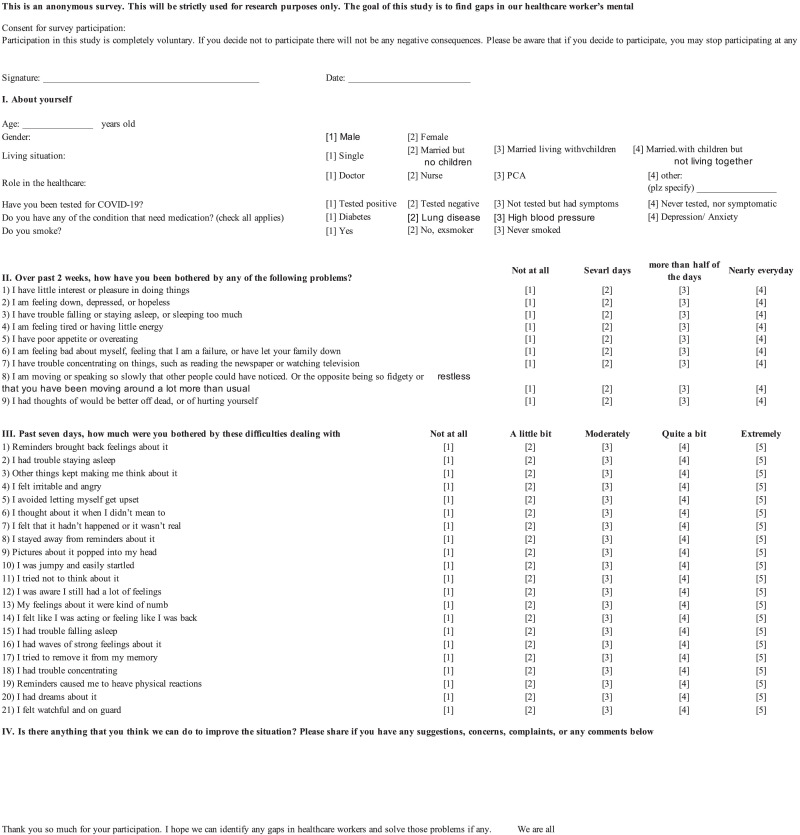
Methods: This is a cross-sectional study whereby trainees of a hospital in New York City were sent a questionnaire. Participants were from the dental and medical departments. Psychological measures of depression and post traumatic stress disorder were assessed utilizing the Patient Health Questionnaire-9 (PHQ-9) and The Impact of Event Scale-Revised (IES-R) questionnaire. Other variables compared were age, gender, smoking status, living situation and comorbidities. Data analysis utilized chi-squared (X2) and t-tests. Bivariate correlation and linear regression analyses were also utilized.
Results: The survey was sent to 19 dental (Dental) and 171 medical (MD) residents. There were 66 participants. The response rate was 63.16 and 35.09% for the Dental and MD residents, respectively. The mean age for the Dental and MD residents, respectively, was 29.62 ± 2.09 and 34.82 ± 9.32 (P = .014). Eighty-one percent of the Dental respondents were male and 33.3% of the MD respondents were male (P < .001). The mean PHQ-9 score was 18.29 ± 2.88 vs 7.24 ± 7.41 for Dental and MD residents, respectively (P < .001). A higher score represents increased severity of depression. The Dental residents scored 61.9 ± 3.90 on the IES-R vs 30.36 ± 24.67 (P < .001). A higher score indicates a greater frequency of intrusive thoughts and avoidance. Forty-two percent of Dental and 13.3% of MD residents tested positive; 25% of Dental and 28.9% of MD residents self-reported symptoms for COVID-19. Being positive or symptomatic resulted in statistically significant higher IES-R and PHQ-9 scores.
Conclusions: Dental residents and being positive or symptomatic for COVID-19 resulted in higher PHQ-9 and IES-R scores. Being aware of the impact of COVID-19 is an important step in providing intervention.
Copyright © 2021 The American Association of Oral and Maxillofacial Surgeons. Published by Elsevier Inc. All rights reserved.
References
MeSH terms
LinkOut - more resources
Full Text Sources
Medical
