


Towards a deeper understanding of microbial communities: integrating experimental data with dynamic models
- PMID: 34098512
- PMCID: PMC8286325
- DOI: 10.1016/j.mib.2021.05.003
Towards a deeper understanding of microbial communities: integrating experimental data with dynamic models
Abstract
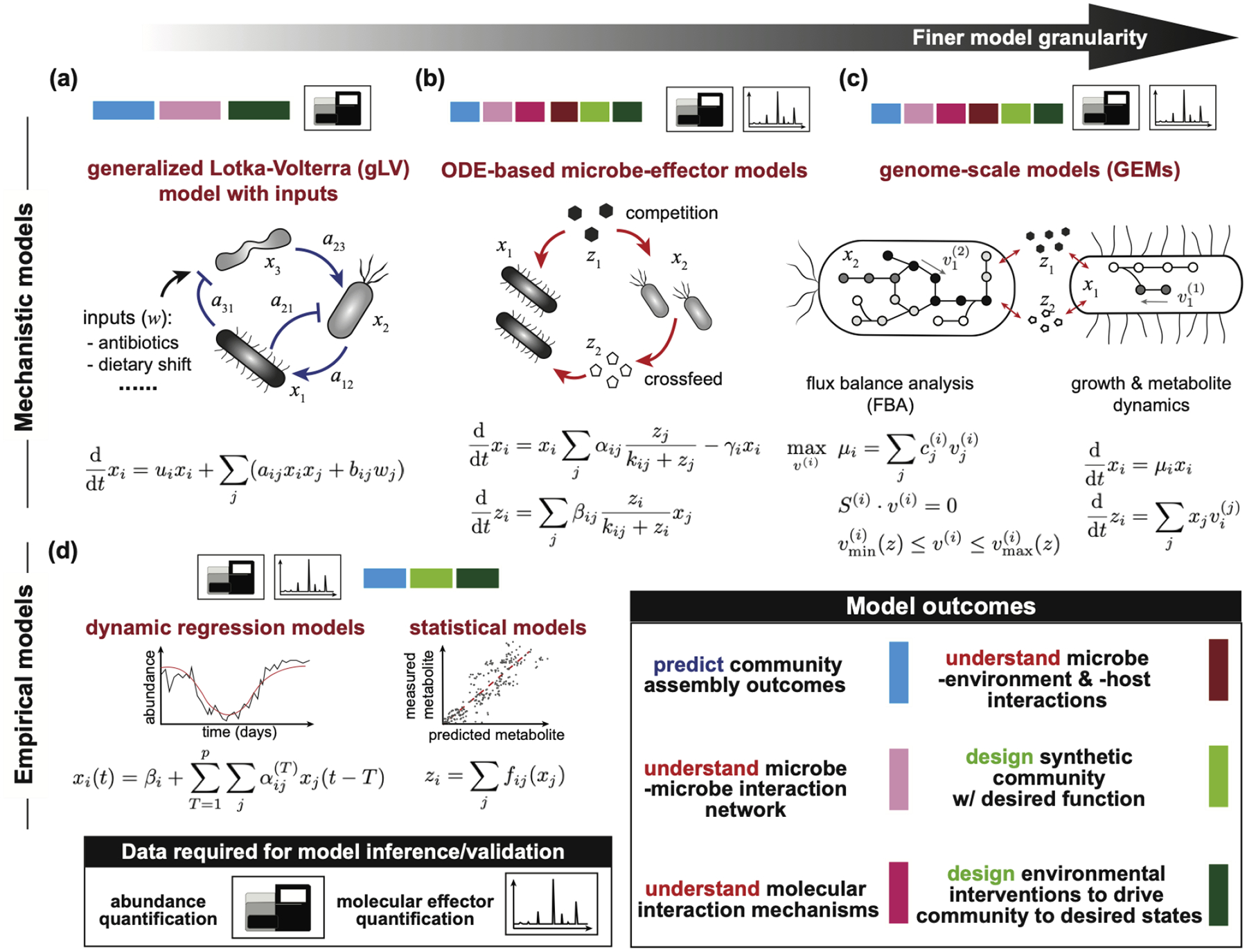
Microbial communities and their functions are shaped by complex networks of interactions among microbes and with their environment. While the critical roles microbial communities play in numerous environments have become increasingly appreciated, we have a very limited understanding of their interactions and how these interactions combine to generate community-level behaviors. This knowledge gap hinders our ability to predict community responses to perturbations and to design interventions that manipulate these communities to our benefit. Dynamic models are promising tools to address these questions. We review existing modeling techniques to construct dynamic models of microbial communities at different scales and suggest ways to leverage multiple types of models and data to facilitate our understanding and engineering of microbial communities.
Copyright © 2021 Elsevier Ltd. All rights reserved.
Conflict of interest statement
Conflict_of_interest
The authors declare that they do not have a conflict of interest.
Figures
References
-
- Zheng P et al. , “Gut microbiome remodeling induces depressive-like behaviors through a pathway mediated by the host’s metabolism,” Mol. Psychiatry, vol. 21, no. 6, pp. 786–796, Jun. 2016. - PubMed
-
- Laserna-Mendieta EJ et al. , “Determinants of Reduced Genetic Capacity for Butyrate Synthesis by the Gut Microbiome in Crohn’s Disease and Ulcerative Colitis,” J. Crohn’s Colitis, vol. 12, no. 2, pp. 204–216, Jan. 2018. - PubMed
Publication types
MeSH terms
Grants and funding
LinkOut - more resources
Full Text Sources
Miscellaneous
