


Therapeutic Effects of Add-On Tenapanor for Hemodialysis Patients with Refractory Hyperphosphatemia
- PMID: 34098559
- PMCID: PMC8491508
- DOI: 10.1159/000516156
Therapeutic Effects of Add-On Tenapanor for Hemodialysis Patients with Refractory Hyperphosphatemia
Abstract
Introduction: Phosphate binders are used to treat hyperphosphatemia. Some patients have inappropriately controlled serum phosphorus levels, which may occur for many reasons, including a high pill burden and adverse events (AEs). Tenapanor selectively inhibits the passive paracellular transfer of phosphate in the gastrointestinal tract, thereby reducing serum phosphorus levels. This novel mechanism of action may contribute to improved phosphate management. The efficacy and safety of tenapanor have not been evaluated in Japanese patients with high serum phosphorus levels despite treatment with phosphate binders. This study aimed to assess the efficacy and safety of add-on tenapanor therapy for reducing serum phosphorus levels in this population.
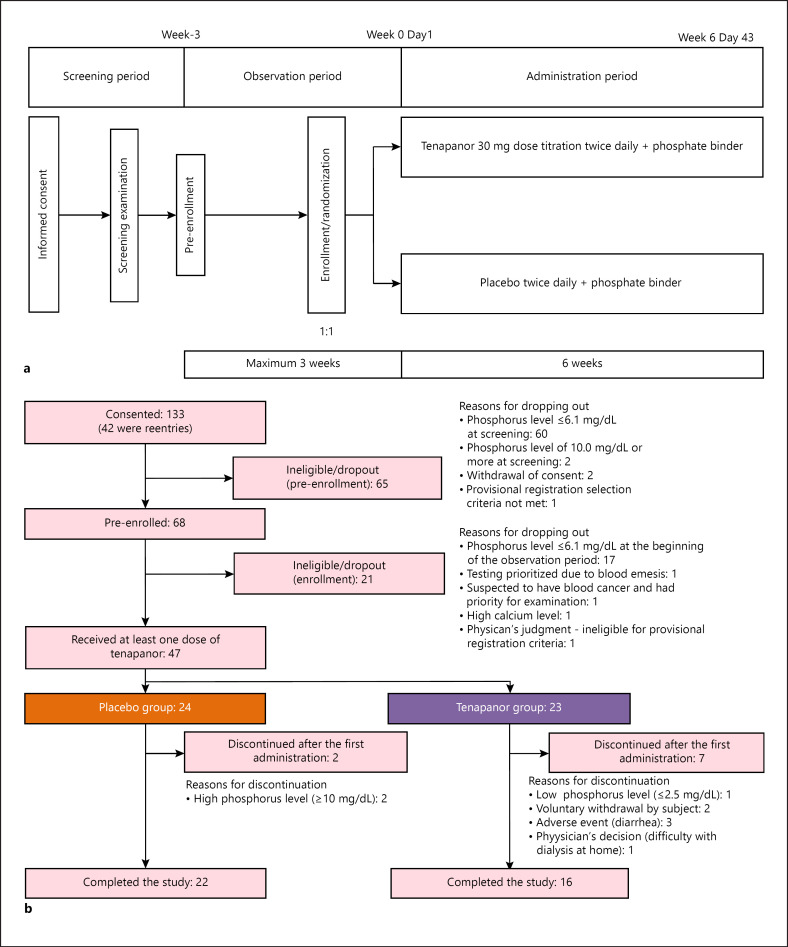
Methods: This multicenter, double-blind, randomized, placebo-controlled trial enrolled patients with refractory hyperphosphatemia undergoing hemodialysis. Patients were randomly assigned in a 1:1 ratio to receive tenapanor or placebo as an add-on to their phosphate binder regimen for 6 weeks. Change in serum phosphorus levels at week 6 (day 43) compared with the baseline value (day 1, week 0) (primary endpoint), achievement of target serum phosphorus levels (serum phosphorus level ≤6.0 or ≤5.5 mg/dL), and safety, based on all AEs and drug-related AEs, were among the outcomes evaluated.
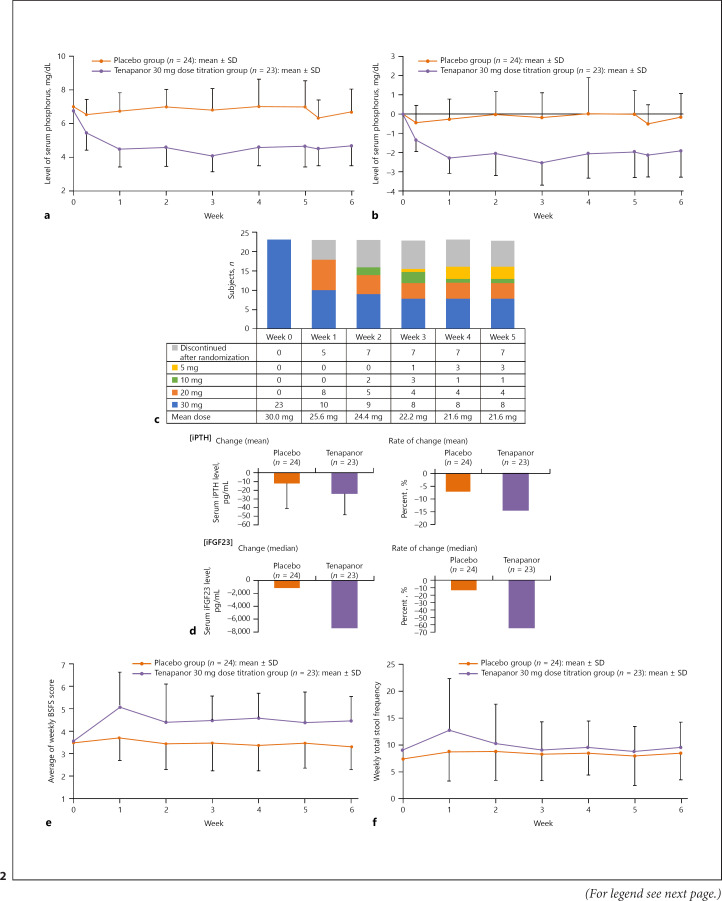
Results: In total, 24 patients were randomly assigned to the placebo group and 23 to the tenapanor group. The mean serum phosphorus level decreased from 7.01 mg/dL on day 1 to 6.69 mg/dL on day 43 in the placebo group and from 6.77 mg/dL on day 1 to 4.67 mg/dL on day 43 in the tenapanor group. In the placebo and tenapanor groups (modified intent-to-treat population), the mean (standard deviation) change in the serum phosphorus level at day 43 (last observation carried forward [LOCF]) was 0.08 (1.52) mg/dL and -1.99 (1.24) mg/dL, respectively, with a between-group difference of -2.07 (95% confidence interval: -2.89, -1.26; p < 0.001). The target achievement rate (serum phosphorus level ≤6.0 mg/dL at week 6 [LOCF]) was 37.5 and 87.0% in the placebo and tenapanor groups, respectively. Diarrhea was the most common drug-related AE, and it occurred in 8.3 and 65.2% of patients in the placebo and tenapanor groups, respectively. No specific AEs were observed with add-on tenapanor or with phosphate binders.
Discussion/conclusion: Therapy with existing phosphate binders and add-on tenapanor resulted in a significant decrease in serum phosphorus level compared with the placebo group in patients with refractory hyperphosphatemia despite treatment with phosphate binders. No new safety signals were raised, and add-on tenapanor was generally well tolerated.
Keywords: Hemodialysis; Hyperphosphatemia; Na+/H+ antiporter 3; Serum phosphorus level; Tenapanor.
The Author(s). Published by S. Karger AG, Basel.
Conflict of interest statement
T.S. has received personal fees from Kyowa Kirin Co., Ltd. during the conduct of the study and outside the submitted work. M.F. has received personal fees from Kyowa Kirin Co., Ltd., Ono Pharmaceutical Co. Ltd., Torii Pharmaceutical Co. Ltd., and Kissei Pharmaceutical Co. Ltd. and grants from Bayer Yakuhin Ltd. during the conduct of the study. T.A. has received personal fees from Kyowa Kirin Co., Ltd. during the conduct of the study and personal fees from Astellas, Bayer Yakuhin Ltd., Kissei Pharmaceutical Co. Ltd., Ono Pharmaceutical Co. Ltd., Fuso Pharmaceutical Industries Ltd., Torii Pharmaceutical Co. Ltd., GlaxoSmithKline, J.T. Pharmaceuticals, Nipro Corporation, Otsuka, Sanwa Chemical, and Chugai Pharmaceutical Co. Ltd. outside the submitted work. Y.U., K.I., and H.K. are employees of Kyowa Kirin Co., Ltd.
Figures
References
-
- Hannedouche T, Fouque D, Joly D. (Metabolic complications in chronic kidney disease: hyperphosphatemia, hyperkalemia and anemia) Nephrol Ther. 2018 Nov;14((6 Supplement)):6S17–25. - PubMed
-
- Marcuccilli M, Chonchol M, Jovanovich A. Phosphate binders and targets over decades: do we have it right now? Semin Dial. 2017 Mar;30((2)):134–41. - PubMed
-
- Vervloet MG, van Ballegooijen AJ. Prevention and treatment of hyperphosphatemia in chronic kidney disease. Kidney Int. 2018 May;93((5)):1060–72. - PubMed
Publication types
MeSH terms
Substances
LinkOut - more resources
Full Text Sources
Other Literature Sources
