


Case Reports
doi: 10.1186/s40478-021-01202-w.
A novel splicing variant of ANXA11 in a patient with amyotrophic lateral sclerosis: histologic and biochemical features
Affiliations
- PMID: 34099057
- PMCID: PMC8186038
- DOI: 10.1186/s40478-021-01202-w
Item in Clipboard
Case Reports
A novel splicing variant of ANXA11 in a patient with amyotrophic lateral sclerosis: histologic and biochemical features
Acta Neuropathol Commun.
.
Erratum in
-
Correction to: A novel splicing variant of ANXA11 in a patient with amyotrophic lateral sclerosis: histologic and biochemical features.Acta Neuropathol Commun. 2021 Jun 28;9(1):115. doi: 10.1186/s40478-021-01217-3. Acta Neuropathol Commun. 2021. PMID: 34183068 Free PMC article. No abstract available.
No abstract available
Conflict of interest statement
The authors declare that they have no competing interests.
Figures
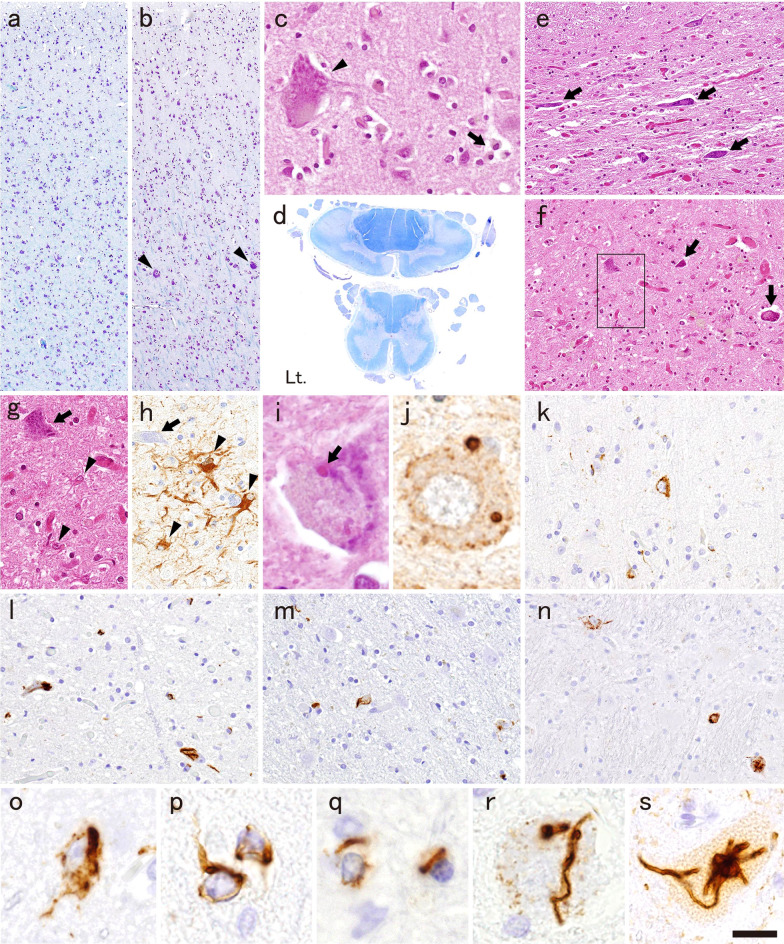
Neuropathologic findings. a, b The motor cortex shows neuronal loss and gliosis more prominently in a the lateral side than b the medial side. Some Betz cells are preserved only in the medial side of the motor cortex (arrowheads in b, c). c Macrophage accumulation in a Betz cell-sized hole (arrow in c), indicating ongoing neuronal degeneration, is evident in the medial side. d Myelin pallor in the bilateral lateral columns of the cervical and lumbar cord, and the left anterior column of the cervical cord, which indicate degeneration of the pyramidal tracts. Atrophy of the anterior horns is also evident in the cervical cord. e–h Severe neuronal loss and gliosis in e the cervical anterior horn, and f–h facial nucleus (arrows, atrophic neurons; arrowheads, reactive astrocytes; g and h, high magnification images of the square in f; h, GFAP-immunohistochemistry). i, j Bunina bodies in the remaining motor neurons of the facial nucleus (j, cystatin C-immunohistochemistry). k–s Phosphorylated TDP-43 (pTDP-43)-immunohistochemistry. Several pTDP-43-immunoreactive (ir) neuronal cytoplasmic inclusions (NCIs) and glial cytoplasmic inclusions (GCIs) in k the motor cortex, l hypoglossal nucleus and m subthalamic nucleus. n NCIs in the pontine nucleus. o Granulofilamentous and (left in p) filamentous NCIs and (right in p) GCI in the motor cortex. q GCIs in the white matter adjacent to the motor cortex. r Thick skein-like NCI in the hypoglossal nucleus. (s) Tube-shaped NCI in the anterior horn of the lumbar cord. Bar = 190 µm for a, b; 35 µm for c, g, h; 3 mm for d; 75 µm for e, f; 10 µm for i, j, o–r; 50 µm for k–n; 15 µm for s
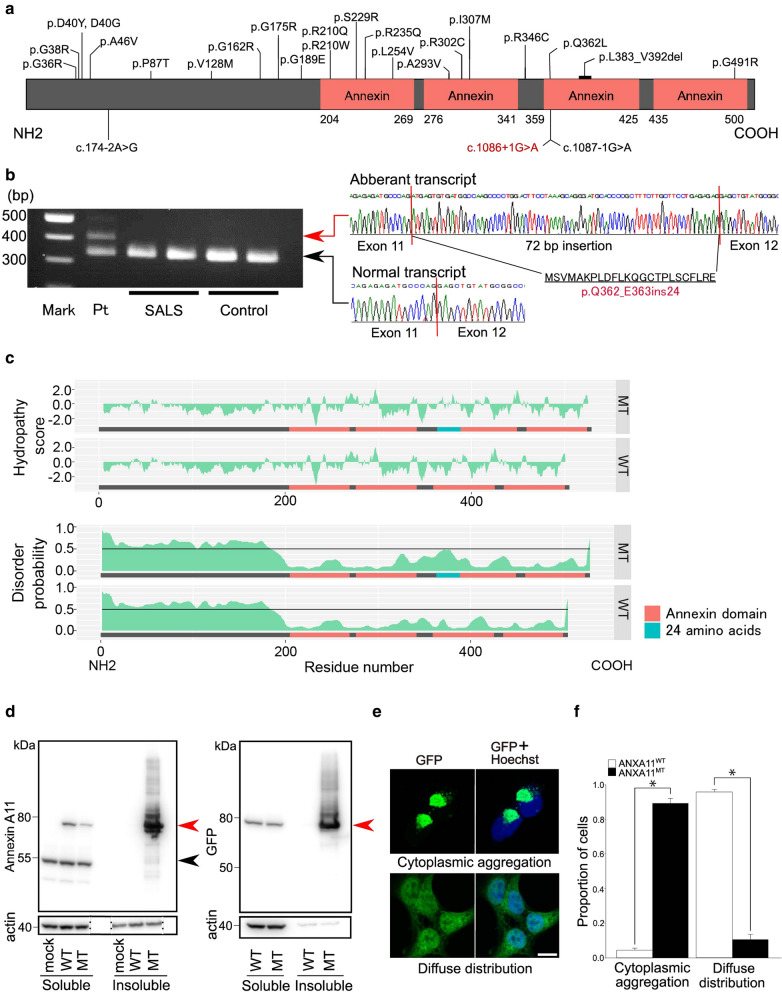
Position of the identified ANXA11 mutation and biological characteristics of the mutant annexin A11. a Annexin A11 protein domains and the position of mutations identified in patients with amyotrophic lateral sclerosis (ALS). Mutations found in the previous studies are in black and that of the present patient is in red. b An aberrant ANXA11 mRNA splicing as a consequence of the c.1086 + 1G > A mutation. Gel electrophoresis shows the reverse transcription PCR products from the autopsied brain of the present patient (Pt), patients with sporadic ALS harboring no ANXA11 mutations (SALS), and controls. The lane of Pt contains two different bands. Sequencing results show that the band located at 339 bp implies a normal transcript, and that located at 411 bp implies an aberrant transcript caused by 72-bp insertion between exons 11 and 12, numbered on the basis of ENSEMBL ANXA11-203. The inserted sequence results in a 24-amino-acid insertion. c Hydrophobicity and protein disorder predictions. Upper panel: Hydropathy plot [2] of the aberrant annexin A11 (MT) obtained using ExPASy shows increased hydrophobicity around the inserted 24-amino-acid site. Lower panel: Disorder profile plot of the aberrant annexin A11 (MT) obtained with PrDOS [1] shows increased disorder probability around the inserted 24-amino-acid site compared with that of the wild type (WT), indicating that the aberrant splicing could affect the stability and function of annexin A11. d Solubility fractionation of the cells transfected with GFP-tagged ANXA11 (GFP-ANXA11) constructs, followed by Western blotting using antibodies for (left) annexin A11 and (right) GFP. The wild type annexin A11 protein is predominantly soluble, whereas the mutant construct shows a prominent increase in the insoluble fraction. Red arrowhead: wild type (WT) and mutant (MT) GFP-annexin A11. Black arrowhead: endogenous annexin A11. β-Actin: loading control. e GFP-annexin A11 localization in HEK293T cells. Cells are classified according to GFP-annexin A11 localization patterns, i.e. cytoplasmic aggregation, and diffuse distribution. Bar = 10 µm for all images in e. f Proportion of cells showing each GFP-annexin A11 localization pattern. The proportion of cells showing cytoplasmic aggregation is significantly higher, and that of cells showing diffuse distribution is significantly lower in cells expressing GFP-annexin A11MT than in those expressing GFP-annexin A11WT (*, p < 0.002; Mann–Whitney U test)
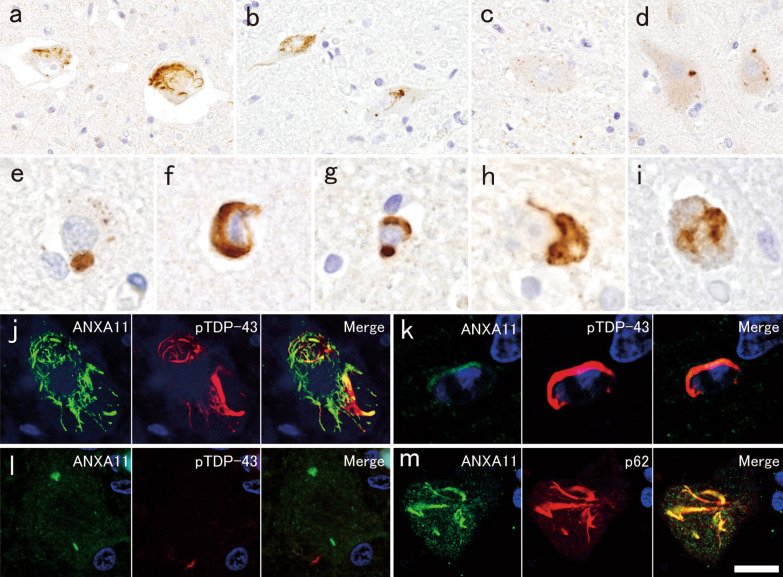
Expression of annexin A11 in autopsied CNS tissue. a–i Annexin A11-immunohistochemistry. a Annexin A11-immunoreactive (ir) skein-like neuronal cytoplasmic inclusions (NCIs) in the anterior horn and b hypoglossal nucleus. c Small dot-like staining pattern in an anterior horn cell from a patient with amyotrophic lateral sclerosis without ANXA11 mutation. d Small irregular-shaped and e round NCIs in the motor cortex. f Filamentous NCI and g glial cytoplasmic inclusion (GCI) in the putamen. h Filamentous NCI in the pontine nucleus and i inferior olivary nucleus. j–l Double-label immunofluorescence with annexin A11 and pTDP-43. j Annexin A11 and pTDP-43 are partially co-localized in the skein-like NCI. k Weak immunoreactivity of annexin A11 in pTDP-43-ir GCI. j, k, lumbar anterior horn. l Annexin A11-ir and pTDP-43-negative small, irregularly shaped and short linear NCIs, and pTDP-43-ir and annexin A11-negative dystrophic neurite in the motor cortex. m Annexin A11-ir and p62-ir NCI in the lumbar anterior horn. j–l green, annexin A11; red, pTDP-43, m green, annexin A11; red, p62. Bar = 60 µm for a, b; 30 µm for c, d; 10 µm for e–i, l; 15 µm for j, m; 6 µm for k
References
Publication types
MeSH terms
Substances
LinkOut - more resources
Full Text Sources
Medical
Miscellaneous
