. 2021 Jun 7;12(1):3327.
doi: 10.1038/s41467-021-23527-9.

Private communication with quantum cascade laser photonic chaos

Affiliations

Private communication with quantum cascade laser photonic chaos

Olivier Spitz et al. Nat Commun. .

Abstract

Mid-infrared free-space optical communication has a large potential for high speed communication due to its immunity to electromagnetic interference. However, data security against eavesdroppers is among the obstacles for private free-space communication. Here, we show that two uni-directionally coupled quantum cascade lasers operating in the chaotic regime and the synchronization between them allow for the extraction of the information that has been camouflaged in the chaotic emission. This building block represents a key tool to implement a high degree of privacy directly on the physical layer. We realize a proof-of-concept communication at a wavelength of 5.7 μm with a message encryption at a bit rate of 0.5 Mbit/s. Our demonstration of private free-space communication between a transmitter and receiver opens strategies for physical encryption and decryption of a digital message.


Conflict of interest statement

The authors declare no competing interests.

Figures
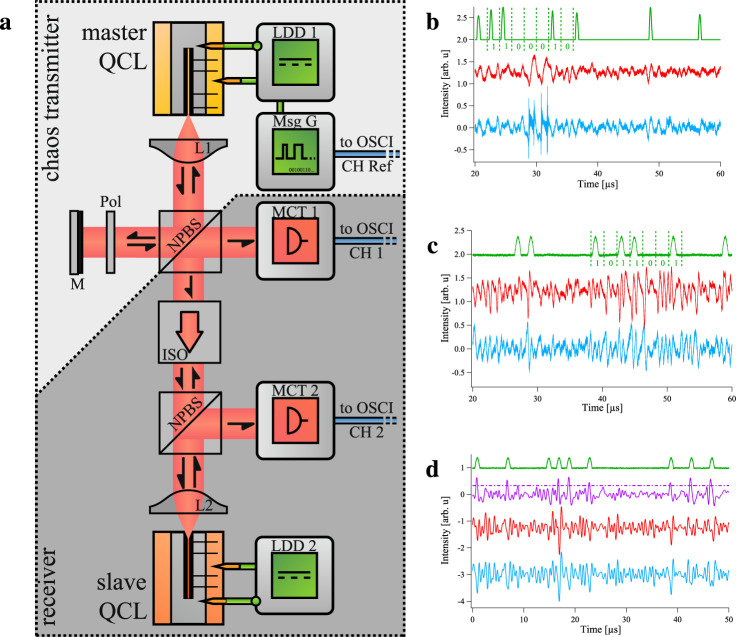
Fig. 1
Fig. 1. Principle of operation.
Left panel: experimental setup showing the transmitter unit (light gray) and receiver unit (dark gray). a In the transmitter part, the master laser is driven chaotically by self-optical feedback that is produced by the gold-plated mirror (M). The feedback strength is precisely tuned thanks to a mid-infrared polarizer (pol) with piezoelectric rotation. Thanks to a non-polarizing beam-splitter (NPBS), part of the signal from the master laser is sent into the slave laser through an optical isolator (ISO) to avoid back-coupling. Both the signal from the master QCL and the signal from the slave QCL are retrieved with a MCT detector and then subsequently analyzed. LDD: laser diode driver. Right panel: time series retrieved during the private communication process. b Synchronization case. c Anti-synchronization case. d Filtered time series during message recovery in the anti-synchronization case. The color code is as follows: time trace of the message (green), which is magnified by a factor 30 for a better visualization; time trace of the intensity of the master laser (red) with encoded message hidden within the signal; time trace of the slave laser (blue); time trace of the difference between the red and the blue signal (purple), the dashed line sets the limit between the “0”-bits and the “1”-bits during the analysis of the purple time trace.
Fig. 2
Fig. 2. Private communication with chaos synchronization.
2D and 1D (insets) correlation diagrams for the filtered intensity of the slave and the master QCL (left panels). Bit series (right panels) for the initial message (IM in green), the difference (in purple), the master’s signal (in red) and the slave’s signal (in blue). Except for the initial message, the number of errors is written on the right side of the bit series, with the corresponding color. a, b correspond to the global sequence with 791 bits, c, d correspond to a portion of the global sequence, between 1 and 191, e, f correspond to a portion of the global sequence, between 400 and 591, g, h correspond to a cross-analysis between the slave signal of the second row and the master signal of the third row.
Fig. 3
Fig. 3. Private communication with chaos anti-synchronization.
a 2D and 1D (insets) correlation diagrams for the filtered intensity of the slave and the master QCL. The filtered signal of the slave laser was flipped so that the 1D correlation diagram has a maximum value of 1 and the 2D correlation diagram shows a positive correlation (instead of −1 and negative correlation, respectively). b Bit series for the initial message (IM in green), the difference (in purple), the master’s signal (in red), and the slave’s signal (in blue). Except for the initial message, the number of errors is written on the right side of the bit series, with the corresponding color. The translation of the difference bit signal is also displayed by comparison with the initial message. The private mid-infrared transmission achieves a BER of 6%, which corresponds to 12 errors out of 191 bits. c Experimental eye diagrams for the four time traces displayed in Fig. 1d. From these diagrams, one can see that it is impossible to recover the message only from the signal of the master QCL but it becomes possible for most of the bits from the difference signal. Bits deciphered as “0” are drawn with a light color while bits deciphered as “1” are drawn with a stressed color (particularly visible in the difference eye diagram where the “1” and “0” are well separated).
Fig. 4
Fig. 4. Optical spectrum evolution during the coupling process.
Optical spectrum of the slave laser when it is biased at 512.4 mA and for several levels of injection from the master laser. The QCL is monomode under free-running operation and when increasing the injection strength, a second mode is appearing with a subsequently following third mode. The amplitude of these side modes increases with the injection strength while the main mode remains unchanged.

References

    1. He X, et al. 1 Gbps free-space deep-ultraviolet communications based on III-nitride micro-LEDs emitting at 262 nm. Photonics Res. 2019;7:B41–B47. doi: 10.1364/PRJ.7.000B41. - DOI
    1. Soibel A, et al. Midinfrared interband cascade laser for free space optical communication. IEEE Photonics Technol. Lett. 2009;22:121–123. doi: 10.1109/LPT.2009.2036449. - DOI
    1. Su Y, et al. 10 Gbps DPSK transmission over free-space link in the mid-infrared. Opt. Express. 2018;26:34515–34528. doi: 10.1364/OE.26.034515. - DOI - PubMed
    1. Pang X, et al. Free-space communications enabled by quantum cascade lasers. Phys. Status Solidi (A) 2021;218:2000407. doi: 10.1002/pssa.202000407. - DOI
    1. Martini R, et al. High-speed modulation and free-space optical audio/video transmission using quantum cascade lasers. Electron. Lett. 2001;37:191–193. doi: 10.1049/el:20010102. - DOI
