. 2021 Jun 7;11(1):11979.
doi: 10.1038/s41598-021-91095-5.

Multi-community effects of organic and conventional farming practices in vineyards

Affiliations

Multi-community effects of organic and conventional farming practices in vineyards

Noémie Ostandie et al. Sci Rep. .

Abstract

Understanding the response of biodiversity to organic farming is crucial to design more sustainable agriculture. While it is known that organic farming benefits biodiversity on average, large variability in the effects of this farming system exists. Moreover, it is not clear how different practices modulate the performance of organic farming for biodiversity conservation. In this study, we investigated how the abundance and taxonomic richness of multiple species groups responds to certified organic farming and conventional farming in vineyards. Our analyses revealed that farming practices at the field scale are more important drivers of community abundance than landscape context. Organic farming enhanced the abundances of springtails (+ 31.6%) and spiders (+ 84%), had detrimental effects on pollinator abundance (- 11.6%) and soil microbial biomass (- 9.1%), and did not affect the abundance of ground beetles, mites or microarthropods. Farming practices like tillage regime, insecticide use and soil copper content drove most of the detected effects of farming system on biodiversity. Our study revealed varying effects of organic farming on biodiversity and clearly indicates the need to consider farming practices to understand the effects of farming systems on farmland biodiversity.


Conflict of interest statement

The authors declare no competing interests.

Figures
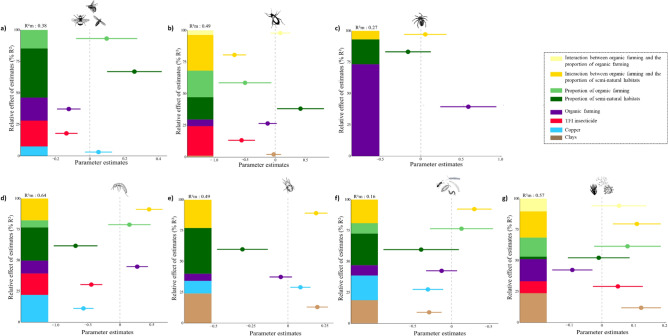
Figure 1
Figure 1
Results of the best models explaining the abundances of (a) pollinators, (b) ground beetles, (c) spiders, (d) springtails, (e) mites, (f) soil microarthropods and (g) microbial biomass according to the type of farming system (organic or conventional), landscape context, farming practices independent of farming systems and soil characteristics. Stacked bars show the relative effects of estimates (%R2) for each explanatory variable calculated as the ratios between the parameter estimates and the sum of all parameter estimates based on a model averaging approach applied to model 1. Points are estimates of the model coefficients, and lines represent confidence intervals. All continuous predictors were scaled to interpret parameter estimates at comparable scales. All individual plots representing the effects of significant explanatory variables of Fig. 1 are provided as supplementary material (Fig S1-S8). Note that results of best models for models 2 explaining abundances of the different groups by specific farming practices, landscape context and soil characteristics are provided in Figure S10. This figure was made using R version 4.0.3 (https://www.R-project.org/) and Inkscape 1.0 (www.inkscape.org).
Figure 2
Figure 2
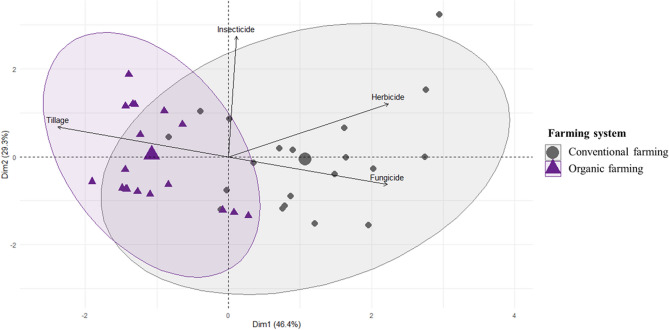
Principal component analysis (PCA) of the four variables used to characterize profiles of agricultural practices in our study. Purple triangles represent plots under organic systems, and grey circles, systems under conventional farming. The largest triangles and circles represent centroids of the ellipses characterizing organic and conventional farming systems, respectively. Pearson correlation matrix between variables are provided in Suppl. Mat. Fig S13. This figure was made using R version 4.0.3 (https://www.R-project.org/).

References

    1. Díaz et al. Summary for Policymakers of the Global Assessment.pdf.
    1. Kehoe L, et al. Biodiversity at risk under future cropland expansion and intensification. Nat. Ecol. Evolut. 2017;1:1129–1135. doi: 10.1038/s41559-017-0234-3. - DOI - PubMed
    1. Hendershot JN, et al. Intensive farming drives long-term shifts in avian community composition. Nature. 2020;579:393–396. doi: 10.1038/s41586-020-2090-6. - DOI - PubMed
    1. Bommarco R, Kleijn D, Potts SG. Ecological intensification: Harnessing ecosystem services for food security. Trends Ecol. Evol. 2013;28:230–238. doi: 10.1016/j.tree.2012.10.012. - DOI - PubMed
    1. Michael DR, Wood JT, O’Loughlin T, Lindenmayer DB. Influence of land sharing and land sparing strategies on patterns of vegetation and terrestrial vertebrate richness and occurrence in Australian endangered eucalypt woodlands. Agr. Ecosyst. Environ. 2016;227:24–32. doi: 10.1016/j.agee.2016.05.001. - DOI

Publication types