


Time trends and disparities in anxiety among adolescents, 2012-2018
- PMID: 34100110
- PMCID: PMC8183580
- DOI: 10.1007/s00127-021-02122-9
Time trends and disparities in anxiety among adolescents, 2012-2018
Abstract
Purpose: Prior studies have been inconclusive in documenting whether the prevalence of adolescent anxiety is increasing, given sampling and measurement limitations. This study adds new information on recent time trends in anxiety prevalence, specifically investigating trends among previously unexamined sociodemographic subgroups.
Methods: Weighted data of 37,360 youth respondents (51.1% female, 71.8% White, 91.3% heterosexual, 99.2% cisgender) from the 2012-2018 Dane County Youth Assessment, a county-wide survey administered to youth in participating school districts, were analyzed to estimate time trends in anxiety prevalence among the whole sample and by sociodemographic subgroups.
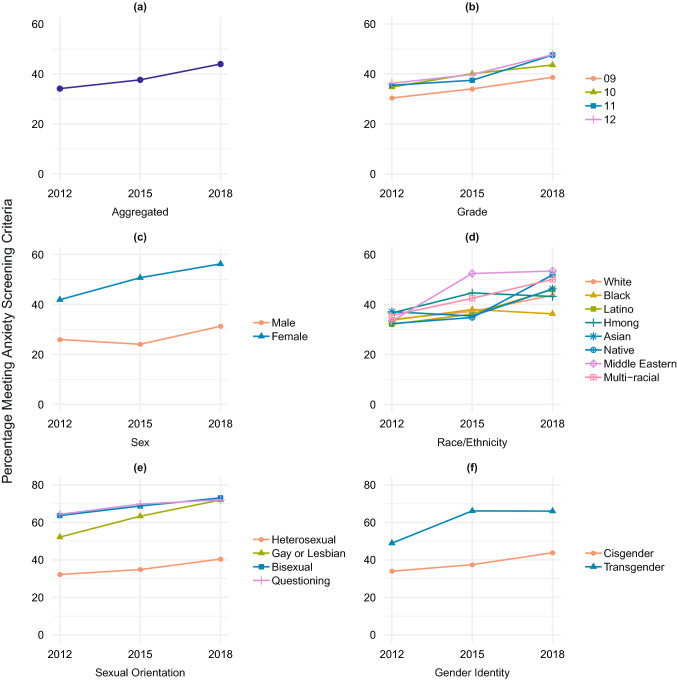
Results: The prevalence of youth meeting anxiety-screening criteria increased from 34.1% (95% CI 33.4-34.9) in 2012 to 44% (95% CI 43.2-44.7) in 2018 (OR for trend = 1.07, P for trend < 0.001). The trend remained significant after adjusting for known confounds (AOR for trend = 1.07, P for trend < 0.001). Anxiety increased significantly for several subgroups and widening disparities were documented among females relative to males (P < 0.001), and sexual minority youth relative to heterosexual youth (P = 0.003). In addition, Black youth did not increase at the same swift rate as White youth over the study period (P < 0.001).
Conclusion: This study reports recent data on anxiety time trends and finds that among a geographically representative sample of adolescents, anxiety prevalence is rising. Findings provide new evidence documenting increased anxiety prevalence among sexual minority youth relative to their peers. Results highlight the need to bolster public health interventions focused on adolescent mental health, with tailored interventions for vulnerable groups.
Keywords: Adolescence; Anxiety; Epidemiology; Health disparity; Time trend.
© 2021. Springer-Verlag GmbH Germany, part of Springer Nature.
Conflict of interest statement
On behalf of all the authors, the corresponding author states that there is no conflict of interest.
Figures
References
MeSH terms
LinkOut - more resources
Full Text Sources
