


[Case-based learning can improve the teaching quality in trauma surgery education : A survey analysis among medical students]
- PMID: 34100962
- PMCID: PMC8881268
- DOI: 10.1007/s00113-021-01009-3
[Case-based learning can improve the teaching quality in trauma surgery education : A survey analysis among medical students]
Abstract
Background: Medical education has always been challenging for students and teachers. Of growing importance is the promotion of knowledge of correlations and knowledge transfer from theoretical aspects into clinical practice. In order to achieve this aim, student-centered teaching concepts are increasingly being employed in the literature.
Objective: Can a trauma surgery practical seminar be improved by a case-based teaching concept?
Material and methods: For this purpose, standardized case studies and corresponding teaching materials, such as classification aids and treatment strategies, were made available to the students and lecturers. Using a two-staged evaluation the effects of the modified teaching design could be recorded and statistically analyzed.
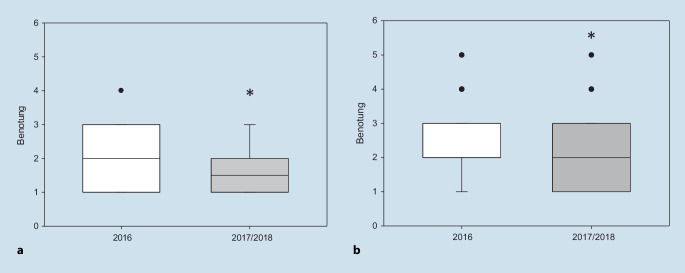
Results: The seminar was considered to be relevant for the examinations. The teaching by the lecturers was found to be more competent and appeared more motivated. Overall, the seminar was rated better by the students.
Conclusion: A case-based teaching concept can significantly improve the education in trauma surgery, when correctly and specifically implemented.
Zusammenfassung: HINTERGRUND: Medizinische Lehre ist seit jeher eine Herausforderung für Studierende und Dozenten. Die Förderung des Zusammenhangswissens und ein Wissenstransfer von der Theorie auf die Praxis gewinnen in den letzten Jahren an Bedeutung. Um dieses Ziel zu erreichen, werden zunehmend studierendenzentrierte Lehrkonzepte in der Literatur eingesetzt.
Fragestellung: Kann durch ein fallbasiertes Lehrkonzept das unfallchirurgische Seminar verbessert werden?
Material und methoden: Den Studierenden und Dozenten wurden standardisierte Fallbeispiele und dazugehörige Unterrichtsmaterialien wie Klassifikationshilfen und Versorgungsstrategien zur Verfügung gestellt. Durch eine zweizeitige Evaluation konnten die Auswirkungen dieser Modifikationen des Lehrdesigns erfasst und statistisch ausgewertet werden.
Ergebnisse: Das Seminar wurde als prüfungsrelevanter empfunden. Die Lehre durch die Dozenten wurde als kompetenter und motivierter empfunden. Insgesamt wurde das Seminar durch die Studierenden besser bewertet.
Schlussfolgerungen: Ein fallbasiertes Lehrkonzept kann daher, richtig und gezielt eingesetzt, die unfallchirurgische Lehre signifikant verbessern.
Keywords: Case-based learning; Student-centered teaching format; Surgical teaching; Teaching; Trauma surgery seminar.
© 2021. The Author(s).

References
Literatur
Verwendete Literatur
-
- Berdel WE, Zühlsdorf M, Nippert RP, Marschall B, Wilhelm MJ, Stümpel F, et al. Problemorientiertes Lernen-interdisziplinare Tumormedizin (poL-iT): ein integriertes Modell der Universitat Munster [Problem-based learning–interdisciplinary tumor medicine: an integrated model of the Munster University] Onkologie. 2001;24(6):587–594. doi: 10.1159/000055148. - DOI - PubMed
-
- Björck U. Distributed problem-based learning. Studies of a pedagogical model in practice. Göteborg: Acta Universitas Gothoburgensis; 2004.
-
- De Grave WS, Schmidt HG, Boshuizen HPA. Effects of problem-based discussion on studying a subsequent text: a randomized trial among first year medical students. Instr Sci. 2001;29:33–44. doi: 10.1023/A:1026571615672. - DOI
Weiterführende Literatur
-
- Kaufmann DM. Implement problem-based learning in medical education: lessons from successful innovations. New York: Springer; 1985.
-
- St Pierre M, Breuer G. Simulation in der Medizin. 2. 2013. p. 116.
MeSH terms
LinkOut - more resources
Full Text Sources
