


Disparities in Social and Economic Determinants of Health by Sexual Identity, Gender, and Age: Results from the 2015-2018 National Survey on Drug Use and Health
- PMID: 34101498
- PMCID: PMC8252906
- DOI: 10.1089/lgbt.2020.0390
Disparities in Social and Economic Determinants of Health by Sexual Identity, Gender, and Age: Results from the 2015-2018 National Survey on Drug Use and Health
Abstract
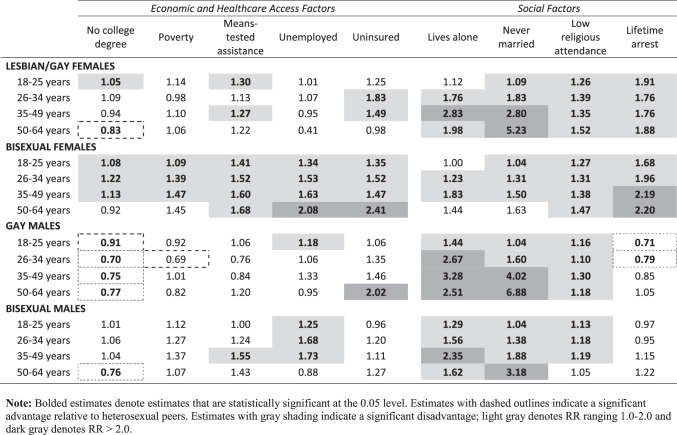
Purpose: We characterize disparities between lesbian, gay, and bisexual (LGB) adults and heterosexual adults across multiple health determinants in a nationally representative sample. Methods: Data on 153,939 adults (including 11,133 LGB adults) were from the 2015-2018 National Survey on Drug Use and Health. Separate Poisson regression models were used to estimate the relative risk (RR) that gay/lesbian and bisexual adults, respectively, experienced each health determinant, relative to heterosexual adults of the same gender and age group (ages 18-25, 26-34, 35-49, and 50-64). Statistically significant RR estimates were interpreted as a disparity. Results: Bisexual females exhibited disparities on all economic/health care access factors (no college degree, household poverty, means-tested assistance, unemployment, and lacking health insurance) across nearly all age groups; lesbian/gay females exhibited disparities in means-tested assistance and health insurance for some age groups. Notably fewer economic disparities were observed among gay and bisexual males. LGB adults (across identity, gender, and age group) were more likely to live alone, to have never been married, and to report low religious service attendance. Bisexual and lesbian/gay females, across age groups, had 1.7-2.2 times the risk of a lifetime arrest for a criminal offense, relative to same-age heterosexual females. Conclusions: Our results highlight that LGB females, particularly bisexual females, experience significant disparities in economic determinants of health, and all LGB subgroups exhibited disparities in some of the examined social determinants of health. The observed disparities, which spanned across age groups, likely contribute to disparities in physical and mental health observed among LGB adults.
Keywords: economics; poverty; sexual minority; social determinants.
Conflict of interest statement
No competing financial interests exist.
Figures
References
-
- Galea S: Well: What We Need to Talk About When We Talk About Health. New York: Oxford University Press, 2019
-
- Marmot M: The Health Gap: The Challenge of an Unequal World. London, UK: Bloomsbury, 2015 - PubMed
-
- Marmot M: The influence of income on health: Views of an epidemiologist. Health Aff (Millwood) 2002;21:31–46 - PubMed
-
- Johnson MK, Staff J, Schulenberg JE, Patrick ME: Living healthier and longer: A life course perspective on education and health. In: Handbook of the Life Course. Edited by Shanahan MJ, Mortimer JT, Johnson MK. Cham, Swizerland: Springer, 2016, pp 369–388
Publication types
MeSH terms
Grants and funding
LinkOut - more resources
Full Text Sources
Medical
