. 2021 Nov;21(11):3649-3662.
doi: 10.1111/ajt.16712. Epub 2021 Jul 5.

Characterization of ABH-subtype donor-specific antibodies in ABO-A-incompatible kidney transplantation

Affiliations

Characterization of ABH-subtype donor-specific antibodies in ABO-A-incompatible kidney transplantation

Andrew Bentall et al. Am J Transplant. 2021 Nov.

Abstract

ABO-incompatible (ABOi) transplantation requires preemptive antibody reduction; however, the relationship between antibody-mediated rejection (AMR) and ABO-antibodies, quantified by hemagglutination (HA), is inconsistent, possibly reflecting variable graft resistance to AMR or HA assay limitations. Using an ABH-glycan microarray, we quantified ABO-A antigen-subtype (A-subtype)-specific IgM and IgG in 53 ABO-O recipients of ABO-A kidneys, before and after antibody removal (therapeutic plasma exchange [TPE] or ABO-A-trisaccharide immunoadsorption [IA]) and 1-year posttransplant. IgM binding to all A-subtypes correlated highly (R2 ≥ .90) and A-subtype antibody specificities was reduced equally by IA versus TPE. IgG binding to the A-subtypes (II-IV) expressed in kidney correlated poorly (.27 ≤ R2 ≤ .69). Reduction of IgG specific to A-subtype-II was equivalent for IA and TPE, whereas IgG specific to A-subtypes-III/IV was not as greatly reduced by IA (p < .005). One-year posttransplant, IgG specific to A-II remained the most reduced antibody. Immunostaining revealed only A-II on vascular endothelium but A-subtypes II-III/IV on tubular epithelium. These results show that ABO-A-trisaccharide is sufficient for IgM binding to all A-subtypes; this is true for IgG binding to A-II, but not subtypes-III/IV, which exhibits varying degrees of specificity. We identify A-II as the major, but importantly not the sole, antigen relevant to treatment and immune modulation in adult ABO-A-incompatible kidney transplantation.

Keywords: ABO incompatibility; antibody biology; antigen biology; clinical research/practice; glycomics; histocompatibility; kidney transplantation/nephrology; translational research/science.


Conflict of interest statement

The authors of this manuscript have no conflicts of interest to disclose as described by the American Journal of Transplantation.

Figures

FIGURE 1
FIGURE 1
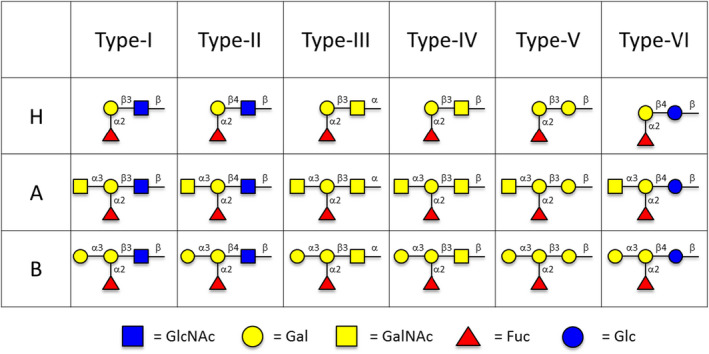
ABO subtype antigens: A‐subtype I–VI, B‐subtype I–VI, and H‐subtype I–VI (Symbol Nomenclature for Glycans 36 )
FIGURE 2
FIGURE 2
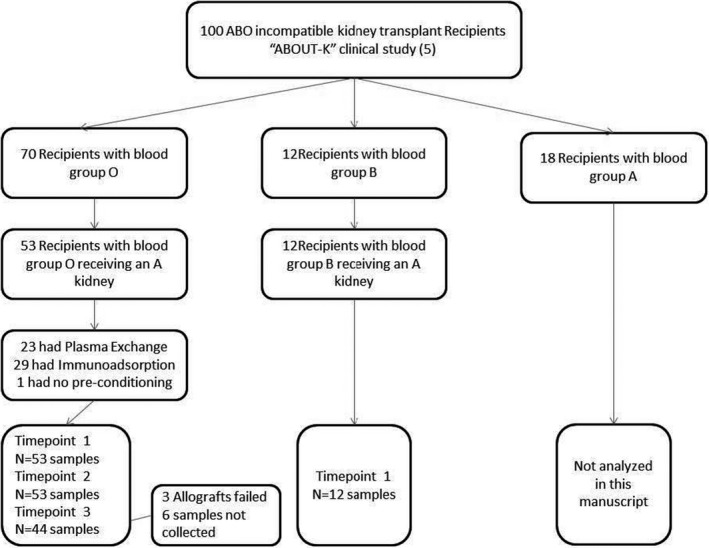
Flowsheet of ABO‐incompatible patient cohort included in current study with sample correlations. “ABOUT‐K” study population with inclusion criteria for this study, where recipient is ABO‐O and donor kidney is ABO‐A and available sera at each timepoint. ABO‐B recipient data are reported in supporting information figures
FIGURE 3
FIGURE 3
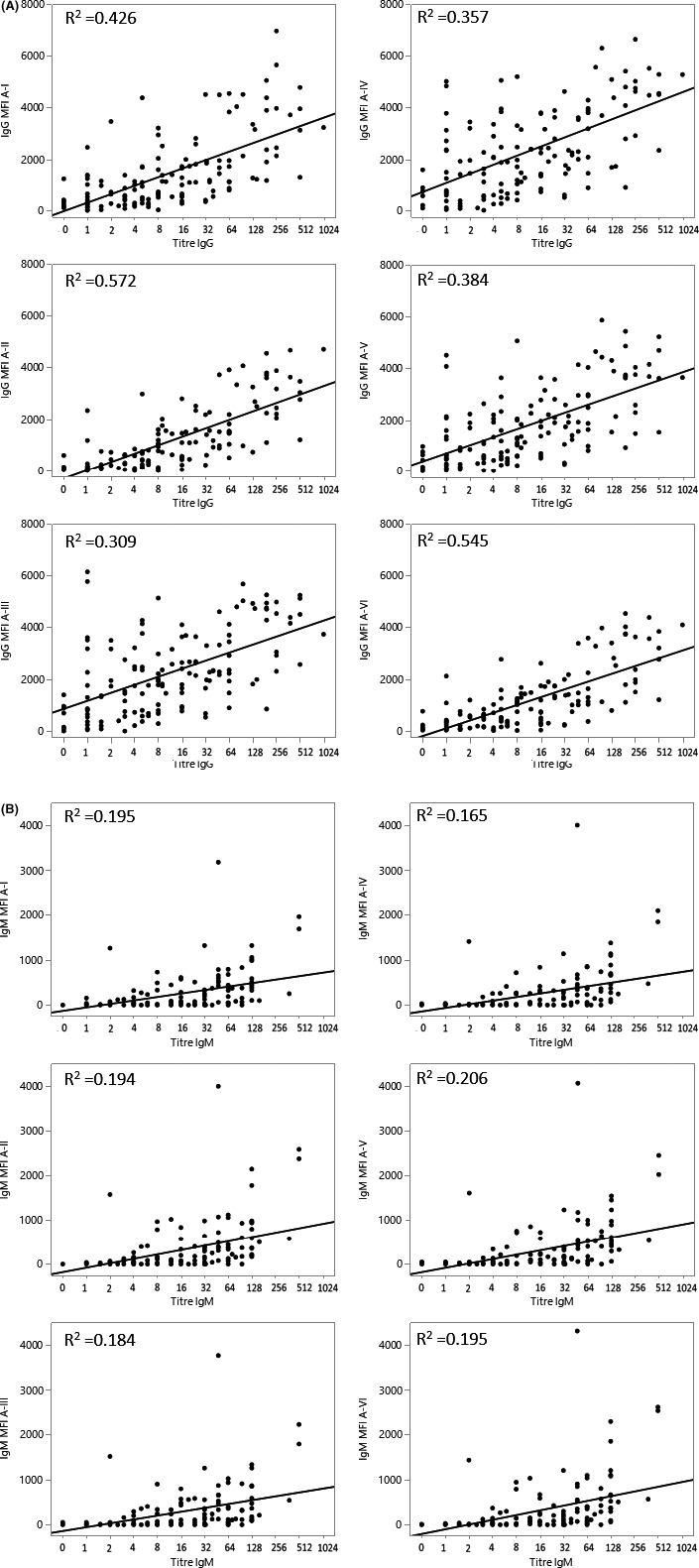
Anti‐A IgG and IgM hemagglutination titers at any timepoint in ABO‐O recipients of ABO‐A kidneys against microarray for each A‐subtype I, II, III, IV, V, and VI. (A) IgG anti‐A titers compared to IgG binding to A‐antigen subtypes. The correlation of hemagglutination IgG titers against A red blood cells in Blood Group O recipients compared to IgG binding to each subtype I, II, III, IV, V, and VI with R 2 .426, .572, .309, .357, .384, and .545, respectively, for each subtype. (B) IgM anti‐A titers compared to IgM binding to A‐antigen subtypes. The correlation of hemagglutination IgM titers against A red blood cells in Blood Group O recipients compared to IgM binding to each subtype I, II, III, IV, V and VI with R 2 .195, .194, .184, .165, .206, and.195, respectively, for each subtype
FIGURE 4
FIGURE 4
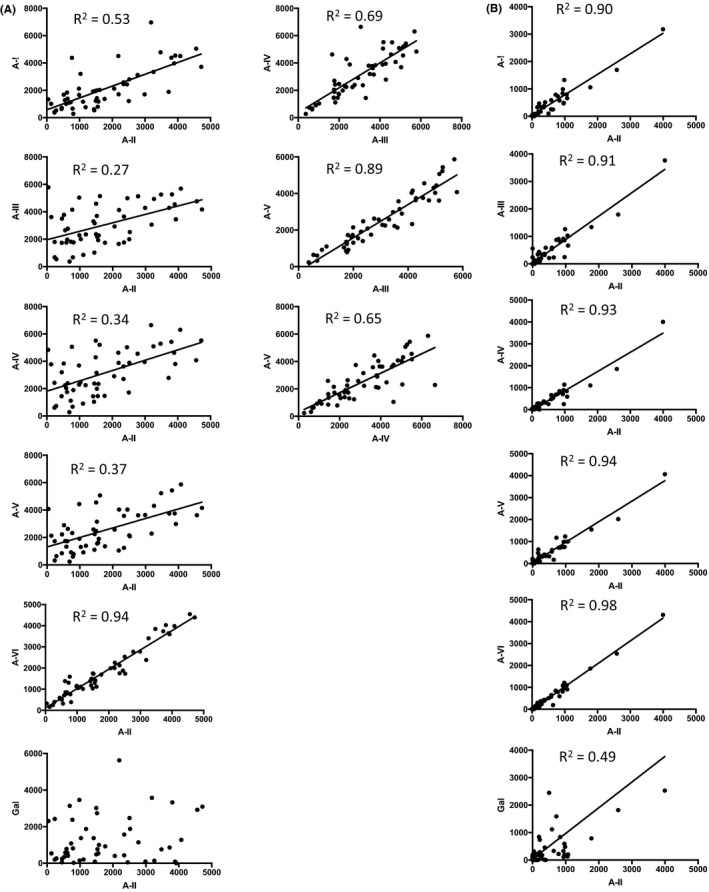
Correlation of antibody binding to different A antigen subtypes in pre‐transplant sera (timepoint 1). (A) Correlation of IgG binding. Prior to EART there was a significant correlation of IgG to all A‐subtypes (p < .001) but not to αGal. The relationships between binding to A‐II and other A‐subtypes are shown to the left, and between A‐subtypes III, IV, and V to the right. IgG binding to A‐I did not correlate any more closely with binding to other A‐subtypes than with binding to A‐II. (B) Correlation of IgM binding. Prior to EART there was a highly significant correlation of IgM to all A‐subtypes and to αGal (p < .001). The relationship between binding to A‐II and to other A‐subtypes is shown
FIGURE 5
FIGURE 5
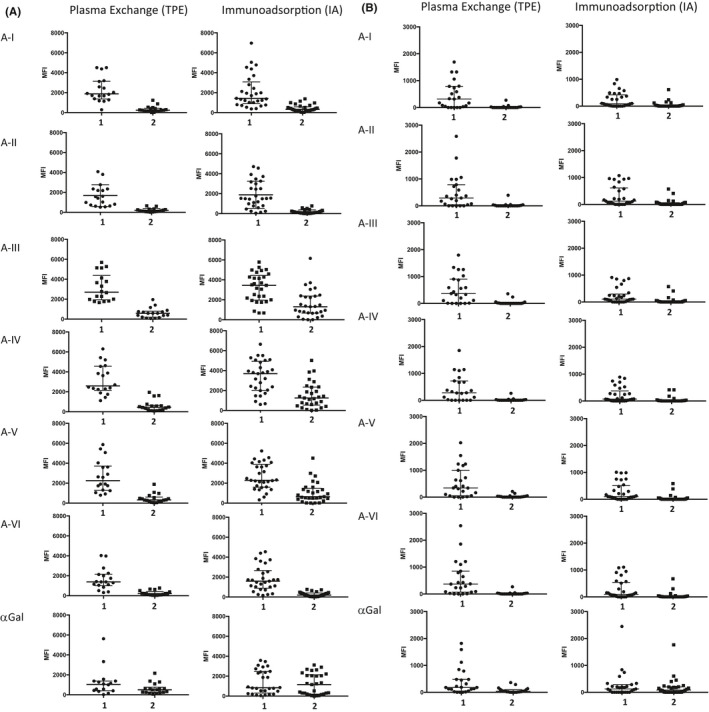
A‐subtype‐specific antibodies in ABO‐O patients undergoing plasma exchange or immunoadsorption measured at timepoints 1 and 2. (A) IgG antibodies. At timepoint 1, IgG binding to any A‐subtype was not significantly different between the cohorts that subsequently underwent EART by plasma exchange and by antigen‐specific immunoadsorption. At timepoint 2 there was a significant reduction in IgG binding to all A‐subtypes (p < .001). IgG binding to αGal was reduced only by plasma exchange. There was no significant difference between plasma exchange and antigen‐specific immunoadsorption with respect to IgG binding to A‐I, II and VI at timepoint 2 (p > .3), whereas IgG binding to A‐III, IV, and V was significantly higher in the group treated with immunoadsorption (p ≤ .006). Data points on individual patients, and lines showing median and interquartile range in this and all subsequent dotplots. (B) IgM antibodies. At timepoint 1, IgM binding to A‐subtypes was not significantly different in the plasma exchange group except for A‐III which reached statistical significance (p = .04). There was no significant difference between plasma exchange and antigen‐specific immunoadsorption with respect to IgM binding to any A‐subtypes at timepoint 2 (p ≥ .4)
FIGURE 6
FIGURE 6
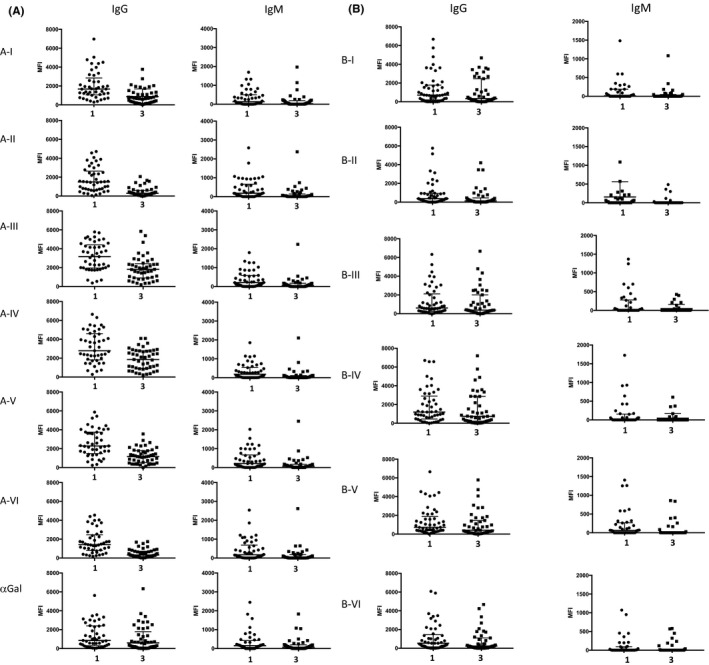
Serum antibodies binding of A‐into‐O recipients at timepoints 1 and 3. (A) Binding to A‐subtype antigens at timepoints 1 and 3. MFI of antibody binding to A‐subtypes at timepoints 1 and 3 (data shown for paired samples only) was significantly lower for both IgM (p < .005) and IgG (p < .0005) to all A‐subtypes at timepoint 3. There was no significant difference in IgG or IgM binding to αGal across the cohort at these timepoints. (B) Serum antibodies binding to B‐subtype antigens at timepoints 1 and 3. IgG binding to B‐I and III‐VI was not significantly different at timepoint 3 compared to timepoint 1, but it was lower for B‐II binding (p = .04). IgM binding to each B‐subtype was not significantly different at timepoint 3 compared to timepoint 1
FIGURE 7
FIGURE 7
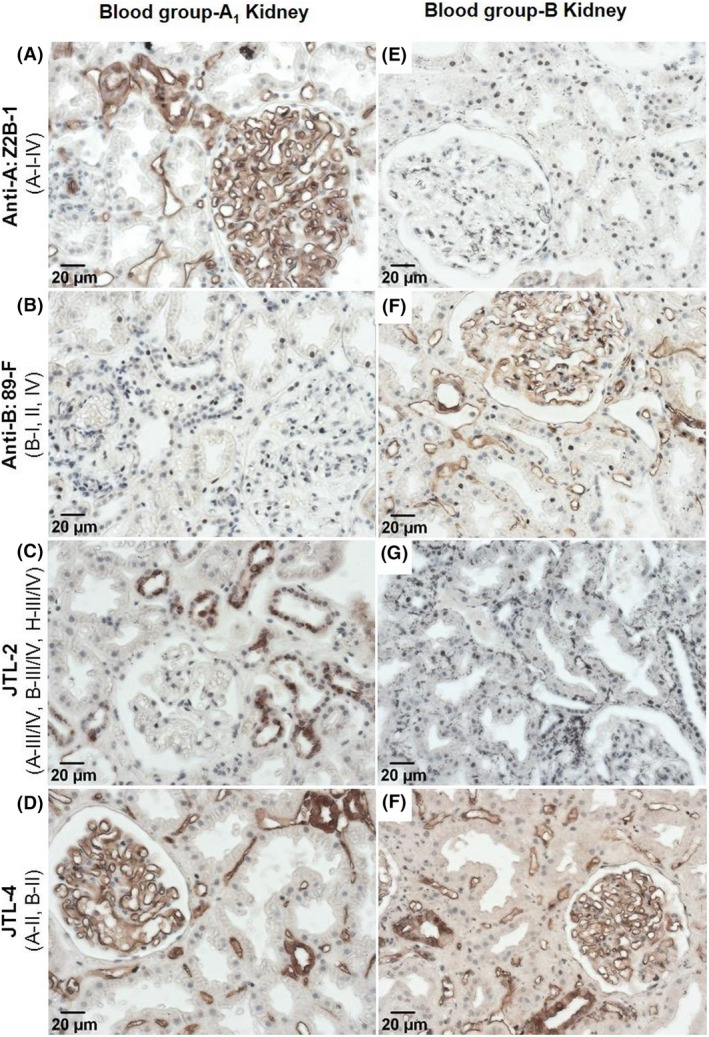
A‐subtype and B‐subtype expression in renal vascular and tubular compartments. Biopsies obtained from blood group A1 (panels A–D) and blood group B (panels E–H) kidney grafts in ABO‐O recipients at 1–3 months posttransplant were stained for expression of A‐ and B‐subtype structures. Vascular endothelial cells (glomeruli and peritubular capillaries) express only subtype II A or B antigens (panels D and H, respectively). Tubular epithelial cells of ABO‐A kidneys express A‐subtypes II, III/IV (positive staining in panels C and D), whereas in ABO‐B kidneys tubular epithelial cells express only B‐subtype II antigens (negative staining in panel G, positive staining in panel H). Representative images are of immunohistochemistry staining of ABO‐A1 (n = 4) and ABO‐B (n = 4) kidney grafts. Monoclonal antibody specificities: Z2B‐1: A‐I, II, III/IV. 89F: B‐I, II, IV. JTL‐2: A‐III/IV, B‐III/IV, H‐III/IV. JTL‐4: A‐II and B‐II

References

    1. Massie AB, Orandi BJ, Waldram MM, et al. Impact of ABO‐incompatible living donor kidney transplantation on patient survival. Am J Kidney Dis. 2020;76:616‐623. - PubMed
    1. de Weerd AE , van Agteren M , Leebeek FW, Ijzermans JN, Weimar W, Betjes MG. ABO‐incompatible kidney transplant recipients have a higher bleeding risk after antigen‐specific immunoadsorption. Transpl Int. 2015;28:25‐33. - PubMed
    1. Montgomery JR, Berger JC, Warren DS, James NT, Montgomery RA, Segev DL. Outcomes of ABO‐incompatible kidney transplantation in the United States. Transplant. 2012;93:603‐609. - PMC - PubMed
    1. Becker LE, Siebert D, Susal C, et al. Outcomes following ABO‐Incompatible kidney transplantation performed after desensitization by nonantigen‐specific immunoadsorption. Transplant. 2015;99:2364‐2371. - PubMed
    1. Bentall A, R. Barnett AN, Braitch M, et al. Clinical outcomes with ABO antibody titer variability in a multicenter study of ABO‐incompatible kidney transplantation in the United Kingdom. Transfusion. 2016;56:2668‐2679. - PubMed

Publication types

Substances

Grants and funding