


Assessing school-based policy actions for COVID-19: An agent-based analysis of incremental infection risk
- PMID: 34102403
- PMCID: PMC8163694
- DOI: 10.1016/j.compbiomed.2021.104518
Assessing school-based policy actions for COVID-19: An agent-based analysis of incremental infection risk
Abstract
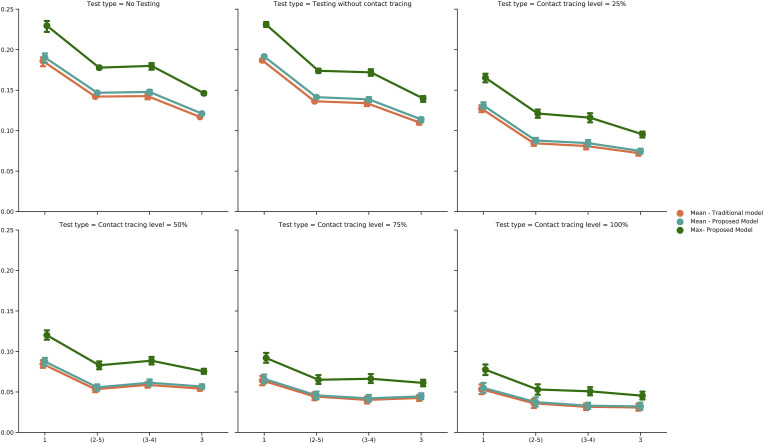
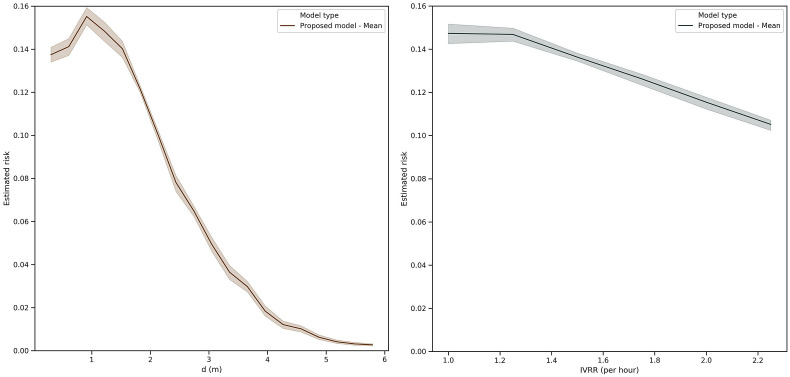
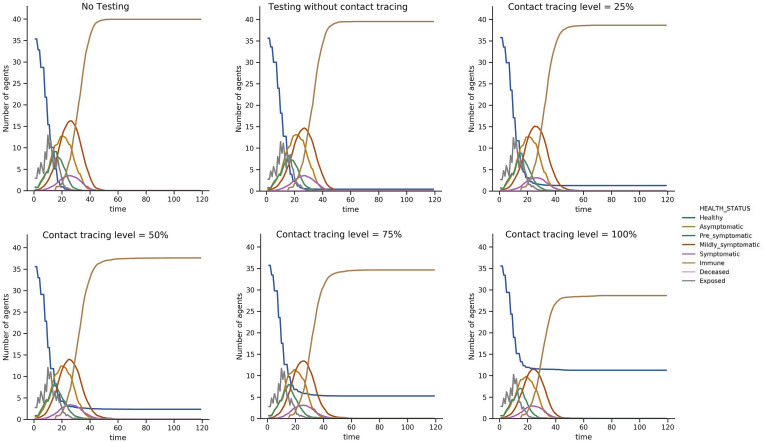
Many schools and universities have seen a significant increase in the spread of COVID-19. As such, a number of non-pharmaceutical interventions have been proposed including distancing requirements, surveillance testing, and updating ventilation systems. Unfortunately, there is limited guidance for which policy or set of policies are most effective for a specific school system. We develop a novel approach to model the spread of SARS-CoV-2 quanta in a closed classroom environment that extends traditional transmission models that assume uniform mixing through air recirculation by including the local spread of quanta from a contagious source. In addition, the behavior of students with respect to guideline compliance was modeled through an agent-based simulation. Estimated infection rates were on average lower using traditional transmission models compared to our approach. Further, we found that although ventilation changes were effective at reducing mean transmission risk, it had much less impact than distancing practices. Duration of the class was an important factor in determining the transmission risk. For the same total number of semester hours for a class, delivering lectures more frequently for shorter durations was preferable to less frequently with longer durations. Finally, as expected, as the contact tracing level increased, more infectious students were identified and removed from the environment and the spread slowed, though there were diminishing returns. These findings can help provide guidance as to which school-based policies would be most effective at reducing risk and can be used in a cost/comparative effectiveness estimation study given local costs and constraints.
Keywords: Agent-based simulation; Contact tracing; SARS-CoV-2 (COVID-19); Social distancing; Surveillance testing; Ventilation; Virus airborne transmission.
Copyright © 2021 Elsevier Ltd. All rights reserved.
Figures
References
-
- WHO Director General's opening remarks at the media briefing on COVID-19 - 11 March 2020. https://www.who.int/director-general/speeches/detail/who-director-genera... [WWW Document], n.d. URL. (accessed 12.10.20)
-
- New Covid-19 Cases Worldwide Johns Hopkins coronavirus resource center. https://coronavirus.jhu.edu/data/new-cases [WWW Document], n.d. URL. (accessed 5.6.21)
-
- Mandavilli A. N. Y. Times; 2021. Reaching ‘Herd Immunity’ Is Unlikely in the U.S., Experts Now Believe.
MeSH terms
LinkOut - more resources
Full Text Sources
Medical
Research Materials
Miscellaneous
