Review
. 2021 May;23(2):183-201.
doi: 10.5853/jos.2020.05015. Epub 2021 May 31.

Current Approaches to the Treatment of Post-Stroke Aphasia

Affiliations
Review

Current Approaches to the Treatment of Post-Stroke Aphasia

Julius Fridriksson et al. J Stroke. 2021 May.

Abstract

Aphasia, impairment of language after stroke or other neurological insult, is a common and often devastating condition that affects nearly every social activity and interaction. Behavioral speech and language therapy is the mainstay of treatment, although other interventions have been introduced to augment the effects of the behavioral therapy. In this narrative review, we discuss advances in aphasia therapy in the last 5 years and focus primarily on properly powered, randomized, controlled trials of both behavioral therapies and interventions to augment therapy for post-stroke aphasia. These trials include evaluation of behavioral therapies and computer-delivered language therapies. We also discuss outcome prediction trials as well as interventional trials that have employed noninvasive brain stimulation, or medications to augment language therapy. Supported by evidence from Phase III trials and large meta-analyses, it is now generally accepted that aphasia therapy can improve language processing for many patients. Not all patients respond similarly to aphasia therapy with the most severe patients being the least likely responders. Nevertheless, it is imperative that all patients, regardless of severity, receive aphasia management focused on direct therapy of language deficits, counseling, or both. Emerging evidence from Phase II trials suggests transcranial brain stimulation is a promising method to boost aphasia therapy outcomes.

Keywords: Aphasia; Brain; Language therapy; Speech therapy; Stroke.


Figures
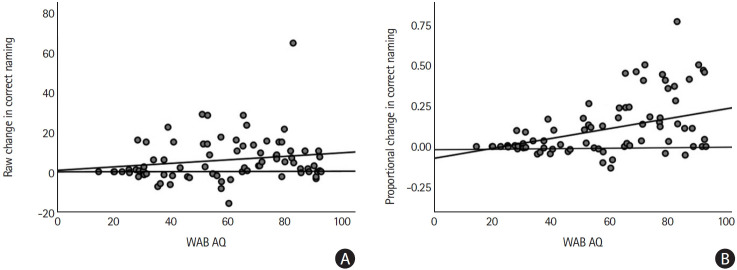
Figure 1.
Figure 1.
The relationship between improvement in naming (y-axis) and aphasia severity (x-axis). Improvement in correct naming was measured using the Philadelphia Naming Test (PNT) whereas aphasia severity was qualified as the overall severity score, aphasia quotient on the Western Aphasia Battery-Revised Aphasia Quotient (WAB-R AQ). (A) The graph shows raw change in correct naming whereas (B) the graph shows change in naming as proportion of potential room for improvement. Note the discrepancy in the graphs at the higher end of the WAB AQ spectrum, which is caused by the mildest cases having relatively limited room for improvement at baseline compared to their counterparts with more severe forms of aphasia.
Figure 2.
Figure 2.
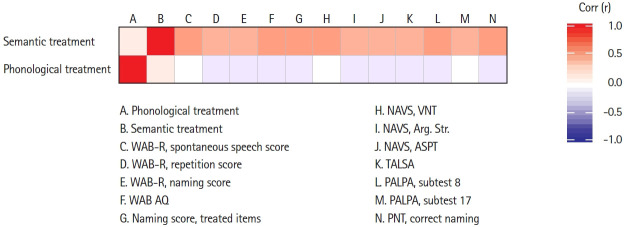
Correlation matrix showing improvements in correct naming following semantic therapy (top row) and phonological therapy (bottom row) in relation to several different language tests. AQ, aphasia quotient; NAVS, Northwestern Assessment of Verbs and Sentences; VNT, verb naming test; Arg. Str., argument structure; ASPT, argument structure production test; TALSA, Temple Assessment of Language and Short-term Memory in Aphasia; PALPA, Psycholinguistic Assessment of Language Processing in Aphasia (Subtest 8: Nonword repetition; Subtest 17: Phonological segmentation of final sounds in words); PNT, Philadelphia Naming Test.
Figure 3.
Figure 3.
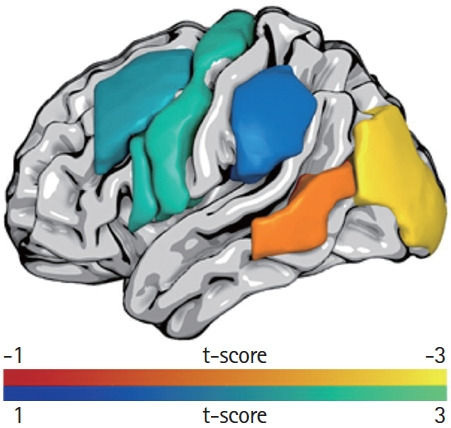
Overall improvement in correct naming on the Philadelphia Naming Test (PNT) was predicted by less damage to the middle occipital gyrus and posterior middle temporal gyrus (red-yellow scale) whereas greater PNT improvement following the phonological treatment phase was predicted by greater damage to anterior regions and the supramarginal gyrus (blue-green scale). The color scales indicate t-scores.
Figure 4.
Figure 4.
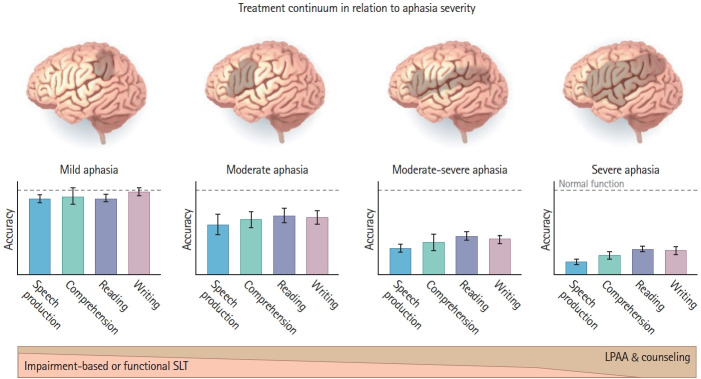
A simple schema suggesting how clinicians might determine how much of their effort in treatment should be devoted to speech and language therapy (SLT) versus Life Participation Approaches to Aphasia (LPAA) based on aphasia severity
Figure 5.
Figure 5.
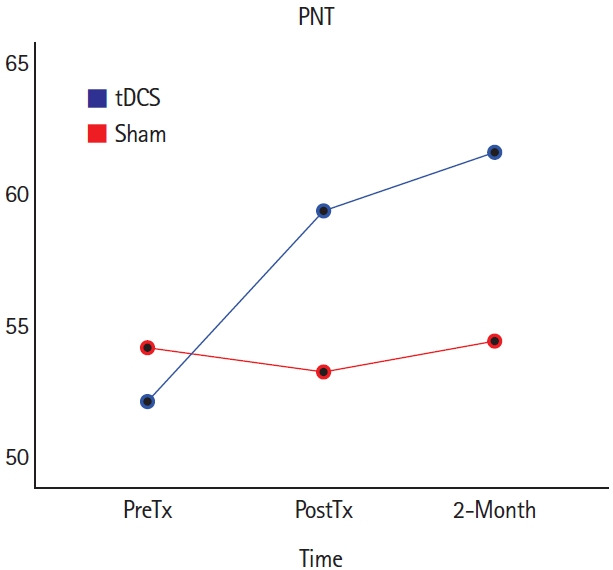
Mean accuracy in naming untrained words on the Philadelphia Naming Test (PNT) with right cerebellar transcranial direct current stimulation (tDCS) versus sham conditions, at pre-treatment (PreTx), post-treatment (PostTx), and 2 months PostTx. This figure illustrates data from reference 133 but combines data for anodal and cathodal right cerebellar tDCS, which did not have significantly different effects. Both tDCS conditions resulted in greater improvements than sham from PreTx to PostTx, and sustained 2 months later. To see results reported separately for anodal and cathodal tDCS, see reference 111.
Figure 6.
Figure 6.
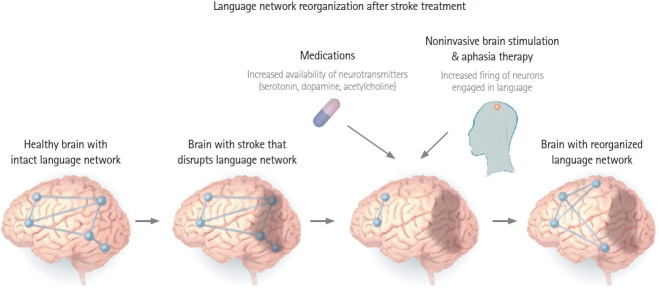
Combined behavioral, noninvasive brain stimulation, and pharmaceutical intervention promote reorganization of the language network to support improved language processing, as demonstrated through a variety of functional imaging studies of aphasia recovery with treatment.[3-6, 112]

References

    1. Nardo D, Holland R, Leff AP, Price CJ, Crinion JT. Less is more: neural mechanisms underlying anomia treatment in chronic aphasic patients. Brain. 2017;140:3039–3054. - PMC - PubMed
    1. Abel S, Lambon Ralph MA. Cognitive neuroscience of aphasia recovery and therapy. Aphasiology. 2018;32:739–741.
    1. Crinion JT, Leff AP. Using functional imaging to understand therapeutic effects in poststroke aphasia. Curr Opin Neurol. 2015;28:330–337. - PubMed
    1. Fridriksson J, Smith K. Neuroplasticity associated with treated aphasia recovery. In: Hickok G, Small SL. Neurobiology of Language. Amsterdam, NL: Elsevier; 2016. pp. 1007–1013.
    1. Kiran S, Meier EL, Johnson JP. Neuroplasticity in aphasia: a proposed framework of language recovery. J Speech Lang Hear Res. 2019;62:3973–3985. - PMC - PubMed

LinkOut - more resources