


Intensive human contact correlates with smaller brains: differential brain size reduction in cattle types
- PMID: 34102890
- PMCID: PMC8188006
- DOI: 10.1098/rspb.2021.0813
Intensive human contact correlates with smaller brains: differential brain size reduction in cattle types
Abstract
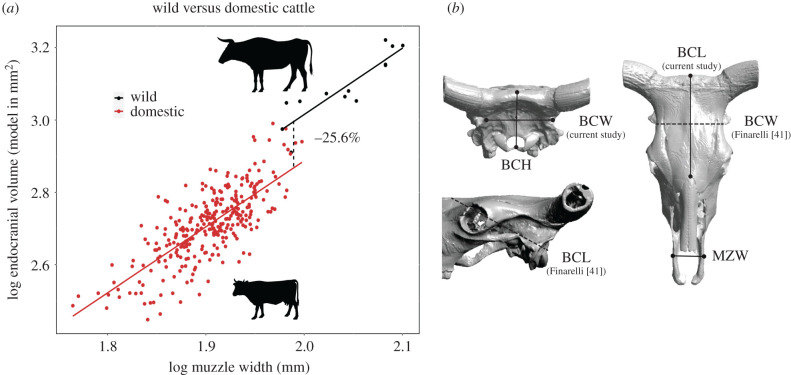
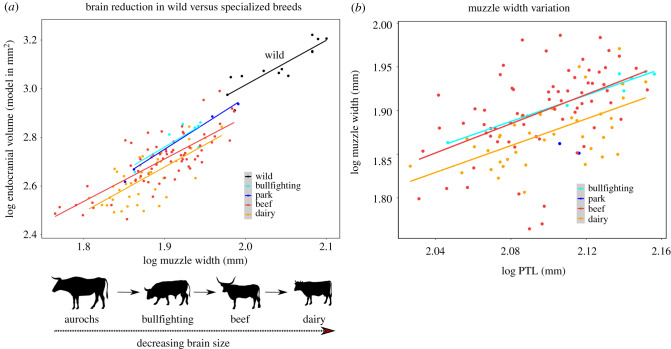
Cattle are one of the most intensively bred domestic animals, providing humans with a multitude of products and uses. Using data from the fossil record, we test if their domestication, as for other taxa, has resulted in a reduction of their brain size. We not only conclude that Bos taurus (domestic cattle) have smaller brains than their wild ancestor, Bos primigenius (aurochs), but that brain size varies significantly by breed, with some having much smaller brains than others. Differences in husbandry practices between several breed categories align with a range of human engagement, which also aligns with the degree of selection for docility. Sampling 317 domestics from 71 breeds, we investigate if differences in brain size correlate with the intensity of human contact. A clear pattern emerges whereby a brain reduction gradient parallels a gradient in behavioural selection. Bullfighting cattle, which are bred for fighting and aggressive temperament, have much larger brains than dairy breeds, which are intensively selected for docility. Our results add to a fundamental aspect of animal domestication theory: the interplay between basic features of the domestic environment-selection for docility, absence of predators and human provision of resources-seems to explain differences in brain size.
Keywords: allometry; aurochs; behaviour; domestication; encephalization; phylogeny.
Figures
References
-
- Kruska D. 1970. Uber die Evolution des Gehirns in der Ordnung Artiodactyla Oweb, 1848, insbesondere der Teilordnung Suina Gray, 1868. Bonn, Germany: Deutsche Forschungsgemeinschaft.
-
- Röhrs M, Ebinger P. 1978. Die Berteilung von Hirngrossenunterschieden. J. Zool. Syst. Evol. Res. 16, 1-14. ( 10.1111/j.1439-0469.1978.tb00916.x) - DOI
-
- Röhrs M, Ebinger P. 1998. Sind Zooprzewalskipferde Hauspferde. Berliner und Münchener Tieraerztliche Wochenschrift 111, 273-280. - PubMed
-
- Herre W, Thiede U. 1965. Studien an Gehirnen sudamerikanisther Tylopoden. Zoologische Jahrbiicher Abteilung fur Anatomie und Ontogenie Dertiere 82, 155-176.
Publication types
MeSH terms
Associated data
LinkOut - more resources
Full Text Sources
Other Literature Sources
Medical
