Review
. 2021 Jun 8;13(1):125.
doi: 10.1186/s13148-021-01111-8.

Epigenetic mechanisms underlying prostate cancer radioresistance

Affiliations
Review

Epigenetic mechanisms underlying prostate cancer radioresistance

Catarina Macedo-Silva et al. Clin Epigenetics. .

Abstract

Radiotherapy (RT) is one of the mainstay treatments for prostate cancer (PCa), a highly prevalent neoplasm among males worldwide. About 30% of newly diagnosed PCa patients receive RT with a curative intent. However, biochemical relapse occurs in 20-40% of advanced PCa treated with RT either alone or in combination with adjuvant-hormonal therapy. Epigenetic alterations, frequently associated with molecular variations in PCa, contribute to the acquisition of a radioresistant phenotype. Increased DNA damage repair and cell cycle deregulation decreases radio-response in PCa patients. Moreover, the interplay between epigenome and cell growth pathways is extensively described in published literature. Importantly, as the clinical pattern of PCa ranges from an indolent tumor to an aggressive disease, discovering specific targetable epigenetic molecules able to overcome and predict PCa radioresistance is urgently needed. Currently, histone-deacetylase and DNA-methyltransferase inhibitors are the most studied classes of chromatin-modifying drugs (so-called 'epidrugs') within cancer radiosensitization context. Nonetheless, the lack of reliable validation trials is a foremost drawback. This review summarizes the major epigenetically induced changes in radioresistant-like PCa cells and describes recently reported targeted epigenetic therapies in pre-clinical and clinical settings.

Keywords: DNA repair; Epidrugs; Epigenetics; Prostate cancer; Radioresistance.


Conflict of interest statement

The authors have declared no conflict of interest.

Figures
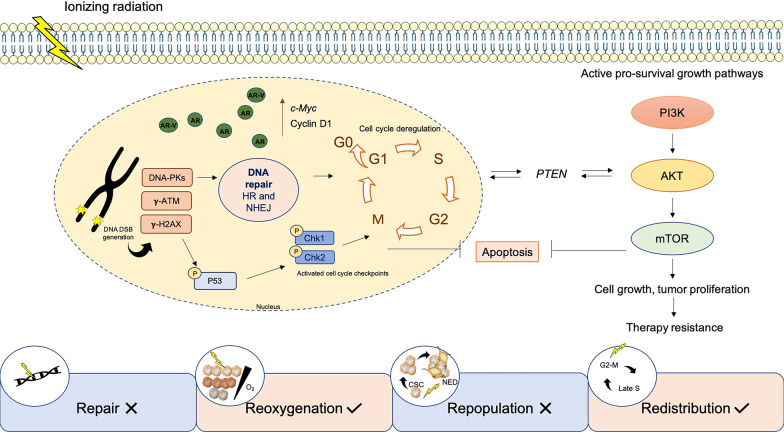
Fig. 1
Fig. 1
Radiation-induced radiobiological molecular pathways in PCa. Ionizing radiation exposure leads to activation of pro-survival cell growth pathways, such as PI3K/Akt/mTOR, entailing efficient DNA DSB damage repair. Specifically, radiation-induced DNA-dependent protein kinases, γ-ATM and γ-H2AX accumulation, and activation of p53 and key factors involved in cell cycle progression, sustain cell growth and tumor proliferation. Furthermore, PTEN is reported to play a role in PCa radioresistance, sustaining cell cycle arrest due to Chk1 regulation in an Akt-dependent manner. All these changes induce PCa cell growth, proliferation, apoptosis evasion, and therapy resistance. This dynamic is supported by current knowledge of the classic R’s of radiobiology, including repair of DNA damage and aggressive cell repopulation, which improve overall tumor cell survival after radiation exposure. Conversely, reoxygenation of deeper layers and cell cycle phases redistribution allows greater therapeutic efficacy.: AKT, protein kinase B; AR, androgen receptor; AR-V, AR variant; ATM, ataxia telangiectasia mutated; ChK1/2, checkpoint kinase 1/2; CSC, cancer stem cells; HR, homologous recombination; mTOR, mechanistic target of rapamycin kinase; NED, neuroendocrine differentiation; NHEJ, non-homologous end joining; PI3K, phosphoinositide 3-kinase; PTEN, phosphatidylinositol 3,4,5-trisphosphate 3
Fig. 2
Fig. 2
Epigenetic landscape in PCa. Aberrant DNA methylation (A) and histone post-translational modifications (B, C) lead to overall PCa progression and aggressiveness due to uncontrolled gene transcription signature. Black filled circles represent methylated sites (A). ac, acetylation; APC, adenomatous polyposis coli; AR, androgen receptor; CBP, CREB-binding protein; CCND2, cyclin D2; CDNK2A, cyclin-dependent kinase inhibitor 2A; CpG, cytosine/guanine enriched sites; EZH2, enhancer of zeste homolog 2; GSTP1, glutathione S-transferase Pi 1; HDAC, histone deacetylase; HOXD3, homeobox protein Hox-D3; KDM, lysine demethylase; me, methylation; MGMT, O6-methylguanine-DNA methyltransferase; PCa, prostate cancer; PTGS2, prostaglandin-endoperoxide synthase 2; RARβ2, retinoic acid receptor beta 2; RASSF1A, Ras association domain family member 1; SIRT, sirtuin; TGS, tumor suppressor genes
Fig. 3
Fig. 3
Radiation-induced epigenetic reprograming in PCa. Epigenetic mechanism regulation plays a key role in PCa radiation response, contributing to cell cycle deregulation, active DNA damage repair, and apoptosis evasion. A Aberrant gene expression is mediated by high DNMT activity at specific CpG sites. This mechanism allows DNA damage repair efficacy and apoptosis evasion. B Histone post-translational modifications are able to modulate cell growth, CSC and EMT gene signature, and cell cycle deregulation. Uncontrolled PCa cell proliferation is maintained by an imbalance between repressive and activating markers. Black filled circles represent methylated sites. ALDH1A1, aldehyde dehydrogenase 1 family member A1; AR, androgen receptor; AKT, protein kinase B; BRCA1, breast cancer type 1; CSC, cancer stem cells; DNMT, DNA methyltransferase; EMT, epithelial-mesenchymal transition; ERK, extracellular regulated kinase; EZH2, enhancer of zeste homolog 2; HDAC, histone deacetylase; MEK, mitogen-activated protein kinase; mTOR, mechanistic target of rapamycin kinase; PI3K, phosphoinositide 3-kinase
Fig. 4
Fig. 4
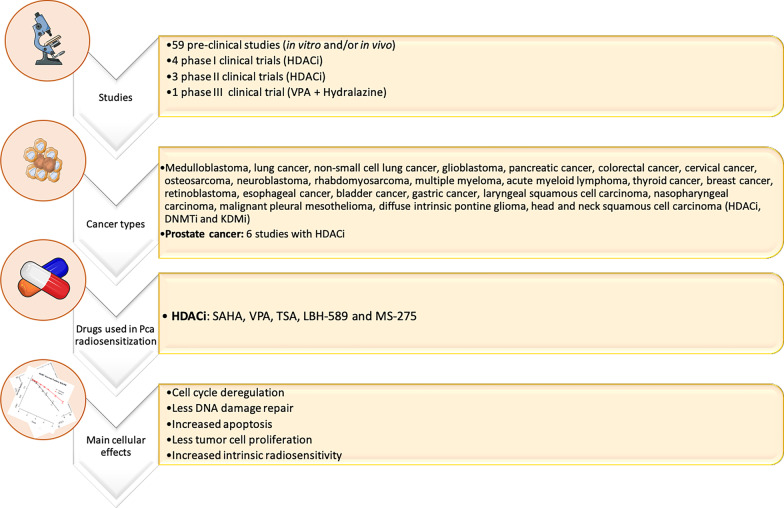
Epigenetic targeting strategies to improve the clinical management of radioresistance. 59 pre-clinical studies have investigated a wide range of HDACi, DNMTi, and KDMi for radiosensitization purposes. Only 6 studies were conducted in PCa models. A further 8 clinical trials (Phase I, II, and III) are evaluating the use of HDACi and DNMTi in several cancer types in combination with conventional RT schemes. Overall, the use of these epidrugs results in cytotoxic effects promoting tumor cell death. DNMTi, DNA methyltransferase inhibitor; HDACi, histone deacetylase inhibitor; KDMi, histone lysine demethylase inhibitor. For additional information please access Additional file 1

References

    1. Bray F, Ferlay J, Soerjomataram I, Siegel RL, Torre LA, Jemal A. Global cancer statistics 2018: GLOBOCAN estimates of incidence and mortality worldwide for 36 cancers in 185 countries. CA Cancer J Clin. 2018;68:394–424. doi: 10.3322/caac.21492. - DOI - PubMed
    1. Sung H, Ferlay J, Siegel RL, Laversanne M, Soerjomataram I, Jemal A, et al. Global cancer statistics 2020: GLOBOCAN estimates of incidence and mortality worldwide for 36 cancers in 185 countries. CA Cancer J Clin. 2021;71:209–249. doi: 10.3322/caac.21660. - DOI - PubMed
    1. Morgan SC, Hoffman K, Loblaw DA, Buyyounouski MK, Patton C, Barocas D, et al. Hypofractionated radiation therapy for localized prostate cancer: executive summary of an ASTRO, ASCO, and AUA evidence-based guideline. Pract Radiat Oncol. 2018;8(6):354–360. doi: 10.1016/j.prro.2018.08.002. - DOI - PubMed
    1. Khuntia D, Reddy CA, Mahadevan A, Klein EA, Kupelian PA. Recurrence-free survival rates after external-beam radiotherapy for patients with clinical T1–T3 prostate carcinoma in the prostate-specific antigen era: what should we expect? Cancer. 2004;100(6):1283–1292. doi: 10.1002/cncr.20093. - DOI - PubMed
    1. Nickoloff JA, Boss MK, Allen CP, LaRue SM. Translational research in radiation-induced DNA damage signaling and repair. Transl Cancer Res. 2017;6(Suppl 5):S875–S891. doi: 10.21037/tcr.2017.06.02. - DOI - PMC - PubMed

Publication types