. 2021 Jun 8;12(1):3455.
doi: 10.1038/s41467-021-23796-4.

Large variation in anti-SARS-CoV-2 antibody prevalence among essential workers in Geneva, Switzerland

Collaborators, Affiliations

Large variation in anti-SARS-CoV-2 antibody prevalence among essential workers in Geneva, Switzerland

Silvia Stringhini et al. Nat Commun. .

Abstract

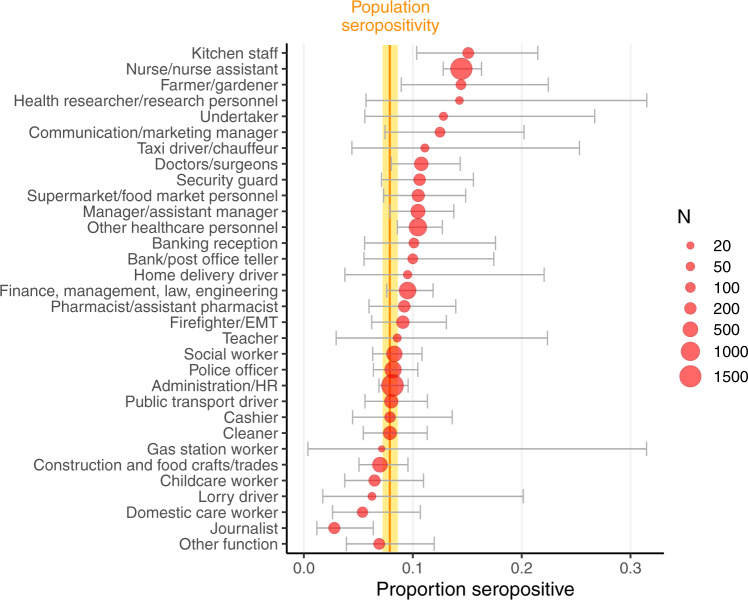
Limited data exist on SARS-CoV-2 infection rates across sectors and occupations, hindering our ability to make rational policy, including vaccination prioritization, to protect workers and limit SARS-CoV-2 spread. Here, we present results from our SEROCoV-WORK + study, a serosurvey of workers recruited after the first wave of the COVID-19 pandemic in Geneva, Switzerland. We tested workers (May 18-September 18, 2020) from 16 sectors and 32 occupations for anti-SARS-CoV-2 IgG antibodies. Of 10,513 participants, 1026 (9.8%) tested positive. The seropositivity rate ranged from 4.2% in the media sector to 14.3% in the nursing home sector. We found considerable within-sector variability: nursing home (0%-31.4%), homecare (3.9%-12.6%), healthcare (0%-23.5%), public administration (2.6%-24.6%), and public security (0%-16.7%). Seropositivity rates also varied across occupations, from 15.0% among kitchen staff and 14.4% among nurses, to 5.4% among domestic care workers and 2.8% among journalists. Our findings show that seropositivity rates varied widely across sectors, between facilities within sectors, and across occupations, reflecting a higher exposure in certain sectors and occupations.


Conflict of interest statement

The authors declare no competing interests.

Figures

Fig. 1
Fig. 1. Prevalence of anti-SARS-CoV-2 IgG antibodies by activity sector, SEROCoV-WORK + study, May–September 2020, Geneva, Switzerland.
Sample size: 10,513 participants, 1026 of which were seropositive. Blue dots represent proportion of seropositive participants per company/workplace facility. Dot size indicates number of employees participating. Darker dots indicate more than one facility with same or very similar seropositivity rate. Vertical orange bar and yellow area indicate general working-age population seropositivity rate and 95% binomial confidence interval, respectively, from SEROCoV-POP study,. Small gray vertical bars show the proportion positive of all participants per sector. Facilities with <10 participants are not shown as dots, but these participants are included in the sector average.
Fig. 2
Fig. 2. Prevalence of anti-SARS-CoV-2 IgG antibodies by occupation, SEROCoV-WORK + study, May–September 2020, Geneva, Switzerland.
Sample size: 10,513 participants, 1026 of which were seropositive. Red dots indicate mean seropositivity rate for each occupation, while horizontal gray lines represent 95% binomial confidence intervals. Dot size indicates number of employees with that occupation. Vertical orange bar and yellow area indicate general working-age population seropositivity rate and 95% binomial confidence interval, respectively, from SEROCoV-POP study,.

References

    1. Han E, et al. Lessons learnt from easing COVID-19 restrictions: an analysis of countries and regions in Asia Pacific and Europe. Lancet. 2020;396:1525–1534. doi: 10.1016/S0140-6736(20)32007-9. - DOI - PMC - PubMed
    1. The Lancet. The plight of essential workers during the COVID-19 pandemic. Lancet. 2020;395:1587. doi: 10.1016/S0140-6736(20)31200-9. - DOI - PMC - PubMed
    1. Baker MG, Peckham TK, Seixas NS. Estimating the burden of United States workers exposed to infection or disease: A key factor in containing risk of COVID-19 infection. PLOS ONE. 2020;15:e0232452. doi: 10.1371/journal.pone.0232452. - DOI - PMC - PubMed
    1. Rho, H. J., Brown, H. & Fremstad, S. A Basic Demographic Profile of Workers in Frontline Industries. (Center for Economic and Policy Research, 2020). https://cepr.net/a-basic-demographic-profile-of-workers-in-frontline-ind...
    1. Oran DP, Topol EJ. Prevalence of Asymptomatic SARS-CoV-2 Infection. Ann. Intern. Med. 2020;173:362–367. doi: 10.7326/M20-3012. - DOI - PMC - PubMed

Publication types