


Progress and challenges of integrated drug efficacy surveillance for uncomplicated malaria in Thailand
- PMID: 34107955
- PMCID: PMC8188767
- DOI: 10.1186/s12936-021-03791-2
Progress and challenges of integrated drug efficacy surveillance for uncomplicated malaria in Thailand
Abstract
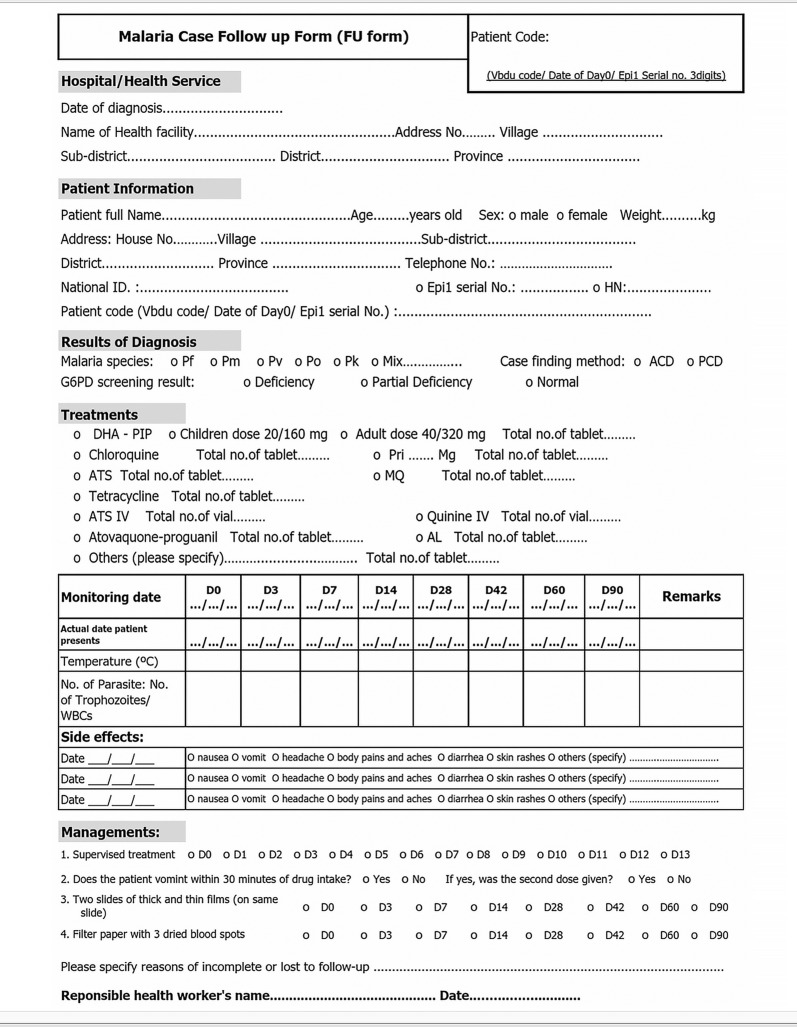
Background: Integrated drug efficacy surveillance (iDES) was formally introduced nationally across Thailand in fiscal year 2018 (FY2018), building on a history of drug efficacy monitoring and interventions. According to the National Malaria Elimination Strategy for Thailand 2017-2026, diagnosis is microscopically confirmed, treatment is prescribed, and patients are followed up four times to ensure cure.
Methods: Routine patient data were extracted from the malaria information system for FY2018-FY2020. Treatment failure of first-line therapy was defined as confirmed parasite reappearance within 42 days for Plasmodium falciparum and 28 days for Plasmodium vivax. The primary outcome was the crude drug efficacy rate, estimated using Kaplan-Meier methods, at day 42 for P. falciparum treated with dihydroartemisinin-piperaquine plus primaquine, and day 28 for P. vivax treated with chloroquine plus primaquine; day 60 and day 90 efficacy were secondary outcomes for P. vivax.
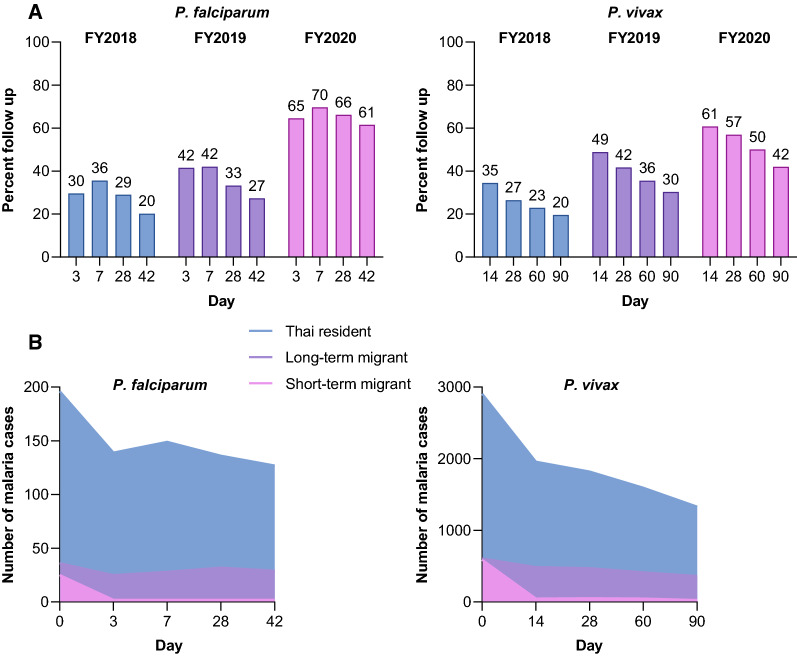
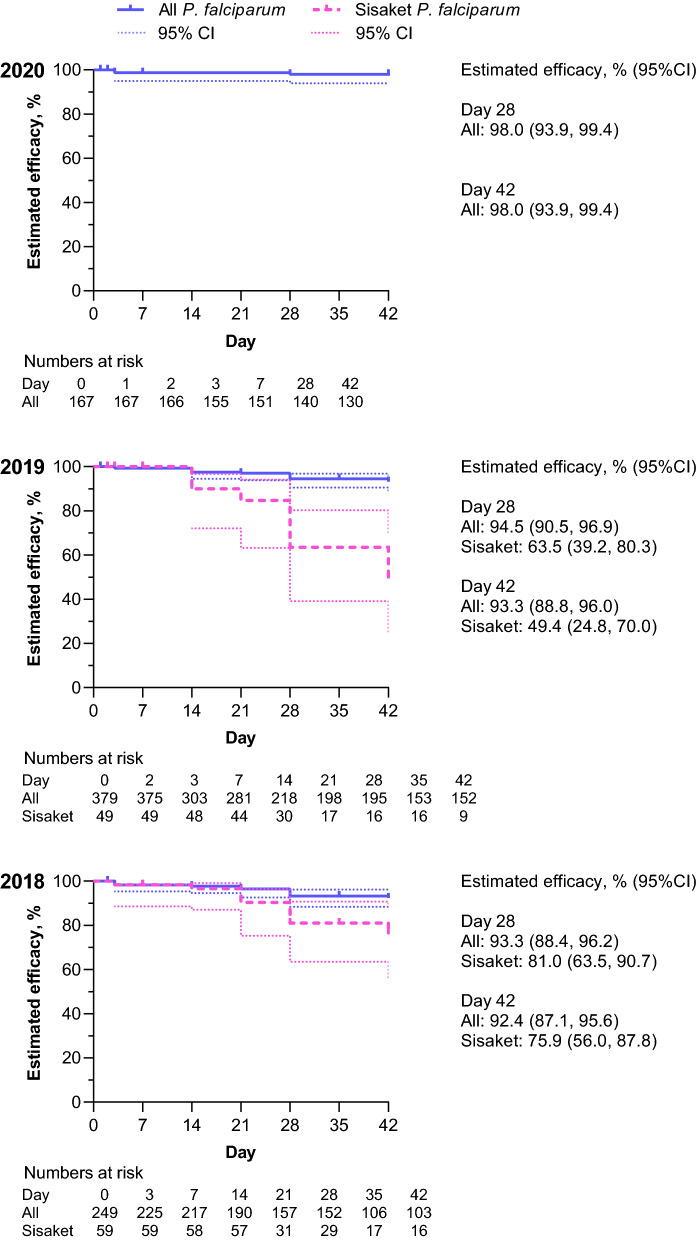
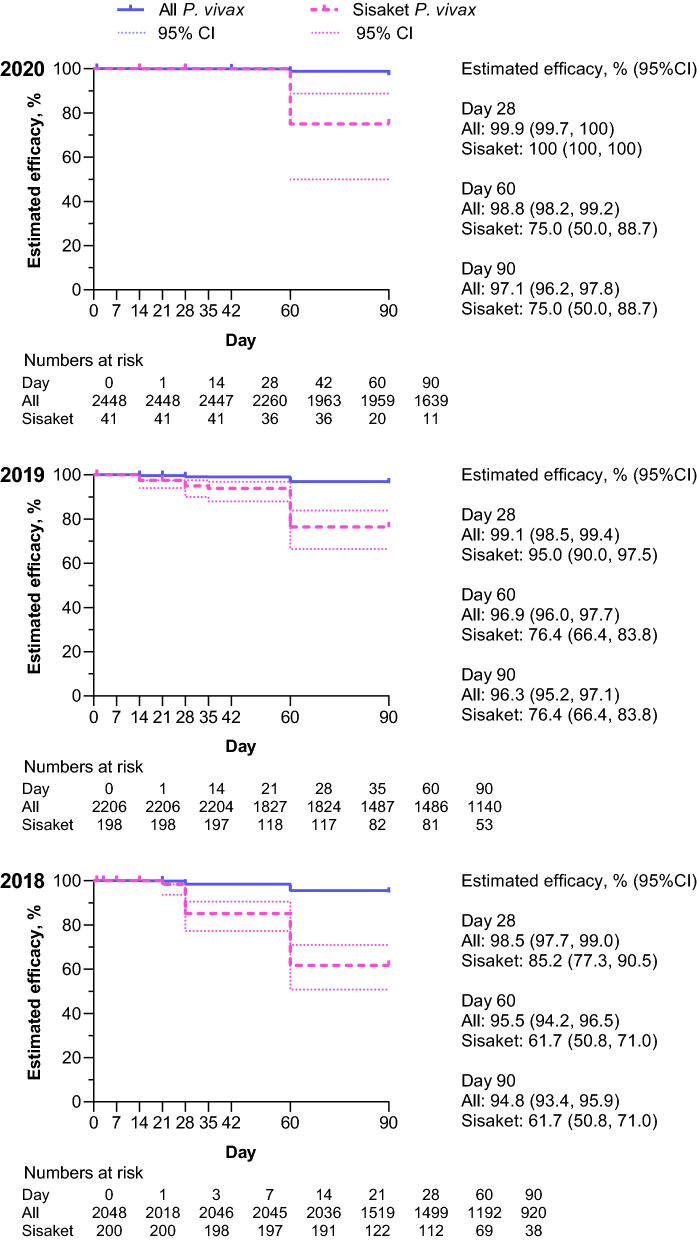
Results: The proportion of patients with outcomes recorded at day 42 for P. falciparum malaria and at day 28 for P. vivax malaria has been increasing, with FY2020 follow-up rates of 61.5% and 57.2%, respectively. For P. falciparum malaria, day 42 efficacy in FY2018 was 92.4% (n = 249), in FY2019 93.3% (n = 379), and in FY2020 98.0% (n = 167). Plasmodium falciparum recurrences occurred disproportionally in Sisaket Province, with day 42 efficacy rates of 75.9% in FY2018 (n = 59) and 49.4% in FY2019 (n = 49), leading to an update in first-line therapy to pyronaridine-artesunate at the provincial level, rolled out in FY2020. For P. vivax malaria, day 28 efficacy (chloroquine efficacy) was 98.5% in FY2018 (n = 2048), 99.1% in FY2019 (n = 2206), and 99.9% in FY2020 (n = 2448), and day 90 efficacy (primaquine efficacy) was 94.8%, 96.3%, and 97.1%, respectively.
Conclusions: In Thailand, iDES provided operationally relevant data on drug efficacy, enabling the rapid amendment of treatment guidelines to improve patient outcomes and reduce the potential for the spread of drug-resistant parasites. A strong case-based surveillance system, integration with other health system processes, supporting biomarker collection and molecular analyses, and cross-border collaboration may maximize the potential of iDES in countries moving towards elimination.
Keywords: Antimalarial; Drug efficacy; Drug resistance; Malaria elimination; Surveillance.
Conflict of interest statement
PS, AS, NK, TT, SK, RS, CL, and DA are employees of the Division of Vector Borne Diseases, Ministry of Public Health, Thailand. JAS and SN are employees of RTI International, Thailand. DG, PR, and MDB are staff members of the World Health Organization; the authors alone are responsible for the views expressed in this publication that do not necessarily represent the decisions, policy, or views of the World Health Organization. NP and DS are employees of the Regional Development Mission for Asia, United States Agency for International Development, Thailand. The authors have no further conflicts of interest to declare.
Figures
References
-
- Khamsiriwatchara A, Sudathip P, Sawang S, Vijakadge S, Potithavoranan T, Sangvichean A, et al. Artemisinin resistance containment project in Thailand. (I): implementation of electronic-based malaria information system for early case detection and individual case management in provinces along the Thai-Cambodian border. Malar J. 2012;11:247. doi: 10.1186/1475-2875-11-247. - DOI - PMC - PubMed
-
- WHO Regional Office for the Western Pacific. Strategy for malaria elimination in the Greater Mekong Subregion: 2015–2030. World Health Organization Regional Office for the Western Pacific; 2015. https://apps.who.int/iris/handle/10665/208203. Accessed 18 Feb 2021.
-
- Bureau of Vector Borne Diseases, Department of Disease Control, Ministry of Public Health Thailand. Guide to malaria elimination for Thailand's local administrative organizations and the health network. Nonthaburi: Thailand; 2019. http://malaria.ddc.moph.go.th/downloadfiles/Guide%20to%20Malaria%20Elimi.... Accessed 9 Oct 2020.
-
- Bureau of Vector Borne Diseases, Department of Disease Control, Ministry of Public Health Thailand. National malaria elimination strategy for Thailand 2017–2026. Nonthaburi: Thailand; 2016.
MeSH terms
Substances
Grants and funding
LinkOut - more resources
Full Text Sources
