. 2021 Jun 9;12(1):43.
doi: 10.1186/s13229-021-00450-w.

Genetic and morphological estimates of androgen exposure predict social deficits in multiple neurodevelopmental disorder cohorts

Affiliations

Genetic and morphological estimates of androgen exposure predict social deficits in multiple neurodevelopmental disorder cohorts

Brooke G McKenna et al. Mol Autism. .

Abstract

Background: Neurodevelopmental disorders (NDDs) such as autism spectrum disorder (ASD) display a strong male bias. Androgen exposure is profoundly increased in typical male development, but it also varies within the sexes, and previous work has sought to connect morphological proxies of androgen exposure, including digit ratio and facial morphology, to neurodevelopmental outcomes. The results of these studies have been mixed, and the relationships between androgen exposure and behavior remain unclear.

Methods: Here, we measured both digit ratio masculinity (DRM) and facial landmark masculinity (FLM) in the same neurodevelopmental cohort (N = 763) and compared these proxies of androgen exposure to clinical and parent-reported features as well as polygenic risk scores.

Results: We found that FLM was significantly associated with NDD diagnosis (ASD, ADHD, ID; all [Formula: see text]), while DRM was not. When testing for association with parent-reported problems, we found that both FLM and DRM were positively associated with concerns about social behavior ([Formula: see text], [Formula: see text]; [Formula: see text], [Formula: see text], respectively). Furthermore, we found evidence via polygenic risk scores (PRS) that DRM indexes masculinity via testosterone levels ([Formula: see text], [Formula: see text]), while FLM indexes masculinity through a negative relationship with sex hormone binding globulin (SHBG) levels ([Formula: see text], [Formula: see text]). Finally, using the SPARK cohort (N = 9419) we replicated the observed relationship between polygenic estimates of testosterone, SHBG, and social functioning ([Formula: see text], [Formula: see text], and [Formula: see text], [Formula: see text] for testosterone and SHBG, respectively). Remarkably, when considered over the extremes of each variable, these quantitative sex effects on social functioning were comparable to the effect of binary sex itself (binary male: [Formula: see text]; testosterone: [Formula: see text] from 0.1%-ile to 99.9%-ile; SHBG: [Formula: see text] from 0.1%-ile to 99.9%-ile).

Limitations: In the devGenes and SPARK cohorts, our analyses rely on indirect, rather than direct measurement of androgens and related molecules.

Conclusions: These findings and their replication in the large SPARK cohort lend support to the hypothesis that increasing net androgen exposure diminishes capacity for social functioning in both males and females.

Keywords: Androgen exposure; Autism spectrum disorder; Masculinity; Neurodevelopment; Social functioning.


Conflict of interest statement

The authors declare that they have no financial or other competing interests.

Figures
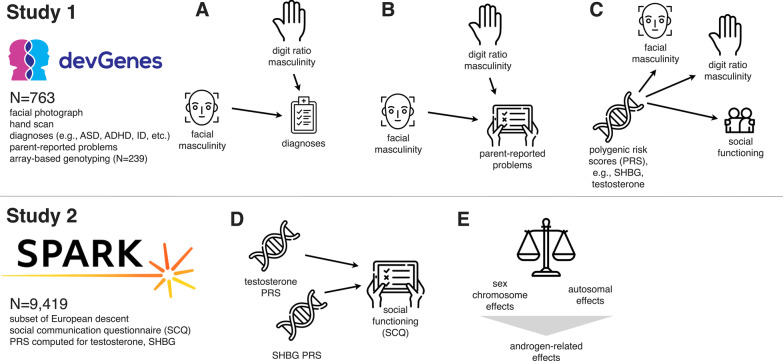
Fig. 1
Fig. 1
Study overview. Study 1 (devGenes, N = 763) investigated computer-generated proxies for masculinization that are evident in facial photographs and the 2D:4D ratio (hand scans), and the relationship of these masculinity measures to diagnoses (a), parent-reported problems (b), and polygenic risk scores (c). These investigations suggested involvement of androgen-related mechanisms in social functioning, a hypothesis we investigated further in study 2 (SPARK, N = 9419). In SPARK, we computed polygenic risk scores for testosterone levels and sex hormone binding globulin (SHBG) levels, and tested those for association with latent factors in the social communication questionnaire (SCQ) (d). This analysis revealed that binary sex effects (male or female) on these factor scores and items were comparable in magnitude to the effect of the polygenic risk scores, which are derived entirely from autosomal genotypes (e)
Fig. 2
Fig. 2
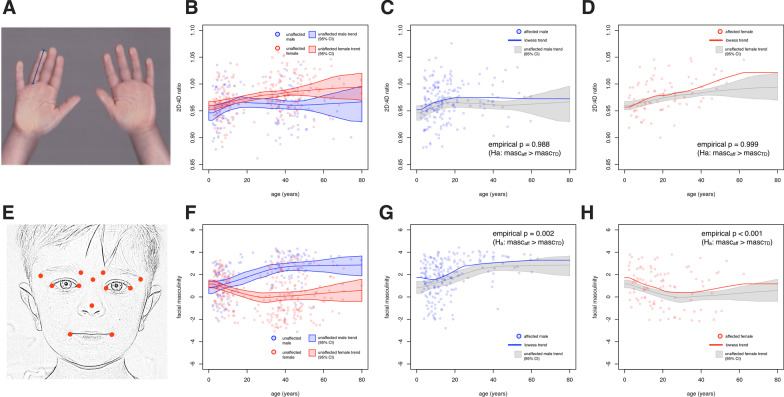
Masculinity as measured by digit ratio and facial landmarks. a Hand scans from devGenes participants were used to measure digit lengths and subsequently the ratio between the index and ring fingers (2D:4D ratio). b Cross-sectional data were collected from individuals spanning from age 2 to age 80. The 95% interval of the lowess trend of 2D:4D ratio vs. age for typically developing males and females is shown. c, d The 2D:4D ratio of affected males and affected females is shown with respect to the 95% confidence interval for their typically developing counterparts, with accompanying empirical p values. e Facial photographs from devGenes participants were used to calculate facial masculinity using a Random Forest classifier. f The lowess trends and 95% confidence interval for typically developing males and females is shown. g, h The facial masculinity of affected males and affected females is shown with respect to the 95% confidence interval for their typically developing counterparts, with empirical p values
Fig. 3
Fig. 3
Masculinity associations with diagnoses and parent-reported problems. When comparing the digit ratio masculinity (DRM) of undiagnosed (TD) individuals and diagnostic groups, no comparison was significant after correction for multiple testing (a). In contrast, a significant positive relationship was found for facial landmark masculinity (FLM) among individuals diagnosed with ADHD, ASD, or ID (b). When examining factor scores based on parent concerns of devGenes participants across a variety of domains (c), social functioning emerged as a point of convergence, where both DRM and FLM showed positive and independent associations with a factor loading on parent-reported concerns about lack of friends and social activity (d)
Fig. 4
Fig. 4
Polygenic associations with social functioning and morphological masculinity. Polygenic risk scores (PRS) for testosterone, SHBG, dissatisfaction with friendships, autism, ADHD, cognitive ability, and educational attainment were computed in the devGenes sample and used as a means to better understand potential genetic mechanisms underlying digit ratio (a) and facial masculinity (b) (DRM and FLM, respectively), as well as the social impairment factor they predict (c) (Fig. 3d). DRM is best predicted by testosterone PRS, while FLM is best predicted by SHBG PRS (a negative relationship). The social impairment factor suggests both a positive contribution by testosterone PRS and a negative contribution by SHBG PRS (both nominally significant at p0.05). The effect of testosterone and SHBG PRS (respectively) on DRM (d, e), FLM (f, g), and the social impairment factor (h, i) is shown. In (di), a SNP threshold of p<0.01 was used for testosterone PRS and p<0.1 for SHBG PRS (these are, respectively, where the associations with DRM and FLM achieved maximal significance)
Fig. 5
Fig. 5
Polygenic androgen signaling associations with social functioning in SPARK. Results of the social communication questionnaire (SCQ) from N = 9419 SPARK participants were synthesized into eight latent factors, whose scores were tested for association with binary sex, testosterone PRS, and SHBG PRS (a, ordered by decreasing effect size of binary sex). Factor loadings are shown in (b). Factor 8, which loads on imaginative, creative, and cooperative play, was significantly associated (p<0.05) with binary sex, testosterone PRS, and SHBG PRS, and in directions in agreement with our hypothesis. Some SCQ items were not well-captured by the factor structure, and so were considered separately (c). Of these, SCQ item 19 “has a best friend or friends” was likewise associated (p<0.05) with binary sex, testosterone PRS, and SHBG PRS in the anticipated directions. When considering the extremes of each explanatory variable (sex: male, female; testosterone and SHBG PRS: 0.1 and 99.9th percentiles) and scaling the effect parameter estimates across those ranges, we observed that the binary sex contribution to Factor 8 (d) and SCQ item 19 (e) was comparable in magnitude to the purely autosomal effects of testosterone and SHBG PRS

References

    1. Rutter M, Caspi A, Moffitt TE. Using sex differences in psychopathology to study causal mechanisms: unifying issues and research strategies. J Child Psychol Psychiatry. 2003;44(8):1092–1115. doi: 10.1111/1469-7610.00194. - DOI - PubMed
    1. Baron-Cohen S. The extreme male brain theory of autism. Trends Cogn Sci. 2002;6:248–254. doi: 10.1016/S1364-6613(02)01904-6. - DOI - PubMed
    1. Baron-Cohen S, Auyeung B, Ashwin E, Knickmeyer R, Lombardo M, Chakrabarti B. The extreme male brain theory of autism: the role of fetal androgens; Autism spectrum disorders. 2011. pp. 991–8.
    1. Baron-Cohen S, Lombardo M, Auyeung B, Ashwin E, Chakrabarti B, Knickmeyer R. Why are autism spectrum conditions more prevalent in males? PLoS Biol. 2011;9:e1001081. doi: 10.1371/journal.pbio.1001081. - DOI - PMC - PubMed
    1. Knickmeyer R, Baron-Cohen S. Topical review: fetal testosterone and sex differences in typical social development and in autism. J Child Neurol. 2006;21:825–845. doi: 10.1177/08830738060210101601. - DOI - PubMed

Publication types