. 2021 Jun 9;4(1):707.
doi: 10.1038/s42003-021-02245-4.

A pair of effectors encoded on a conditionally dispensable chromosome of Fusarium oxysporum suppress host-specific immunity

Affiliations

A pair of effectors encoded on a conditionally dispensable chromosome of Fusarium oxysporum suppress host-specific immunity

Yu Ayukawa et al. Commun Biol. .

Abstract

Many plant pathogenic fungi contain conditionally dispensable (CD) chromosomes that are associated with virulence, but not growth in vitro. Virulence-associated CD chromosomes carry genes encoding effectors and/or host-specific toxin biosynthesis enzymes that may contribute to determining host specificity. Fusarium oxysporum causes devastating diseases of more than 100 plant species. Among a large number of host-specific forms, F. oxysporum f. sp. conglutinans (Focn) can infect Brassicaceae plants including Arabidopsis (Arabidopsis thaliana) and cabbage. Here we show that Focn has multiple CD chromosomes. We identified specific CD chromosomes that are required for virulence on Arabidopsis, cabbage, or both, and describe a pair of effectors encoded on one of the CD chromosomes that is required for suppression of Arabidopsis-specific phytoalexin-based immunity. The effector pair is highly conserved in F. oxysporum isolates capable of infecting Arabidopsis, but not of other plants. This study provides insight into how host specificity of F. oxysporum may be determined by a pair of effector genes on a transmissible CD chromosome.


Conflict of interest statement

The authors declare no competing interests.

Figures
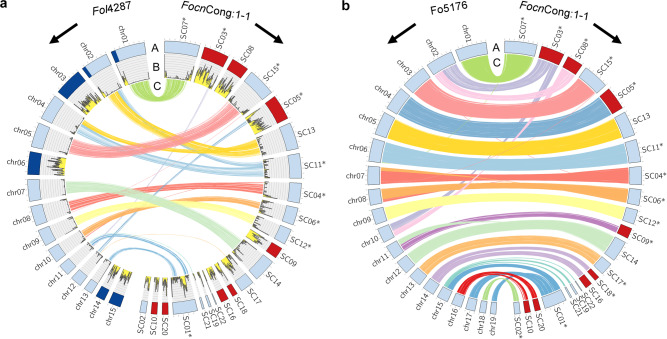
Fig. 1
Fig. 1. Comparison of whole genome assemblies among FocnCong:1-1, Fol4287, and Fo5176.
Whole genome assemblies were compared between Fol4287 and FocnCong:1-1 (a) and between Fo5176 and FocnCong:1-1 (b). Ring A: Circular representation of the pseudomolecules. Red and dark blue indicate dispensable genomic regions in FocnCong:1-1 and known accessory regions in Fol4287 (chr1B; chr2B; chr3; chr6; chr14; chr15), respectively. Light blue indicates the remaining regions. Ring B: Distribution of transposable elements (TEs) in 50 kb windows. Proportions of sequences of respective FocnCong:1-1 SCs associated with TEs are shown in Supplementary Fig. 1. Ring C: Syntenic regions (>95% identity, 30 kb) between Fol4287 and FocnCong:1-1 assemblies (a) and between Fo5176 and FocnCong:1-1 assemblies (b). Asterisks indicate reverse-complemented scaffolds (SCs) for visual clarity. Ticks on bands represent 1 Mb.
Fig. 2
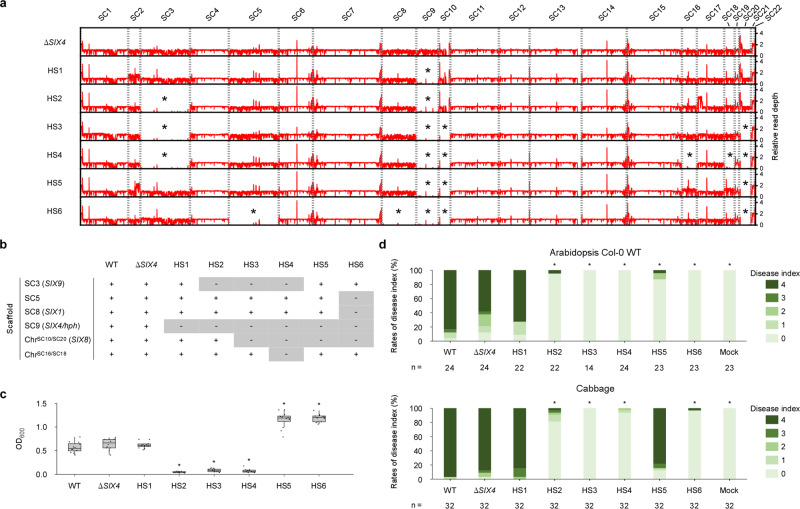
Fig. 2. Effects of loss of conditionally dispensable chromosomes on conidial formation and virulence in FocnCong:1-1.
a Relative read mapping depths of FocnCong:1-1 ΔSIX4 and HSs whole genomes. Asterisks indicate scaffold (SC)-level deletion. b Loss patterns of SC in FocnCong:1-1 HSs. + and – represent maintained- and lost-SCs, respectively. SIXs located on particular SCs are shown in parentheses. c Conidial formation in FocnCong:1-1 WT, ΔSIX4 and HSs. OD600 of conidial suspensions was measured from six colonies after 17 days of incubation on potato dextrose agar. Results of two independent experiments were combined and a total of twelve biological replicates per isolate are plotted. Boxplots indicate median value, estimated 25th and 75th percentiles, and whiskers represent 1.5 times the interquartile range. Asterisks represent significant differences from FocnCong:1-1 ΔSIX4 (*p < 0.0001, Welch’s t-test). d Virulence of FocnCong:1-1 WT, ΔSIX4 and HSs to Arabidopsis and cabbage. Disease index was scored as described in Methods. Results of at least two experiments were combined. n denotes the number of plants investigated. Asterisks represent significant differences from FocnCong:1-1 ΔSIX4 (*p < 0.001, Mann–Whitney U-test). Representative images of Arabidopsis and cabbage at 28 dpi are shown in Supplementary Fig. 5.
Fig. 3
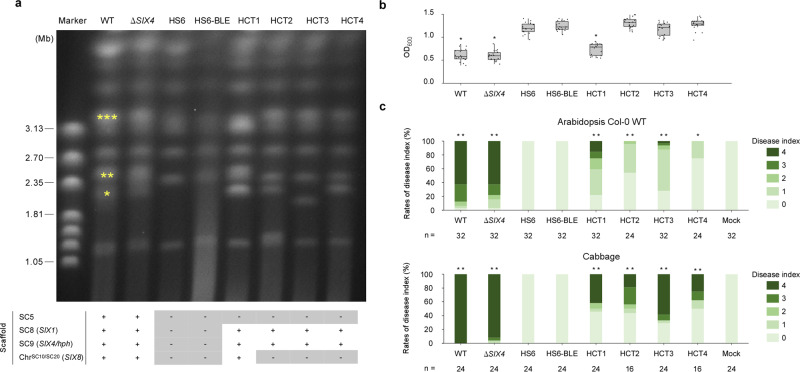
Fig. 3. Effects of chromosome transfer on conidial formation and virulence in FocnCong:1-1 HS6.
a Electrophoretic karyotype of FocnCong:1-1 WT, ΔSIX4, HS6, HS6-BLE, and HCTs. Asterisks indicate chromosomes on which SIX genes are located: *SIX4, **SIX8, ***SIX1. The table indicates the scaffold (SC) patterns confirmed by PCR as shown in Supplementary Fig. 6a. + and – represent maintained- and lost-SCs, respectively. SIXs located on SCs are shown in parentheses. b Conidial formation in FocnCong:1-1 WT, ΔSIX4, HS6, HS6-BLE, and HCTs. OD600 of conidial suspension was measured from six colonies after 17 days of incubation on potato dextrose agar. Results of three independent experiments were combined and a total of 18 biological replicates are plotted. Boxplots indicate median value, estimated 25th and 75th percentiles, and whiskers represent 1.5 times the interquartile range. Asterisks represent significant differences from FocnCong:1-1 HS6-BLE (*p < 0.0001, Welch’s t-test). c Virulence of FocnCong:1-1 WT, ΔSIX4, HS6, HS6-BLE, and HCTs on Arabidopsis and cabbage. Disease index was scored as described in Methods. Results of at least two independent experiments were combined. n denotes the number of plants investigated. Asterisks represent significant difference from FocnCong:1-1 HS6-BLE (**p < 0.001, *p < 0.01 Mann–Whitney U-test). Representative images of Arabidopsis and cabbage at 28 dpi are shown in Supplementary Fig. 9.
Fig. 4
Fig. 4. Involvement of chrSC10/SC20 in suppression of CYP79B2/CYP79B3-mediated immunity.
a Virulence of FocnCong:1-1 WT, ΔSIX4 and HSs on Arabidopsis Col-0 WT and the cyp79b2/cyp79b3 double mutant. Disease index was scored as described in Methods. Results of three independent experiments were combined. n denotes the number of plants investigated. Asterisks represent significant difference from FocnCong:1-1 ΔSIX4 (*p < 0.001, Mann–Whitney U-test). Representative images of Arabidopsis at 28 dpi are shown in Supplementary Fig. 10a, b. b Infection phenotypes of FocnCong:1-1 ΔSIX4, HS2 and HS5 in Arabidopsis. Colonization index of Arabidopsis Col-0 WT and cyp79b2/cyp79b3 double mutant inoculated with GFP-labeled FocnCong:1-1 ΔSIX4SIX4-GFP), HS2 (HS2-GFP) or HS5 (HS5-GFP) at 12 dpi was scored from 0 to 2: 0, germination or colonization on root surface; 1, colonization in xylem vessels of roots, 2, transition from roots to stems. Results of at least two independent experiments were combined. n denotes the number of plants investigated. Asterisks represent significant differences from FocnCong:1-1 ΔSIX4-GFP (**p < 0.001, *p < 0.01, Mann–Whitney U-test). Representative images of root or stem of Arabidopsis at 12 dpi are shown above each bar. Scale bars indicate 200 μm. S stems, R roots. c A simple scheme of biosynthesis of tryptophan (Trp)-derived defense compounds in Arabidopsis. IAOx indole-3-acetaldoxime, 4-OH-ICN 4-hydroxy-indole carbonyl nitrile. d Virulence of FocnCong:1-1 HS5 on Arabidopsis Col-0 WT, pad3, pen2, and cyp82c2 mutants. Disease index was scored as described in Methods. Results of three independent experiments were combined. n denotes the number of plants investigated. Asterisks represent significant difference from Arabidopsis Col-0 WT infected with FocnCong:1-1 HS5 (*p < 0.01, Mann–Whitney U-test). Representative images of Arabidopsis at 28 dpi are shown in Supplementary Fig. 10c.
Fig. 5
Fig. 5. The SIX8-PSE1 locus is involved in virulence of FocnCong:1-1 on Arabidopsis.
a Relative transcript levels of FocnCong_v001893 (SIX8) and FocnCong_v001894 (PSE1) during infection of Arabidopsis Col-0 WT at 3 and 10 dpi. Data from three biologically independent samples are presented as fold changes compared with expression levels in bud cells. Expression levels were determined by qRT-PCR and normalized against FocnCong:1-1 β-tubulin (TUB2). Boxplots indicate median value, estimated 25th and 75th percentiles, and whiskers represent 1.5 times the interquartile range. b Schematic representation of the SIX8-PSE1 locus in FocnCong:1-1. mimp-IR miniature impala-like inverted repeat. c Virulence of FocnCong:1-1 ΔSIX4, HS5, and HS5 transformants introduced with SIX8 (HS5:SIX8), PSE1 (HS5:PSE1) or both (HS5:SIX8-PSE1) on Arabidopsis Col-0 WT. Disease index was scored as described in Methods. n denotes the number of plants investigated. Asterisks represent significant difference from FocnCong:1-1 HS5. (*p < 0.001, Mann–Whitney U-test). Representative images of Arabidopsis at 28 dpi are shown in Supplementary Fig. 14a. d Disease index of Arabidopsis Col-0 WT challenged with FocnCong:1-1 WT, ΔSIX8-PSE1, an ectopic transformant (ect) or water (mock) at 28 dpi was scored as described in Methods. Results of three independent experiments were combined. n denotes the number of plants investigated. Asterisks represent significant difference from WT (*p < 0.05, Mann–Whitney U-test). Representative images of Arabidopsis at 28 dpi are shown in Supplementary Fig. 14b.
Fig. 6
Fig. 6. Genetic and functional conservation of a pair of effectors, SIX8 and PSE1, among F. oxysporum isolates.
Comparison of the SIX8-PSE1 loci in Arabidopsis-infecting (a) and non-Arabidopsis-infecting F. oxysporum isolates (b). A red region in the arrowhead of PSL1 indicates a region of 10 amino acids that differ from PSE1. The amino acid level identity (%) to FocnCong:1-1 SIX8 or PSE1 is shown in parentheses. FocnCong:1-1, F. oxysporum f. sp. conglutinans Cong:1-1; FomtPHW726, F. oxysporum f. sp. matthiolae PHW726; Fol4287, F. oxysporum f. sp. lycopersici 4287; FocbTR4, F. oxysporum f. sp. cubense tropical race 4; Focb160527, F. oxysporum f. sp. cubense 160527; Forc016, F. oxysporum f. sp. radicis-cucumerinum 016; Fom26406, F. oxysporum f. sp. melonis 26406; FoceFus2, F. oxysporum f. sp. cepae Fus2; FovTF1, Fusarium oxysporum f. sp. vasinfectum TF1. c Virulence of FocnCong:1-1 HS5 transformants introduced with a hygromycin B resistance gene (hph) cassette (HS5:empty), the Fomt SIX8-PSE1 locus (HS5:Fomt SIX8-PSE1) and the Fol SIX8-PSL1 locus (HS5:Fol SIX8-PSL1) on Arabidopsis Col-0 WT. Disease index was scored as described in Methods. Results of six independent experiments were combined. n denotes the number of plants investigated. Asterisks represent significant difference from FocnCong:1-1 HS5:empty. (*p < 0.01, Mann–Whitney U-test). Representative images of Arabidopsis at 28 dpi are shown in Supplementary Fig. 21.

References

    1. Covert SF. Supernumerary chromosomes in filamentous fungi. Curr. Genet. 1998;33:311–319. doi: 10.1007/s002940050342. - DOI - PubMed
    1. Soyer JL, Balesdent MH, Rouxel T, Dean RA. To B or not to B: a tale of unorthodox chromosomes. Curr. Opin. Microbiol. 2018;46:50–57. doi: 10.1016/j.mib.2018.01.012. - DOI - PubMed
    1. Miao VP, Covert SF, VanEtten HD. A fungal gene for antibiotic resistance on a dispensable (“B”) chromosome. Science. 1991;254:1773–1776. doi: 10.1126/science.1763326. - DOI - PubMed
    1. Tsuge T, et al. Host-selective toxins produced by the plant pathogenic fungus Alternaria alternata. FEMS Microbiol. Rev. 2013;37:44–66. doi: 10.1111/j.1574-6976.2012.00350.x. - DOI - PubMed
    1. Edel-Hermann V, Lecomte C. Current status of Fusarium oxysporum formae speciales and races. Phytopathology. 2019;109:512–530. doi: 10.1094/PHYTO-08-18-0320-RVW. - DOI - PubMed

Publication types

MeSH terms

Supplementary concepts