Review
. 2021 Jun 10;22(1):55.
doi: 10.1186/s10194-021-01271-1.

Migraine and neuroinflammation: the inflammasome perspective

Affiliations
Review

Migraine and neuroinflammation: the inflammasome perspective

Oguzhan Kursun et al. J Headache Pain. .

Abstract

Background: Neuroinflammation has an important role in the pathophysiology of migraine, which is a complex neuro-glio-vascular disorder. The main aim of this review is to highlight findings of cortical spreading depolarization (CSD)-induced neuroinflammatory signaling in brain parenchyma from the inflammasome perspective. In addition, we discuss the limited data of the contribution of inflammasomes to other aspects of migraine pathophysiology, foremost the activation of the trigeminovascular system and thereby the generation of migraine pain.

Main body: Inflammasomes are signaling multiprotein complexes and key components of the innate immune system. Their activation causes the production of inflammatory cytokines that can stimulate trigeminal neurons and are thus relevant to the generation of migraine pain. The contribution of inflammasome activation to pain signaling has attracted considerable attention in recent years. Nucleotide-binding domain (NOD)-like receptor family pyrin domain containing 3 (NLRP3) is the best characterized inflammasome and there is emerging evidence of its role in a variety of inflammatory pain conditions, including migraine. In this review, we discuss, from an inflammasome point of view, cortical spreading depolarization (CSD)-induced neuroinflammatory signaling in brain parenchyma, the connection with genetic factors that make the brain vulnerable to CSD, and the relation of the inflammasome with diseases that are co-morbid with migraine, including stroke, epilepsy, and the possible links with COVID-19 infection.

Conclusion: Neuroinflammatory pathways, specifically those involving inflammasome proteins, seem promising candidates as treatment targets, and perhaps even biomarkers, in migraine.

Keywords: Comorbidity; Cortical spreading depolarization; Inflammasome; Migraine; Mitochondrial DNA; Neuroinflammation.


Conflict of interest statement

The authors declare that they have no competing interests.

Figures
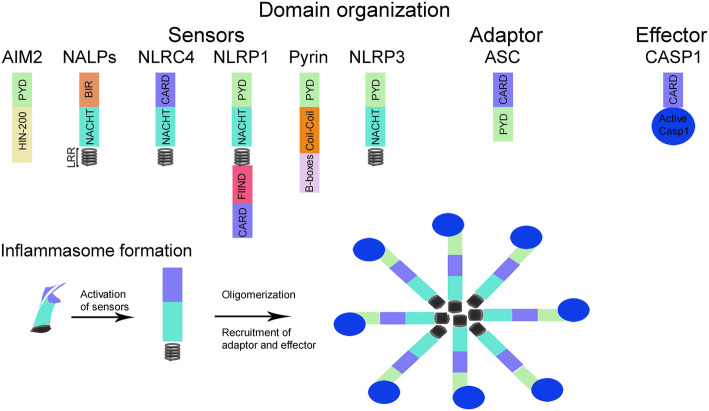
Fig. 1
Fig. 1
Simplified scheme of inflammasome elements, types and formation. Domain organization and basic inflammasome formation. At the molecular level, assembly of inflammasome signaling complexes is mediated through interactions between homotypic protein domains. The domains of AIM2, NALPs, NLRC4, NLRP1, Pyrin, NLRP3, ASC, and CASP1 are shown here. The inflammasome is composed of a sensor, adaptor, and effector protein. Several inflammasomes contain a PYD, responsible for the recruitment of the adaptor protein ASC. After activation, inflammasomes using this adaptor interact with ASC through PYD–PYD interactions, forming large, filamentous oligomers. ASC then recruits CASP1 across CARD–CARD interactions. NLRP1 and NLRC4 may directly interact with CASP1 by CARD–CARD interactions, though these NLRs could also interact with ASC via CARD–CARD interactions. After activation, the sensor oligomerizes and recruits the adaptor and effector proteins to the inflammasome complex. ASC, apoptosis-associated speck-like protein containing a caspase recruitment domain; AIM2, absent in melanoma 2; BIR, baculoviral inhibitor of apoptosis protein repeat; FIIND, function-to-find domain; CARD, caspase recruitment domain; CASP, caspase; LRR, leucine-rich repeat; NALP, Nucleotide-binding oligomerization domain, Leucine-rich Repeat and Pyrin domain containing; NLRC4, NLR family CARD domain-containing protein 4; NLRP1, nucleotide-binding domain (NOD)-like receptor family pyrin domain containing 1; NLRP3, nucleotide-binding domain (NOD)-like receptor family pyrin domain containing 3; PYD, pyrin domain
Fig. 2
Fig. 2
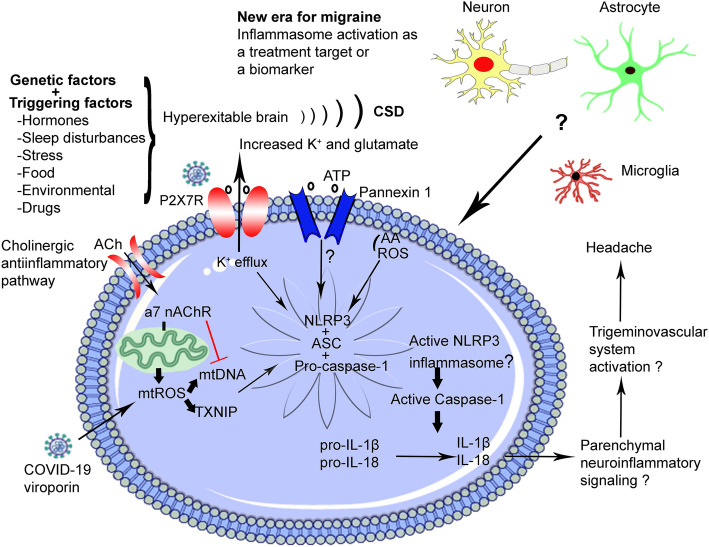
New era for migraine: Inflammasome activation as a treatment target or a biomarker. In the background of genetically hyperexcitable brain, triggering factors induce CSD which results in Pannexin-1 megachannel opening and K+ efflux from P2X7R, consequently creates stress on the cell. Reactive oxygen species (ROS) from membranous Arachidonic acid (AA) and mitochondria respond to this cellular stress via mtROS production which is sensed by mtDNA and TXNIP. K+ efflux, mtDNA and Pannexin-1 megachannel opening cause the assembly of inflammasome complex elements (NLRP3, ASC, pro-caspase-1) and activation of caspase-1 which cleaves pro forms of IL-1β and IL-18 and ignites parenchymal neuroinflammatory signaling to alert adjacent cells. This cascade eventually reaches the trigeminovascular system around meningeal vessels which results in activation of this system and consequently headache. COVID-19 viroporins induce NLRP3 inflammasome formation via increase in mitochondrial ROS production. This may be an overlapping mechanism in migraine and COVID-19 headache. On the contrary, ACh, main actor in cholinergic anti-inflammatory pathway, inhibits NLRP3 inflammasome by decreasing mtDNA release through binding to mitochondrial α7 nAChR

References

    1. Headache Classification Committee of the International Headache Society (IHS) The International Classification of Headache Disorders, 3rd edition. Cephalalgia. 2018;38(1):1–211. doi: 10.1177/0333102417738202. - DOI - PubMed
    1. Collaborators GeBDH Global, regional, and national burden of migraine and tension-type headache, 1990-2016: a systematic analysis for the global burden of disease study 2016. Lancet Neurol. 2018;17(11):954–976. doi: 10.1016/S1474-4422(18)30322-3. - DOI - PMC - PubMed
    1. Buse DC, Loder EW, Gorman JA, Stewart WF, Reed ML, Fanning KM, Serrano D, Lipton RB. Sex differences in the prevalence, symptoms, and associated features of migraine, probable migraine and other severe headache: results of the American Migraine Prevalence and Prevention (AMPP) study. Headache. 2013;53(8):1278–1299. doi: 10.1111/head.12150. - DOI - PubMed
    1. Messali A, Sanderson JC, Blumenfeld AM, Goadsby PJ, Buse DC, Varon SF, et al. Direct and indirect costs of chronic and episodic migraine in the United States: a web-based survey. Headache. 2016;56(2):306–322. doi: 10.1111/head.12755. - DOI - PubMed
    1. Gilhus NE, Deuschl G. Neuroinflammation - a common thread in neurological disorders. Nat Rev Neurol. 2019;15(8):429–430. doi: 10.1038/s41582-019-0227-8. - DOI - PubMed

Substances