Review
. 2021:96:251-310.
doi: 10.1016/bs.afnr.2021.01.003. Epub 2021 May 24.

Zinc

Affiliations
Review

Zinc

Anatoly V Skalny et al. Adv Food Nutr Res. 2021.

Abstract

Since the discovery of manifest Zn deficiency in 1961, the increasing number of studies demonstrated the association between altered Zn status and multiple diseases. In this chapter, we provide a review of the most recent advances on the role of Zn in health and disease (2010-20), with a special focus on the role of Zn in neurodegenerative and neurodevelopmental disorders, diabetes and obesity, male and female reproduction, as well as COVID-19. In parallel with the revealed tight association between ASD risk and severity and Zn status, the particular mechanisms linking Zn2+ and ASD pathogenesis like modulation of synaptic plasticity through ProSAP/Shank scaffold, neurotransmitter metabolism, and gut microbiota, have been elucidated. The increasing body of data indicate the potential involvement of Zn2+ metabolism in neurodegeneration. Systemic Zn levels in Alzheimer's and Parkinson's disease were found to be reduced, whereas its sequestration in brain may result in modulation of amyloid β and α-synuclein processing with subsequent toxic effects. Zn2+ was shown to possess adipotropic effects through the role of zinc transporters, zinc finger proteins, and Zn-α2-glycoprotein in adipose tissue physiology, underlying its particular role in pathogenesis of obesity and diabetes mellitus type 2. Recent findings also contribute to further understanding of the role of Zn2+ in spermatogenesis and sperm functioning, as well as oocyte development and fertilization. Finally, Zn2+ was shown to be the potential adjuvant therapy in management of novel coronavirus infection (COVID-19), underlining the perspectives of zinc in management of old and new threats.

Keywords: Autism; Diabetes; Infertility; Neurodegeneration; Obesity.


Figures

Fig. 1
Fig. 1
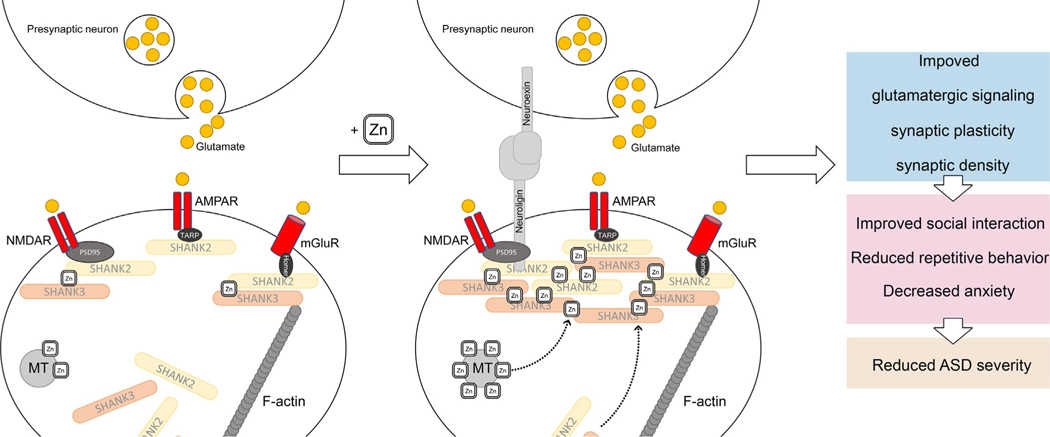
Involvement of ProSAP/Shank scaffold Zn2+-induced modulation of synaptic (dys)function in ASD. Zn2+ supplementation was shown to increase SHANK2 recruitment to synapses, modulate postsynaptic NMDAR currents (Fourie et al., 2018), increase Shank gene expression, and improve synaptic density (Hagmeyer, Mangus, Boeckers, & Grabrucker, 2015), altogether resulting in improved social interaction and reduced autism-like repetitive and anxiety behaviors (Fourie et al., 2018; Lee et al., 2015). Furthermore, Zn deficiency is associated with altered synapse plasticity, formation, and maturation (Grabrucker, 2014; Grabrucker et al., 2014).
Fig. 2
Fig. 2
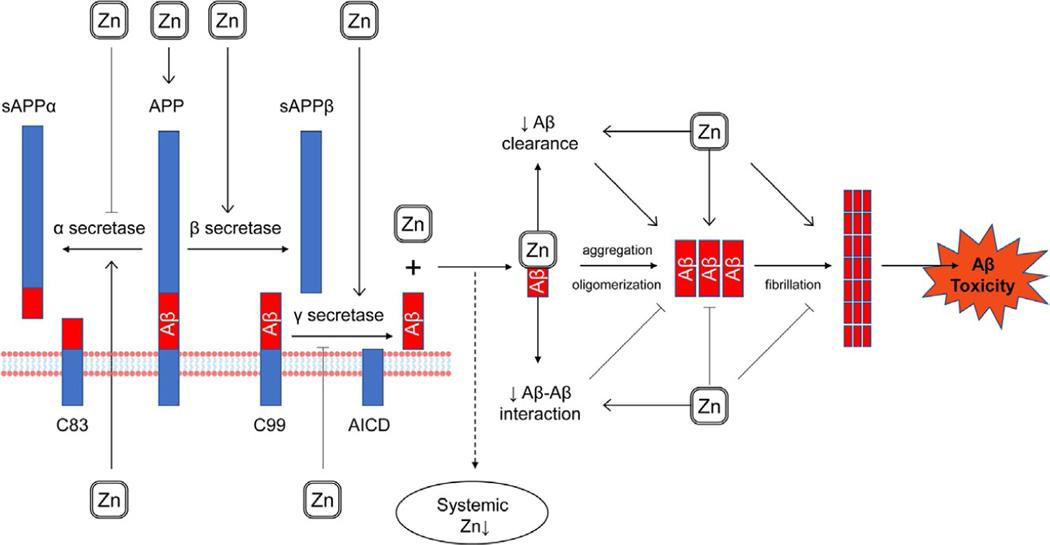
The impact of Zn2+ on amyloid production and processing. Zn2+ is capable of direct interaction with amyloid β, although data on this interaction have yet to be fully delineated. On one hand, Zn2+-Aβ binding induced protein oligomerization (Istrate et al., 2016) and subsequent aggregation (Khatua, Mondal, & Bandyopadhyay, 2019), whereas its prevention was shown to reduce Aβ toxicity (Takeda & Tamano, 2015). On another hand, certain studies reported that Zn2+ may decrease Aβ-Aβ interactions (Hane, Hayes, Lee, & Leonenko, 2016) and reduced fibril elongation (Abelein, Gräslund, & Danielsson, 2015). In turn, direct interaction between Zn2 + and Aβ results in plaque Zn sequestration ultimately leading to a decrease in systemic Zn levels (Baum et al., 2010). In addition to direct interaction with Aβ, Zn2+ was also shown to modulate amyloidogenic pathways (Kim, Lim, & Kim, 2018), although the data are highly contradictory. Particularly, certain studies demonstrated antiamyloidogenic effects of Zn2+ through inhibition of γ-secretase (Li, Liu, Xu, Li, & Xu, 2018), whereas others revealed activation of amyloidogenic pathway through inhibition of α-secretase and a concomitant activation of β- and γ-secretase (Wang et al., 2010).
Fig. 3
Fig. 3
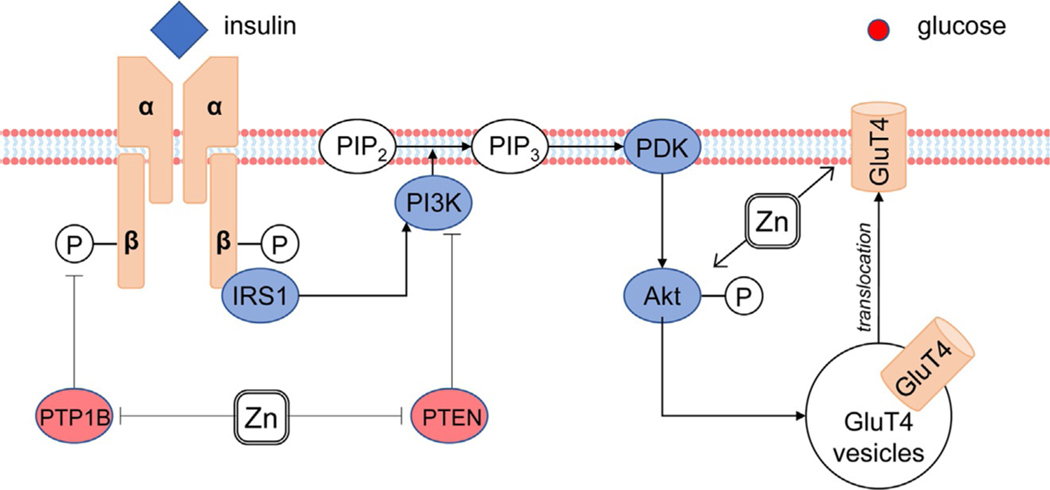
Involvement of Zn2+ in insulin signal transduction. Zn2+ increases phosphorylation of insulin receptor through inhibition of PTP1B, as well as up-regulates phosphoinositide 3-kinase (PI3K)/Akt due to PTEN down-regulation. These effects mediate stimulatory effects of Zn2+ on GluT4 translocation and glucose uptake. It is also notable that Akt phosphorylation and inhibition of PTP1B and PTEN activity that were observed without activation of insulin receptor (Naito, Yoshikawa, Masuda, & Yasui, 2016).

References

    1. Abdollahi S, Toupchian O, Jayedi A, Meyre D, Tam V, & Soltani S. (2020). Zinc supplementation and body weight: A systematic review and dose–response meta-analysis of randomized controlled trials. Advances in Nutrition, 11(2), 398–411. - PMC - PubMed
    1. Abedini M, Ghaedi E, Hadi A, Mohammadi H, & Amani R. (2019). Zinc status and polycystic ovarian syndrome: A systematic review and meta-analysis. Journal of Trace Elements in Medicine and Biology, 52, 216–221. - PubMed
    1. Abelein A, Gräslund A, & Danielsson J. (2015). Zinc as chaperone-mimicking agent for retardation of amyloid β peptide fibril formation. Proceedings of the National Academy of Sciences of the United States of America, 112(17), 5407–5412. - PMC - PubMed
    1. Abregú FMG, Gobetto MN, Castañón A, Lucero D, Caniffi C, Elesgaray R, et al. (2019). Fetal and postnatal zinc restriction: Sex differences in metabolic alterations in adult rats. Nutrition, 65, 18–26. - PubMed
    1. Abuarab N, Munsey TS, Jiang LH, Li J, & Sivaprasadarao A. (2017). High glucose–induced ROS activates TRPM2 to trigger lysosomal membrane permeabilization and Zn2 +-mediated mitochondrial fission. Science Signaling, 10(490), eaal4161. - PubMed