


Prediction of caregiver quality of life in amyotrophic lateral sclerosis using explainable machine learning
- PMID: 34112871
- PMCID: PMC8192926
- DOI: 10.1038/s41598-021-91632-2
Prediction of caregiver quality of life in amyotrophic lateral sclerosis using explainable machine learning
Abstract
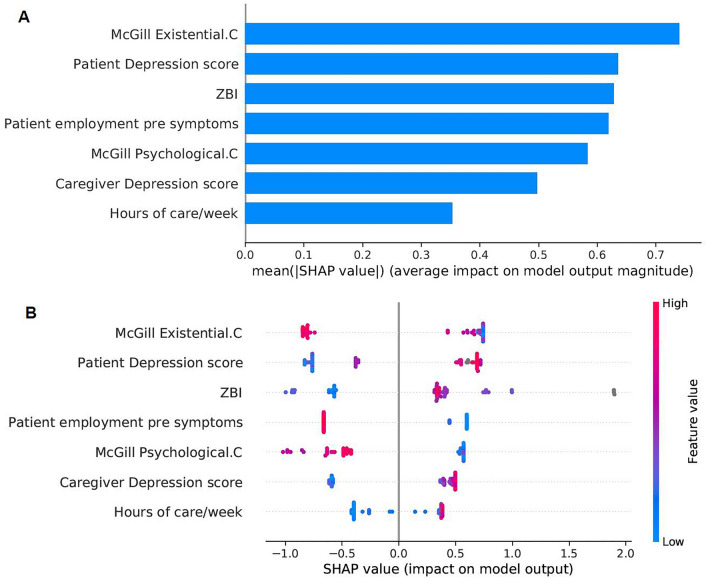
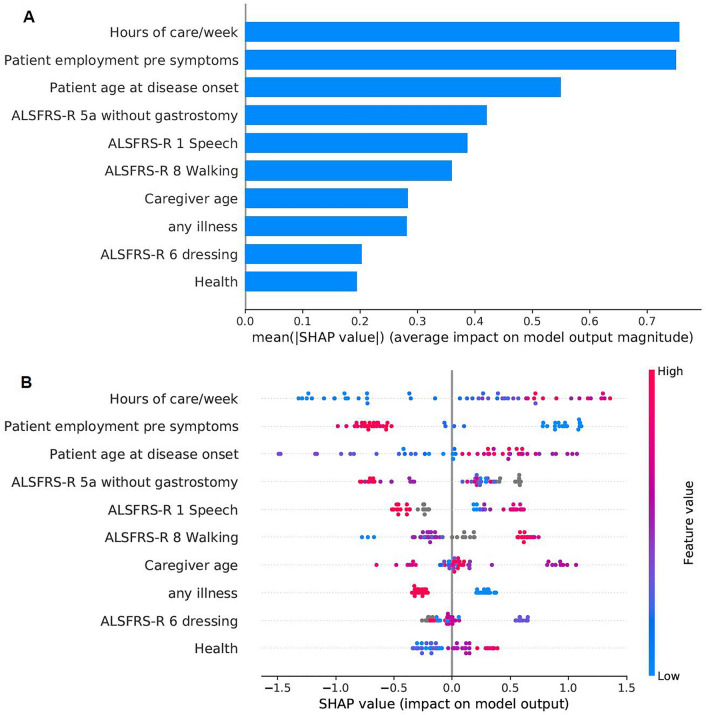
Amyotrophic Lateral Sclerosis (ALS) is a rare neurodegenerative, fatal and currently incurable disease. People with ALS need support from informal caregivers due to the motor and cognitive decline caused by the disease. This study aims to identify caregivers whose quality of life (QoL) may be impacted as a result of caring for a person with ALS. In this study, we worked towards the identification of the predictors of a caregiver's QoL in addition to the development of a model for clinical use to alert clinicians when a caregiver is at risk of experiencing low QoL. The data were collected through the Irish ALS Registry and via interviews on several topics with 90 patient and caregiver pairs at three time-points. The McGill QoL questionnaire was used to assess caregiver QoL-the MQoL Single Item Score measures the overall QoL and was selected as the outcome of interest in this work. The caregiver's existential QoL and burden, as well as the patient's depression and employment before the onset of symptoms were the features that had the highest impact in predicting caregiver quality of life. A small subset of features that could be easy to collect was used to develop a second model to use it in a clinical setting. The most predictive features for that model were the weekly caregiving duties, age and health of the caregiver, as well as the patient's physical functioning and age of onset.
Conflict of interest statement
O.H. is a lead investigator on projects that have received research funding from the following pharmaceutical companies and CROs: Biogen, Ionis, Cytokinetics, Novartis, Takeda, Merk, IQVIA, ICON. O.H. has consulted and received honoraria from the following companies: Biogen, Cytokinetics, Denali, Orphazyme, Neurosense, Aclipse, Wave Pharmaceuticals, Novartis. O.H. is the Editor in Chief of the Journal Amyotrophic Lateral Sclerosis and the Frontotemporal Degenerations. A.A., M.G., M.H. and C.M. declare no competing interests.
Figures

References
-
- Talbott, E., Malek, A. & Lacomis, D. The epidemiology of amyotrophic lateral sclerosis. In Handbook of Clinical Neurology Vol. 138 225–238 (Elsevier, 2016). - PubMed
-
- Olsson Ozanne, A. G., Strang, S. & Persson, L. I. Quality of life, anxiety and depression in als patients and their next of kin. J. Clin. Nurs.20, 283–291 (2011). - PubMed
Publication types
MeSH terms
LinkOut - more resources
Full Text Sources
Medical
Miscellaneous
