


High-performance dialyzers and mortality in maintenance hemodialysis patients
- PMID: 34112908
- PMCID: PMC8192518
- DOI: 10.1038/s41598-021-91751-w
High-performance dialyzers and mortality in maintenance hemodialysis patients
Abstract
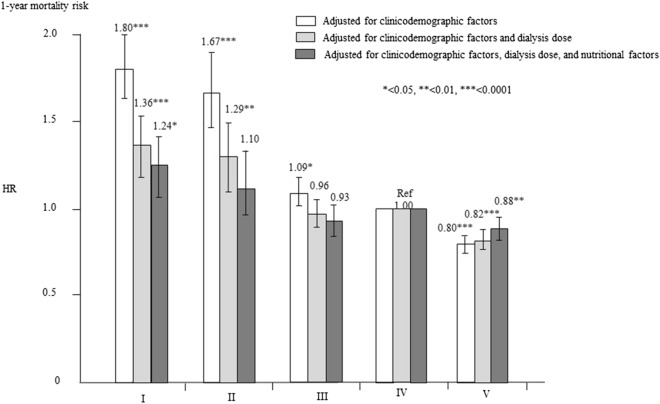
Few data are available regarding the association of dialyzer type with prognosis. In Japan, dialyzers are classified as types I, II, III, IV, and V based on β2-microglobulin clearance rates of < 10, < 30, < 50, < 70, and ≥ 70 mL/min, respectively. We investigated the relationship of the 5 dialyzer types with 1-year mortality. This nationwide cohort study used data collected at the end of 2008 and 2009 by the Japanese Society for Dialysis Therapy Renal Data Registry. We enrolled 203,008 patients on maintenance hemodialysis who underwent hemodialysis for at least 1 year and were managed with any of the 5 dialyzer types. To evaluate the association of dialyzer type with 1-year all-cause mortality, Cox proportional hazards models and propensity score-matched analyses were performed. After adjustment of the data with clinicodemographic factors, the type I, II, and III groups showed significantly higher hazard ratios (HRs) than the type IV dialyzers (reference). After adjustment for Kt/V and β2-microglobulin levels, the HRs were significantly higher in the type I and II groups. After further adjustment for nutrition- and inflammation-related factors, the HRs were not significantly different between the type IV and type I and II groups. However, type V dialyzers consistently showed a significantly lower HR. With propensity score matching, the HR for the type V dialyzer group was significantly lower than that for the type IV dialyzer group. Additional long-term trials are required to determine whether type V dialyzers, which are high-performance dialyzers, can improve prognosis.
Conflict of interest statement
The authors declare no competing interests.
Figures


References
-
- Foreman KJ, et al. Forecasting life expectancy, years of life lost, and all-cause and cause-specific mortality for 250 causes of death: Reference and alternative scenarios for 2016–40 for 195 countries and territories. Lancet. 2018;392:2052–2090. doi: 10.1016/S0140-6736(18)31694-5. - DOI - PMC - PubMed
-
- Tattersall J, et al. EBPG guideline on dialysis strategies. Nephrol. Dial. Transplant. 2007;22(Suppl 2):ii5–ii21. - PubMed
-
- National Kidney Foundation Clinical practice guidelines for hemodialysis adequacy, update 2006. Am. J. Kidney. Dis. 2006;48(Suppl 1):S2–S90. - PubMed
-
- Watanabe Y, et al. Maintenance hemodialysis: Hemodialysis Prescriptions” Guideline Working Group, Japanese Society for Dialysis Therapy. Japanese society for dialysis therapy clinical guideline for “Maintenance hemodialysis: Hemodialysis prescriptions. Ther. Apher. Dial. 2015;19(Suppl 1):67–92. doi: 10.1111/1744-9987.12294. - DOI - PubMed
MeSH terms
Substances
LinkOut - more resources
Full Text Sources
Medical
Research Materials
