Review
. 2021 Jul;22(1):564.
doi: 10.3892/ol.2021.12825. Epub 2021 May 29.

LZTR1: A promising adaptor of the CUL3 family

Affiliations
Review

LZTR1: A promising adaptor of the CUL3 family

Hui Zhang et al. Oncol Lett. 2021 Jul.

Abstract

The study of the disorders of ubiquitin-mediated proteasomal degradation may unravel the molecular basis of human diseases, such as cancer (prostate cancer, lung cancer and liver cancer, etc.) and nervous system disease (Parkinson's disease, Alzheimer's disease and Huntington's disease, etc.) and help in the design of new therapeutic methods. Leucine zipper-like transcription regulator 1 (LZTR1) is an important substrate recognition subunit of cullin-RING E3 ligase that plays an important role in the regulation of cellular functions. Mutations in LZTR1 and dysregulation of associated downstream signaling pathways contribute to the pathogenesis of Noonan syndrome (NS), glioblastoma and chronic myeloid leukemia. Understanding the molecular mechanism of the normal function of LZTR1 is thus critical for its eventual therapeutic targeting. In the present review, the structure and function of LZTR1 are described. Moreover, recent advances in the current knowledge of the functions of LZTR1 in NS, glioblastoma (GBM), chronic myeloid leukemia (CML) and schwannomatosis and the influence of LZTR1 mutations are also discussed, providing insight into how LZTR1 may be targeted for therapeutic purposes.

Keywords: CUL3; LZTR1; Noonan syndrome; RAS/MAPK signaling pathway; glioblastoma; ubiquitin ligase; ubiquitination.


Conflict of interest statement

The authors declare that they have no competing interests.

Figures
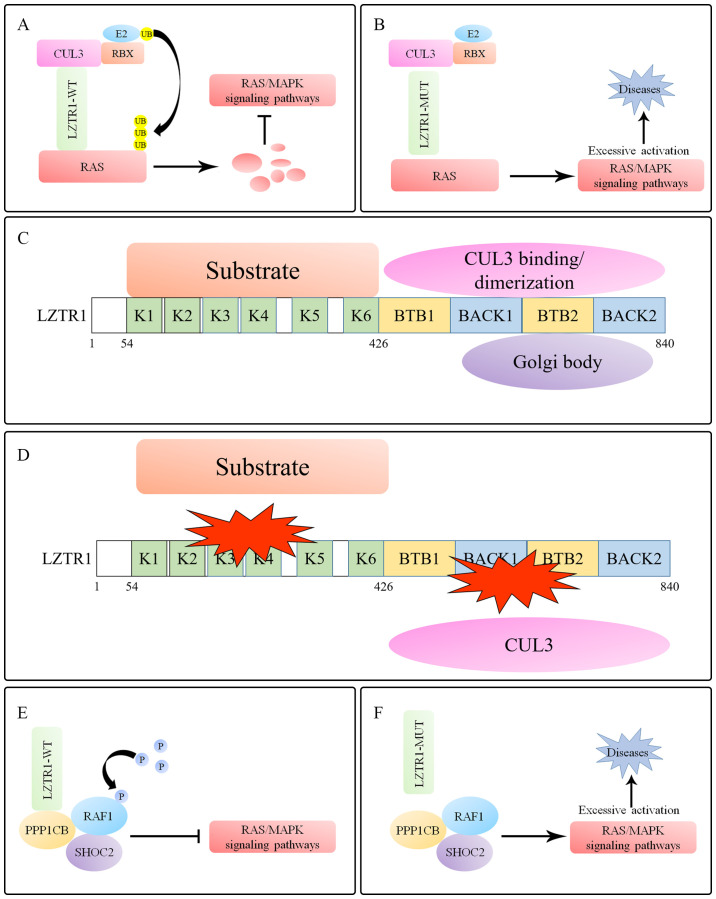
Figure 1.
Figure 1.
LZTR1 regulates RAS/MAPK signaling. (A) LZTR1 induces polyubiquitination and degradation of RAS proteins to inhibit the RAS/MAPK signaling pathway. (B) Mutated LZTR1 loses the ability to regulate RAS superfamily proteins, leading to excessive activation of the RAS/MAPK signaling pathway. (C) A total of six N-terminal Kelch motifs and two BACK domains are located at the C-terminus within LZTR1. The Kelch domains selectively recruit substrates, whereas the BACK domains are predicted to mediate dimerization and CUL3 binding. (D) Mutations in Kelch domains decrease binding to substrates. The mutations located in the BTB/BACK domains of LZTR1 prevent the binding of LZTR1 to CUL3. All of these mutations prevent the formation of the substrate-LZTR1-CUL3 complex. (E) LZTR1 mediates RAF phosphorylation by binding to the RAF1/PPP1CB/SHOC2 complex to inhibit the RAS/MAPK signaling pathway. (F) Mutations in LZTR1 lead to loss of RAF1 regulation, leading to excessive activation of the RAS/MAPK signaling pathway, eventually resulting in Noonan syndrome. LZTR1, leucine zipper-like transcription regulator 1; BTB, broad-complex, tramtrack, and bric-a-brac; BACK, BTB and C-terminal Kelch; CUL, cullin; PPP1CB, protein phosphatase 1 catalytic subunit β; RBX, RING box protein; WT wild-type; Mut, mutant; UB, ubiquitin; P, pyrophosphate.
Figure 2.
Figure 2.
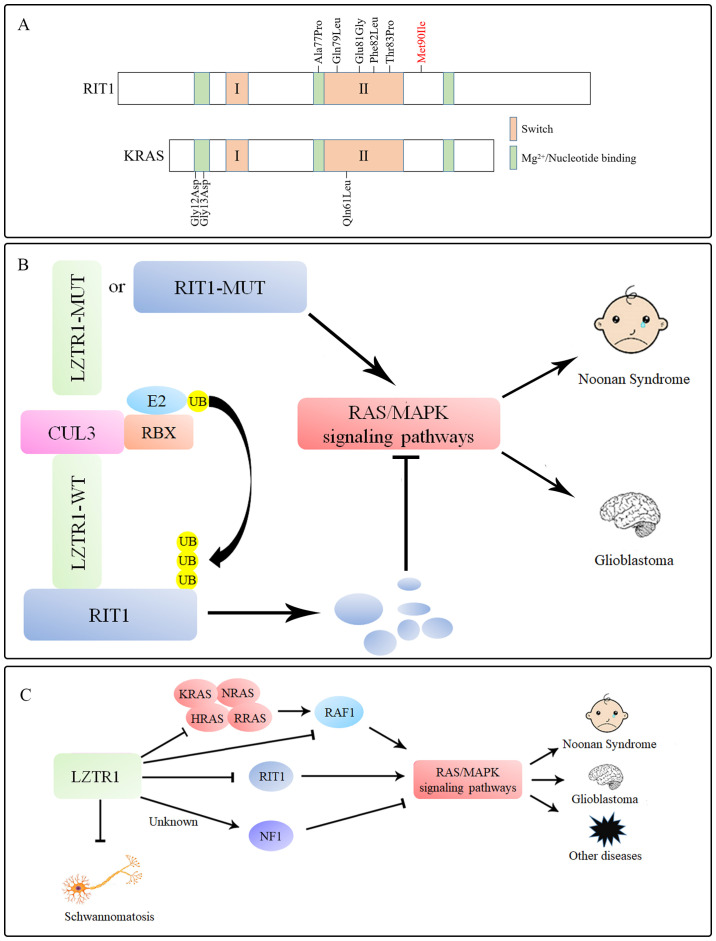
LZTR1 inhibits the RAS/MAPK signaling pathway by regulating RIT1 in NS and GBM. (A) NS-related RIT1 mutations do not occur in codons analogous to the classic Gly12, Gly13, and Gln61 alleles compared with other RAS-superfamily proteins, although they are clustered around the switch II region. (B) LZTR1 induces polyubiquitination and degradation of RIT1 to inhibit the RAS/MAPK signaling pathway. By contrast, mutations in LZTR1 or RIT1 prevent the formation of the substrate-LZTR1-CUL3 complex, resulting in insufficient degradation of RIT1, abnormal activation of RAS/MAPK signaling, leading to the occurrence of NS or GBM. (C) LZTR1 regulates RAS/MAPK signaling, and mutations in LZTR1 or RAS-superfamily proteins lead to excessive activation of the RAS/MAPK signaling pathways, eventually resulting in NS and GBM. LZTR1 inhibits the occurrence of schwannomatosis, although the specific mechanism remains unclear. The relationship between NF1, which serves as a negative regulator of the RAS signaling pathway, and LZTR1 remains to be studied. LZTR1, leucine zipper-like transcription regulator 1; RIT1, RAS-like without CAAX1; CUL, cullin; NS, Noonan syndrome; GBM, glioblastoma; NF1, neurofibromin 1; RBX, RING box protein; WT, wild-type; Mut, mutant; UB, ubiquitin; P, pyrophosphate.

References

    1. Hershko A, Ciechanover A. The ubiquitin system. Annu Rev Biochem. 1998;67:425–479. doi: 10.1146/annurev.biochem.67.1.425. - DOI - PubMed
    1. Mani RS. The emerging role of speckle-type POZ protein (SPOP) in cancer development. Drug Discov Today. 2014;19:1498–1502. doi: 10.1016/j.drudis.2014.07.009. - DOI - PMC - PubMed
    1. Zou T, Zhang J. Diverse and pivotal roles of neddylation in metabolism and immunity. FEBS J. Oct 6;:s2020. doi: 10.1111/febs.15584. - PubMed
    1. Petroski MD, Deshaies RJ. Function and regulation of cullin-RING ubiquitin ligases. Nat Rev Mol Cell Biol. 2005;6:9–20. doi: 10.1038/nrm1547. - DOI - PubMed
    1. Asmar AJ, Beck DB, Werner A. Control of craniofacial and brain development by Cullin3-RING ubiquitin ligases: Lessons from human disease genetics. Exp Cell Res. 2020;396:112300. doi: 10.1016/j.yexcr.2020.112300. - DOI - PMC - PubMed